On April 7, 1780, 750 Virginia soldiers completed a nearly 800 mile trek from Morristown, New Jersey to Charleston, South Carolina, only to be captured and sent to prison ships in Charleston harbor.
In November and December of 1779, both British General Sir Henry Clinton in New York City and American General George Washington in Morristown, New Jersey, began to turn their eyes south. A combined Franco-American force under the command of General Benjamin Lincoln and Count d’Estaing had made a bloody assault to try and capture the Southern city of Savannah to no avail. The Count d’Estaing took his French force and returned to the Caribbean, and Lincoln took his demoralized American army back to Charleston, South Carolina. With only about 2,400 Continentals and militia, Lincoln’s army (and the city of Charleston) looked like a ripe target for Clinton, who had been part of the botched attempt to capture that city in June of 1776.
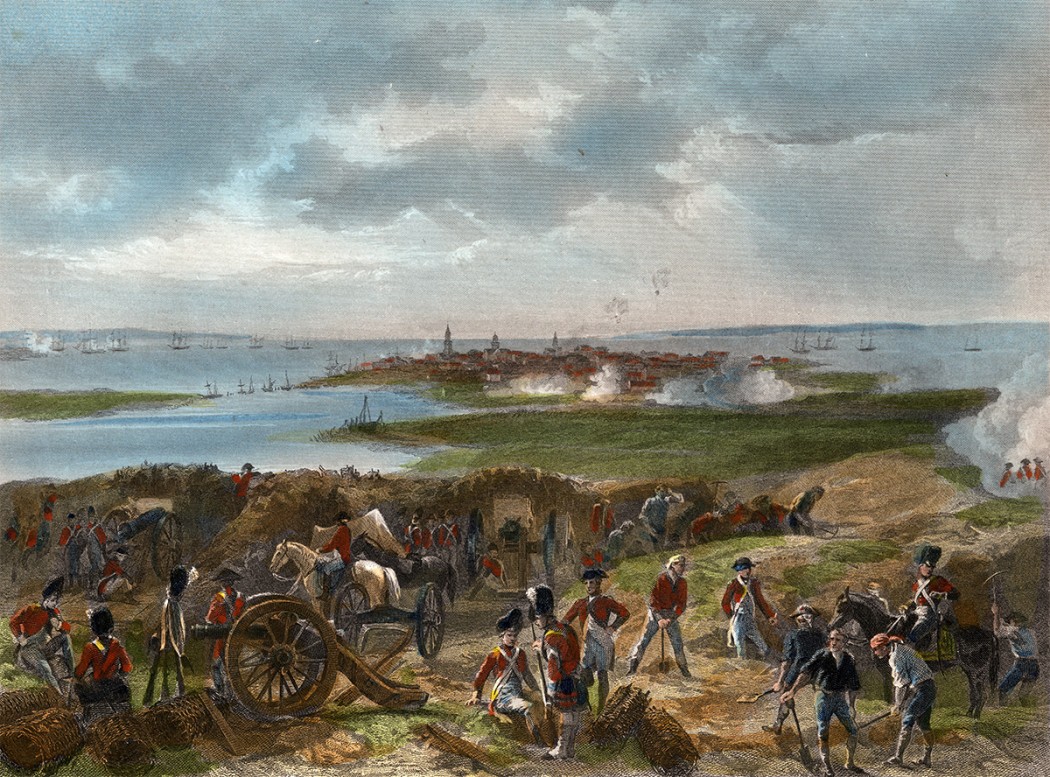
Siege of Charleston by Alonzo Chappel
Clinton made the bold decision to take about 9,000 men from his army in New York City and sail them down to South Carolina to make an attempt to capture Charleston and Lincoln’s army.
Washington, learning that Clinton was preparing part of his army to disembark from New York City, began to direct efforts to help defend the city of Charleston. Washington was repeatedly receiving letters requesting troops and supplies from Lincoln and Congress. In November, Washington dispatched the North Carolina Continental line regiments (almost 1,000 men) to reinforce Lincoln, but after talking to his former aide-de-camp Lt. Col. John Laurens, who visited him personally after fighting at Savannah, Washington understood how desperate a situation Lincoln was in. Congress and Washington made the bold decision to send the entire Virginia Continental line regiments (almost 2,500 men) to join Lincoln’s army that December. Washington parted with these venerable veteran soldiers even though it weakened his position guarding against the main British Army at New York City.
New York City is well known for skyscrapers, pizza, Broadway, and the Statue of Liberty. What is less known, is the fact that it was the site of one of the largest and most consequential battles of the Revolutionary War. Major fighting occurred all over New York City at Brooklyn, Kips Bay, Harlem, and Fort Washington and Fort Lee.
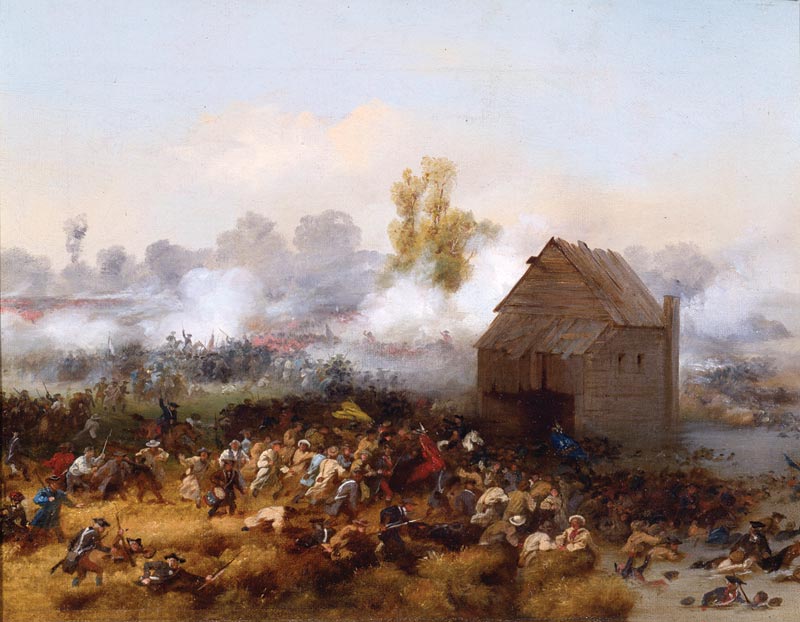
The Battle of Long Island
These were major battles that cost Washington some of his best soldiers. Though the Americans were driven from the city, the area became the center of focus for the Northern theater for the remainder of the war. Today, though these battlefields have been greatly altered and built over, remnants and markers of this important military history still exist.
Grab your favorite adult beverage and join us for the next “Rev War Revelry” historian happy hour on Easter Sunday (April 4) at 7 pm ET on our Facebook page as we discuss the Battles of New York with Mark Maloy, Dan Welch, and Adam Zielinski. To watch, simply click this link to our Facebook page. If you can’t make it at that time, you can watch it later on our YouTube page. There you will find dozens of hours of videos about all sorts of topics related to the Revolutionary War. Enjoy!
Over the next few months, we will be highlighting the speakers and topics for our 2021 Symposium, Hindsight is 2020: Revisiting Misconceptions of the Revolution, taking place on May 22nd. Due to the COVID 19 pandemic, the Symposium will be virtual. Today we highlight historian Travis Shaw who will be covering the role of American Loyalists during the Revolution. Not all Americans supported the “patriot” and many sided with the British.
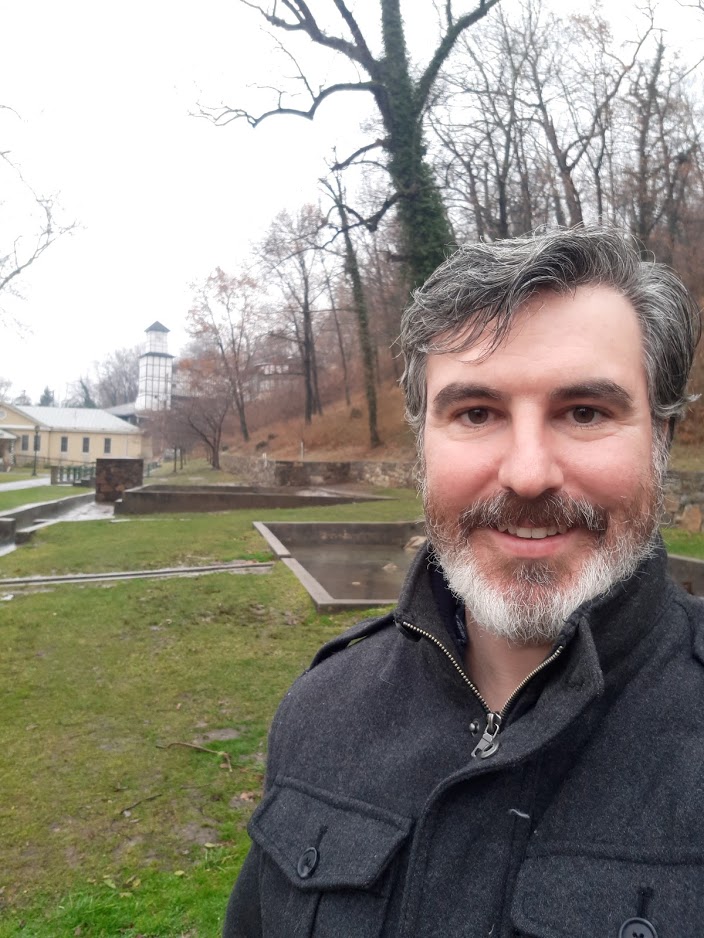
Travis Shaw is currently the Public Programs Coordinator for the Virginia Piedmont Heritage Area. He brings nearly two decades of experience in the fields of historic preservation, archaeology, and museum education, working with both private and public institutions. Prior to joining VPHA he spent time at Historic St. Mary’s City, The Maryland Archaeological Conservation Lab, Mount Vernon, and Oatlands Historic House and Gardens. He holds a BA in history from St. Mary’s College of Maryland and an MA in history with a concentration in public history from American University. His areas of research include the material culture of colonial America, the American Revolution, and maritime history. In his free time, Travis enjoys exploring historic sites with his family and participating in 18th and early 19th century living history events.
He will be presenting his talk “Disaffected and Dangerous Persons”: Loyalist Resistance in the Mid-Atlantic at the May symposium.
Doyou believe the study of Loyalists in the American Revolution has been overlooked and why?
It absolutely has been overlooked for most of the post-Revolutionary era. As the saying goes, history is written by the winners, and loyalists have largely been written out of the national narrative. If they get mentioned at all they are portrayed as a small and unimportant group of weak and cowardly traitors. In reality loyalists hailed from nearly every background and every colony and represented a sizable minority in the colonies. They played an important role in the political and military conduct of the revolution. Following the war tens of thousands would flee the newly independent states, while many more remained behind and had to reintegrate into society. In the interest of post-revolutionary unity their story was suppressed, ignored, and villainized and it’s only been in the last few decades that academics have given their stories serious study.
What first attracted you to the study of early American history? What keeps you involved in the study of this history? Do you find these things are the same or different?
For me, the study of history has always been intensely personal. I grew up near Frederick, Maryland, and so history was all around me. I used to spend countless hours wandering Civil War battlefields or exploring colonial cemeteries. It grounded me in the past and made history a very tangible thing for me. I could immerse my self in the landscape and literally touch it. This led me to archaeology. Uncovering artifacts and knowing that you are the first person to have touched that object in hundreds or even thousands of years is an incredibly powerful feeling.
One of the big missions of the Virginia Piedmont Heritage Area is the preservation of the historic landscape in northern Virginia. Being able to share this passion with others makes it easy to stay involved.
What is the biggest myth about the role Loyalists played in the war, and how did it come about?
I think that the biggest myth about loyalists is that they were all wealthy, deeply conservative people who adhered to the British cause to protect their financial and social status. There were certainly were some who fit this description, such as the influential New Yorker James De Lancy, but the vast majority of loyalists during the revolution came from the middle and lower classes of society, representing a full cross-section of the population. Their reasons for choosing loyalty were just as varied. For some it was driven by a real respect for the British constitution and way of government, which at the time represented the freest and most prosperous government on earth. For many ethnic and religious minorities there was a real fear of oppression at the hands of the local majority if British legal protections disappeared. As the war raged many enslaved people saw an opportunity for freedom with the British, while Native Americans saw British rule as the best bulwark against expanding colonists. For many loyalists, however, their decision was a deeply personal one, based on family and community ties and personal ideas of patriotism and honor. Many others were forced into loyalist after suffering at the hands of their patriot neighbors. There were as many motivations for loyalism as there were loyalists.
Do you think there are common misconceptions of the era of the American Revolution among the American people? If so, what are they and have they ever affected your work?
I come across a number of misconceptions in studying loyalism during the American Revolution. One of the biggest is the idea that the revolutionary movement was wildly popular during the period. Even by the best estimates, the patriot cause never held the majority in many regions during the war, and that the plurality of people just wanted to get by and survive. As with any conflict there are a lot of shades of gray, and an individual could move fluidly between categories of patriot, loyalist, and neutral. It’s also important to note that enthusiasm for the revolutionary cause waxed and waned dramatically depending on the fortunes of war. This is a topic that I’ll be examining at the symposium – how war weariness in communities led to resistance against the patriot government.
In a broader sense, I have always been irritated by the term “founding fathers,” as if all the founders were a monolithic block that all believed the same thing. It gets thrown around by modern people on both ends of the political spectrum as if their very invocation gives their argument indisputable weight. What this obscures is that the founders were individuals who held a wide range of sometimes conflicting political, religious, and cultural beliefs. Some were deeply conservative, others were radically progressive, but they managed to win a war and form a nation.
Join us for our SECOND annual Emerging Revolutionary War Symposium, co-hosted by Gadsby’s Tavern Museum, speakers and topics include:
Michael Harris on Misconceptions of Battle of Brandywine Vanessa Smiley on Myths of the Southern Campaigns Travis Shaw on American Loyalists John U Rees on African American Continental Soldiers Mark Maloy on myths of the Battle of Trenton
Our registration fee is now only $40 per person and $20 for students. This will allow us to broaden our audience with the virtual program. We hope that 2022 will allow us to come together again in Alexandria for our third annual symposium. To register, visit: https://shop.alexandriava.gov/Events.aspx
Stay tuned as we highlight our speakers and their topics in future blog posts.
This past Sunday’s Rev War Revelry was a great success! Thank you to all who watched live and watched the replay of ERW historians Vanessa Smiley and Kate Gruber and special guest Heidi Campbell-Shoaf, Executive Director of the Daughters of the American Revolution Museum in Washington D.C., discussing and interpreting women in Early American History.
A number of folks were interested in the resources that were shared during the program. We have compiled a list of those mentioned as well as additional resources to dive deeper into the stories of women during this pivotal time in American history.
“The women of ’76: “Molly Pitcher” the heroine of Monmouth” by Currier & Ives. Library of Congress.
Books:
Revolutionary Backlash: Women and Politics in the Early Republic by Rosemarie Zagarri
The Diary of Elizabeth Drinker: The Life of an Eighteenth-Century Woman by Elaine Forman Crane (editor)
Book of Ages: The Life and Opinions of Jane Franklin by Jill Lepore
Betsy Ross and the Making of America by Marla Miller
The Needle’s Eye: Women and Work in the Age of Revolution by Marla Miller
Women of the Revolution by Robert Dunkerly
Women of the Republic by Linda Kerber
Articles:
Jane Bartram’s “Application”: Her Struggle for Survival, Stability, and Self-Determination in Revolutionary Pennsylvania by Wayne Bodie (article link courtesy of Pennsylvania Magazine of History and Biography)
Digital Resources
DAR Library – A wealth of American Revolution resources! “The DAR Library collection contains over 225,000 books, 10,000 research files, thousands of manuscript items, and special collections of African American, Native American, and women’s history, genealogy and culture.”
Library of Congress – always a good source if you know what you’re looking for.
Have a great resource on women in the American Revolution? Share in the comments!
“I cannot pretend to describe the Horror of the Scene within the Redoubt when we enter’d it,” British Marine Lt. John Waller wrote to a friend on June 21, 1775, four days after the British Pyrrhic victory at the Battle of Bunker Hill on June 17, “’twas streaming with Blood & strew’d with dead & dying Men the Soldiers stabbing some and dashing out the Brains of others was a sight too dreadful for me to dwell any longer on.”[1] All said and done, the bloody exchange claimed 226 British and 450 Patriot lives, with still over 1,000 more wounded, captured, or missing from both belligerents.[2]
This unspeakable carnage, which proved too distressing for even a seasoned British Marine to recount, surely imprinted itself in the hearts and minds of all who witnessed it—but not all witnesses to the battle’s shocking scenes were soldiers. One was a young woman named Faith Trumbull Huntington. She too would find the bloody Battle of Bunker Hill, and the anxieties and unknowns of her world at war, heavy burdens to bear.
Double Portrait of Governor Jonathan and Faith Trumbull, John Trumbull, 1778, Connecticut Historical Society
Born in 1743 to Jonathan and Faith Trumbull in Lebanon, daughter Faith came of age in a prominent and respected Connecticut family, which also included younger brother John Trumbull, born in 1756, who was destined to become one of the era’s most important artists. On May 1, 1766 Faith married Jedidiah Huntington, and the couple welcomed a son, Jabez, in September 1767. At the onset of the war, the Trumbulls and the Huntingtons quickly mobilized and made known their patriot loyalties. Faith’s father, at that time the Royal Governor of Connecticut, refused to deliver manpower to support the British army’s advances against the colonists in Boston, and became a patriot hero whom George Washington held in high esteem. Jedidiah advanced to colonel in the Connecticut militia, and soon saw action at the Siege of Boston. Faith’s father, husband, and brothers dedicated themselves to the patriot cause. Her sister Mary was married to a member of the Sons of Liberty and future signer of the Declaration of Independence.
Jedediah Huntington, John Trumbull, about 1790, Bequest of Frederick Jabez Huntington, Connecticut Historical Society
Over the next few months, we will be highlighting the speakers and topics for our 2021 Symposium, Hindsight is 2020: Revisiting Misconceptions of the Revolution, taking place on May 22nd. Due to the COVID 19 pandemic, the Symposium will be virtual. Today we highlight historian and author John U. Rees who will be covering a much overlooked and misunderstood part of the Revolution, the role of African American Continental soldiers during the war.
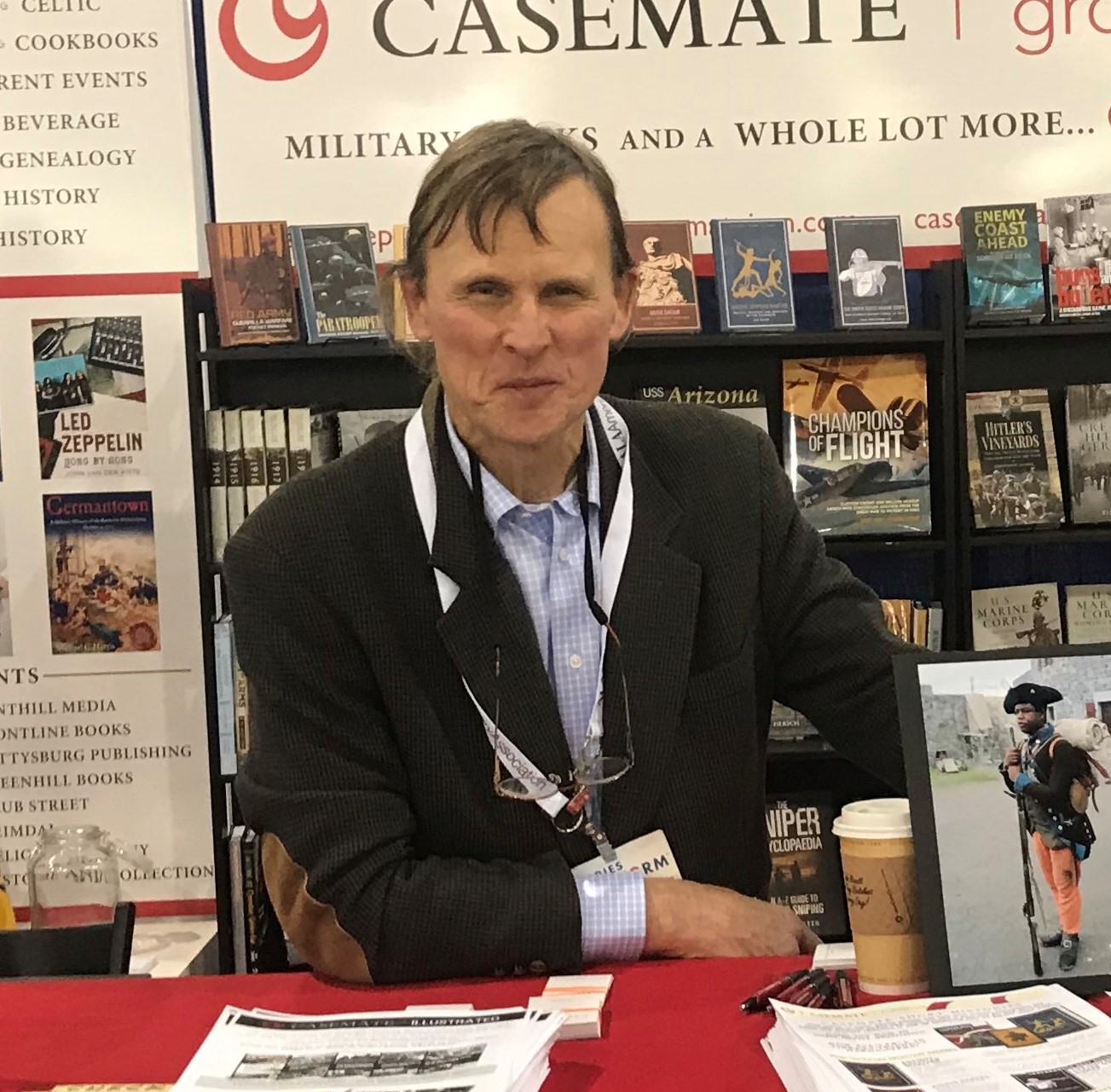
John Rees is an independent writer and researcher specializing in the common soldiers’ experience during the War for American Independence, and North American soldiers’ food, 1755 to the modern era. Since 1986 he has produced almost 200 monographs on these and associated subjects. His work has been published in a number of journals and books, including Military Collector & Historian, the Oxford Encyclopedia of American Food and Drink, and the Thomson Gale edition of Boatner’s Encyclopedia of the American Revolution. His first book, “They Were Good Soldiers”: African Americans Serving in the Continental Army, 1775-1783 was published by Helion Books in 2019.
A list of his publications, plus a number of complete works, may be viewed online at https://tinyurl.com/JohnURees-articles . He will be presenting his talk “They Were Good Soldiers”: An Overview of African Americans in the Continental Army at the May symposium.
Do you believe the study of African American soldiers in the American Revolution has been overlooked and why?
To my mind the core cause for this lack of knowledge is American willingness to gloss over history, in this case American history. Add to that, many of our fellow citizens, past and present, through wilfulness, mis-education, or lack of caring, think of the American Revolution as a white man’s conflict, with little to no contribution by Americans of African descent. Artwork and films portraying the period have done little to disabuse us of that notion.
I think, in the 1960s and 70s, many Americans knew of Crispus Attucks’ participation and death in the 1770 Boston Massacre; I know I learned of him as a child in the early 60s. Others may have seen the U.S. Postal Service stamp in the mid-70s featuring Massachusetts African American soldier Salem Poor, but other than those instances most people didn’t (and don’t) really consider black participation on either side of the American Revolution. It also seems that when Americans do become aware of their role as soldiers, they learn about the “black” 1st Rhode Island Regiment (which only existed for two and half years of an eight-year war), when the greatest number of African Americans fighting for the cause of American independence were in integrated units. And then, there were the black women and children, among the hundreds of women and children who accompanied the troops and contributed to their welfare, who no one is aware of.
What first attracted you to the study of early American history?
My parents, especially my mother, were avid readers, and I followed suit very early on. I read many of the Landmark history and biography books, and those likely guided my interest in stories of individual people in extraordinary circumstances. I loved military history early on, and in my pre-teens focused on the Second World War; I then moved on to the Napoleonic era and the American Civil War, all the while reading a great deal of fiction. In 1984 I got involved with Revolutionary War living history, and the fact I had a hard time getting answers about the unit we portrayed led me to begin researching that regiment.
I had the good fortune to live very close to the David Library of the American Revolution, and in 1986 I produced my first (never published) manuscript. As I pored through books and microfilmed manuscript collections, I came across tidbits of interesting information I then had no need of; I copied it and put it aside for possible future use. It was not until 1990 that my first article was published; since that year until now I’ve published almost 200 articles, mostly on the Revolutionary War, but a substantial number on military food and other miscellaneous subjects. At some point in the 1990s I realized that the Revolutionary period was a relatively wide-open field for anyone who wished to study and write about it.
What keeps you involved in the study of this history?
There remain so many stories to tell, too many “small things forgotten,” I still want to write about, I feel the era is still wide open for anyone who wishes to focus on it.
What is the biggest myth about African American soldiers in the Continental Army, and how did it come about?
Likely that the segregated 1st Rhode Island Regiment is the best example of African American soldiers’ participation in the war, when, in fact, the largest proportion of African Americans served in integrated units, in the Continental Army and state militias. Add to that, there were two other segregated regiments during the war, one in the French Army that served for four to five years, and one Loyalist regiment, that existed for only a year.
Do you think there are common misconceptions of the era of the American Revolution among the American people? If so, what are they and have they ever affected your work?
My short list contains two things, one pertaining to Revolutionary ideals, the other to the military side. First is the contention by many people that it was a conservative Revolution, when in actuality the core concepts were quite radical, and significant portion of Revolutionaries retained that radical view, during and after the Revolutionary period.
Regarding the military aspects, I think the idea is still common that American militia forces won the War of the Revolution, which was not the case, and (okay a third item) that the American troops fought using innovative tactics (you know, fighting from behind walls and trees), and the Crown forces were militarily conservative. The facts are too long to go into, but on the last point I highly recommend Matthew Springs book With Zeal and With Bayonets Only.
Why do you think it is important for us to study the Revolutionary Era?
At this point in our country’s history, it seems we, as a society, need go back and look at our beginning, to see how both leaders and other participants comported themselves and sacrificed attempting to gain not only independence from Britain, but in support of the high ideals of the 1776 Declaration.
On a lesser, but to me still important, note, we need to study the lives of ordinary people of every side – civilian and military; men, women, and children of all creeds and colors – in order to gain a truer understanding of our founding era, and, perhaps, ourselves.
Join us for our SECOND annual Emerging Revolutionary War Symposium, co-hosted by Gadsby’s Tavern Museum, speakers and topics include:
Michael Harris on Misconceptions of Battle of Brandywine Vanessa Smiley on Myths of the Southern Campaigns Travis Shaw on American Loyalists John U Rees on African American Continental Soldiers Mark Maloy on myths of the Battle of Trenton
Our registration fee is now only $40 per person and $20 for students. This will allow us to broaden our audience with the virtual program. We hope that 2022 will allow us to come together again in Alexandria for our third annual symposium. To register, visit: https://shop.alexandriava.gov/Events.aspx
Stay tuned as we highlight our speakers and their topics in future blog posts.
“I remember all the accounts there given of the battle fields and struggles for the liberties of the country, and none fixed themselves upon my imagination so deeply as the struggle here at Trenton, New Jersey. The crossing of the river; the contest with the Hessians; the great hardships endured at that time, all fixed themselves on my memory more than any single revolutionary event.” – Abraham Lincoln, Trenton, NJ, February 21, 1861
The Civil War generation of Americans knew the story of George Washington and the Revolutionary War very well. Their letters and writings often harkened back to the days of 1776. However, now almost 250 years, the stories and battlegrounds of that war are often overlooked or forgotten.
Here is your opportunity to visit some of the most important and overlooked battlefields in the United States. Emerging Civil War’s sister site, Emerging Revolutionary War, is offering a special two-day tour of the Trenton and Princeton battlefields.
In ten days, George Washington orchestrated an ingenious military campaign that shocked the British empire and saved the Patriot cause in the American Revolution. Frederick the Great remarked that the campaign was “the most brilliant of any recorded in the annals of military achievement.”
On the morning of August 27, 1780 there was a knock on the door of the Charleston, South Carolina residence of Christopher Gadsden, lieutenant governor of South Carolina. He had stayed when the city capitulated to British forces in May. Gadsden had represented the civil government and handed the city over to the British commander, Sir Henry Clinton. He was released on parole.
Christopher Gadsden
Now, approximately three months later, Clinton was back in New York, and the new British commander Lord Charles Cornwallis had reneged on the parole agreement. Along with another 20 civil officers, Gadsden was led through the town to the docks to a waiting ship, set to sail for St. Augustine in British East Florida.
Upon arrival in the oldest city in European North America, Gadsden was given the opportunity by Governor Tonyn to avoid incarceration in Florida. This is when the 56-year old patriot probably uttered the phrase below.
“I gave my parole once, and it has been shamefully violated by the British Government: I shall not give another to people on whom no faith can be reposed.”
With that decision, Gadsden landed himself in Castillo de San Marcos the large coquina stone fortress that stood guard over St. Augustine. Not only was the South Carolinian kept in a cell, he was kept in solitary confinement for the next 42 weeks!
Upon his release in September 1781, Gadsden and the rest of the civil prisoners were sent by merchant vessel to Philadelphia. Gadsden wasted no time in hurrying southward to South Carolina and a return to the state House of Representatives. He served in various political roles, although he had to decline the governorship because of the affects of his imprisonment. He died in 1805. A grandson, James Gadsden would give his name to the Gadsden Purchase.
Gadsden was held in the cell to the right (author photo)
Today one can visit Castillo de San Marcos, a national park unit within the National Park Service. When touring the Castillo you can view the cell where Gadsden spent his solitary confinement and read the accompanying exhibits.
Emerging Revolutionary War welcomes guest historian Sean Chick
On October 7, 1780, Britain’s attempt to regain at least part of the rebellious North American colonies was dealt a major blow at King’s Mountain. The rebels rejoiced, since it was their first major victory since 1777 and it came after the twin disasters at Charleston and Camden. Thomas Jefferson, then governor of Virginia, considered it the decisive battle of the war. Years later, Theodore Roosevelt echoed that sentiment. In 1930, when the site was set to become a national park, Herbert Hoover gave a speech. For the embattled president, it was an attempt to shore up his falling support and vindicate his strategy to peel southern states away from the Democratic Party. Hoover said “This is a place of inspiring memories. Here less than a thousand men, inspired by the urge of freedom, defeated a superior force entrenched in this strategic position. This small band of Patriots turned back a dangerous invasion well designed to separate and dismember the united Colonies.”
Hoover, understandably, never mentioned the atrocities committed. Many were executed after the battle. Nor did he mention that King’s Mountain was not a contest between redcoats and rebels, but brother against brother. The only British man present was Major Patrick Ferguson. His command was made up entirely of Loyalists. His second in command, Captain Abraham de Peyster, was from New York City.
Joseph Galloway (courtesy of NYPL)
Few groups in American history are as forgotten as the Loyalists and few were as complex. They were a varied lot, often making up the highest in colonial society, including wealthy merchants and colonial officials. They often included the very lowest in the society, such as recent immigrants, slaves, indigenous, and subsistence farmers. Their ideology was in many ways not radically different from those who rebelled. They were generally not in favor of absolute monarchy or the supremacy of Parliament but simply favored union with Britain and slow reform. A few, such as Joseph Galloway, were part of early protests against British colonial policy, but were unwilling to jump into the chasm of revolution. Some, such as South Carolina merchant David Fanning, were merely aggrieved and sought to settle scores. Others were on the margins of society and saw the colonists, or at least the revolutionary colonial elite, as their real oppressors.
The Loyalists were at first spurned by the British high command. Major General William had over 30,000 men under his command in 1776 and Loyalists would have added to the logistical strain. He also thought a soft war policy that he hoped would induce the colonies to return, and therefore it was reasonable to avoid civil war. Yet, by 1777 the British were using some Loyalist regiments. They would fight in John Burgoyne’s ill-fated drive on Albany and served as rangers at Brandywine.
Emerging Revolutionary War welcomes back guest historian Gabe Neville.
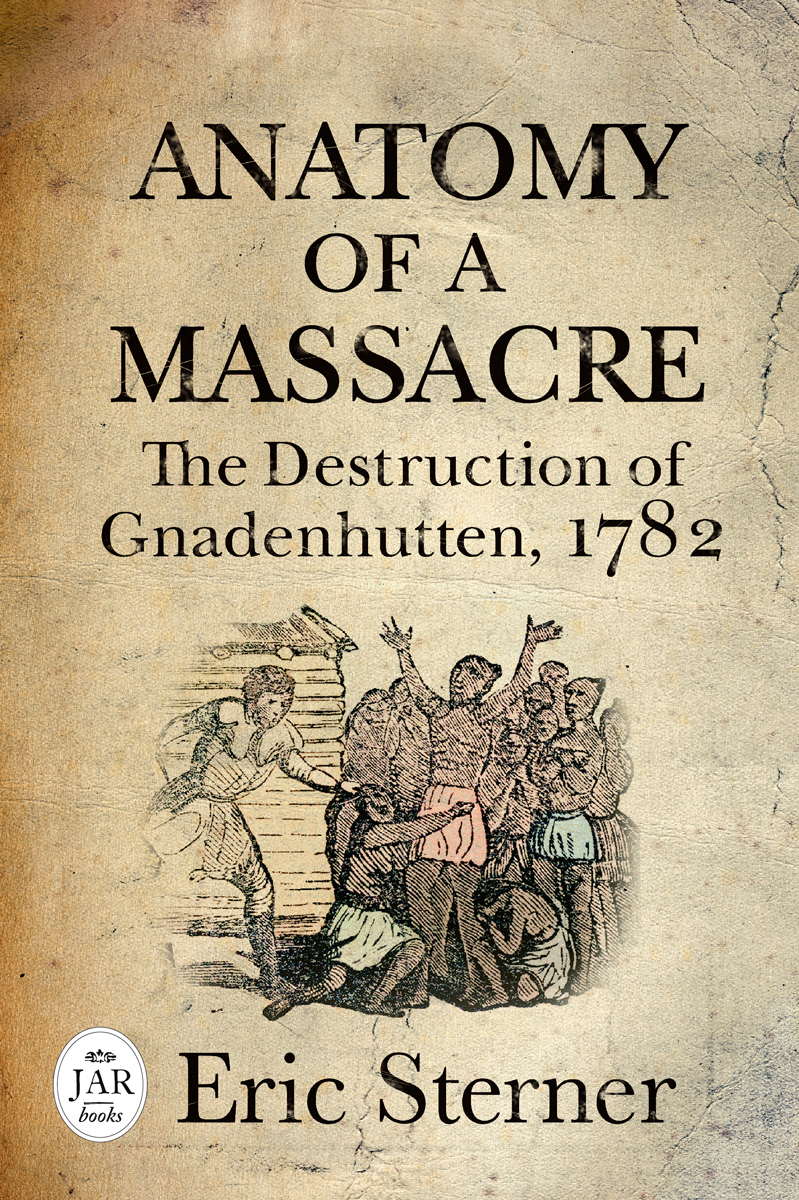
In his first book, Anatomy of a Massacre: The Destruction of Gnadenhutten, 1782, Eric Sterner has taken on a difficult subject. Racial violence is something many writers would shy away from while others might delight in the chance to condemn the perpetrators. Mr. Sterner, laudably, does neither. Instead, he seeks to understand what happened.
It is worth noting that the first known massacre of Indians by white men in what is now the United States occurred long before the events in the book. It happened near Jamestown, Virginia in 1610 when Virginia’s governor, Thomas West, 3rd Baron de la Warr, ordered an attack on the Paspahegh Band of Powhatans. Seventy men attacked the village, killing between 65 and 75 Paspaheghs and kidnapping the village leader’s wife and children. Rowing away, the colonists decided to kill the children, “w[hi]ch was effected by Throweinge them overboard and shoteinge owtt their Braynes in the water.” Three centuries of violence ensued.[1]
Lord de la Warr’s name appears frequently in Mr. Sterner’s story. His name was given to the Delaware River, which in turn lent its name to the Lenape people who have long been known to English speakers as the Delaware Tribe. Mr. Sterner has provided the definitive account of the worst atrocity of the Revolutionary War. In 1782 more than eighty white settlers clubbed, killed, and scalped ninety-six peaceful, Christian Indians as they prayed and sang hymns. The attack on the Moravian mission town of Gnadenhutten (Ohio) was intended as both a punitive and preemptive strike, conducted by settlers whose families and farms had been targeted by other Indians acting as proxies of the British. It is a horrific story that has defied understanding until now.
Histories of conflict between Native and European Americans have often served us poorly, reducing one or both sides to caricatures. Earlier histories, written by white men, put a finger on the scale of historical interpretation such that Indian atrocities were called “massacres” while white atrocities were called “battles” or “raids.” In the last half of the 20th century, the finger moved to the other side of the scale. Territorial expansion, the introduction of Old World diseases, missionary activity, the presumption of Manifest Destiny, and acts of violence large and small were braided together into a narrative of premeditated genocide.
These approaches reveal the eras and ideologies of their writers. More problematic is both schools tendency to gloss over of the complexity of frontier culture. The Gnadenhutten Massacre is not a cowboys-and-Indians story of “white” and “red” men exchanging bullets and arrows. It is far more complicated than that, with many of its actors desiring little more than their own survival. Though never stated, Mr. Sterner’s approach seems inspired by the axiom: “Don’t judge a man until you have walked a mile in his shoes.” The original expression, appropriately enough, referred to walking “a mile in his moccasins.”
The people in Mr. Sterner’s story can certainly be categorized as “whites” and “Indians,” and for narrative purposes two of the book’s chapters align with these groupings. Still, though racism is an important element of the story, there is plenty to suggest that skin color was not the only matter at issue. The two most prominent white characters –John Heckewelder and David Zeisberger—were Moravian missionaries who lived for decades among the Indians and were wholly dedicated to their welfare. Other whites, British agents, were Indian allies. The killers at Gnadenhutten were white, but acted independently and in defiance of government authority. On the Native American side, the Delaware, Shawnee, Wyandot, and Iroquois tribes were distinct political entities with different alliances, histories, and leaders. Even within these tribes, individual bands (what the author calls “phratries”) disagreed with each other, sometimes sharply, on military and political questions. Some were allied with the British and some with the Americans. The victims at Gnadenhutten were—though Indians—also pious, hymn-singing Christians. The white perpetrators behaved in a decidedly un-Christian manner despite their heritage. History, it turns out, was just as full of contradictions as the present is.
European-American settlers could indeed be brutal, as the events at Gnadenhutten show. Indians could also be ruthless. The first known massacre perpetrated by North American Indians was committed long before Europeans arrived on the continent. The tactic later employed by American armies of destroying villages and burning crops was first used by Indians against the colonists around Jamestown in 1622. Further complexity is found in the fact that even the line between “whites” and “Indians” was sometimes blurred. The Indian victims of the Gnadenhutten Massacre were Christians who dressed and lived much as Europeans did. Conversely, Indian armies—notably at the 1774 Battle of Point Pleasant—sometimes had white warriors among them. These were typically men who had been kidnapped as children and adopted into Indian society.
Mr. Sterner takes a dispassionate, investigatory approach to his work. It is refreshingly free of grand economic or social theories. He seeks to comprehend the events as those involved comprehended them and shows little interest in passing judgment. Instead, he seeks to “walk” a mile in their shoes and moccasins. In doing so, he respectfully refers to Natives by the Indian names, uncynically takes the faith of the Moravians at face value, and justly illustrates the terrors experienced by settlers on the frontier. Each of these groups is examined in its own chapter. Then, in his fourth and final chapter, Mr. Sterner tells us what happened at Gnadenhutten. By then the reader is left struggling to reconcile his or her outrage with the realization that what happened was likely inevitable.
The chance to experience this tension between the world that was and the world that ought to have been is a gift to Mr. Sterner’s readers. Conceiving of a world as it ought to have been is easy. Understanding it as it actually was is much harder. Period accounts indicate that even the perpetrators of the massacre wrestled with this tension in real time. One of them, after executing a dozen Moravian Indians, “sat down and cried because he found in it no satisfaction for his murdered wife and children.” Another whose family had been killed by Indians sat down by the river bank and burst into tears, crying, “You know I couldn’t help it!”[2]
Anatomy of a Massacre could have had an epilogue. Shortly after the events at Gnadenhutten, Col. William Crawford was captured and cruelly tortured to death by Delaware tribesmen as payback for the massacre. Crawford had played no part in the earlier atrocity, but men under his command had. Mr. Sterner has written about Crawford’s death for Emerging Revolutionary War and no doubt made a considered decision to let the Gnadenhutten story stand on its own.
The last “massacre” of American Indians occurred in 1911 in Nevada, when state police killed eight members of Mike Daggett’s Band of Shoshones, whom they were pursuing for horse theft and murder. This “Battle of Kelly Creek” occurred three hundred and one years after the massacre of the Paspahegh Band of Powhatans near Jamestown and closed the book on three centuries of racial violence between Native and European Americans. It is a cringe-inducing history, to be sure.
Mr. Sterner’s book suggests two lessons. First is that we should not blame atrocities so much on the perpetrators’ culture and demographics but rather on the killers themselves and on human nature. Culture matters, but people in every culture will do terrible things in terrible circumstances. Second is that we cannot substitute a cartoonish caricature of history for the nuanced reality of what really happened. The consequence of dumbed-down history is not a partial understanding but rather a false understanding. The Moravian Indians and missionaries lived in villages that were both physically and figuratively between two cultures. Though neutral, family and social ties to the war’s combatants remained and neither side could accept or understand them as a unique group. That led the Wyandots and British-allied Delaware to forcibly relocate them, and it motivated the settlers led by David Williamson to kill them.
An analogous refusal to understand the past for what it really was does a different kind of “violence” to history. Mr. Sterner’s book provides hope that historians can in fact focus on real history, avoiding the polemics and theorizing that characterizes so much academic writing. Like Glenn Williams, author of Dunmore’s War, Mr. Sterner seeks to trace the course of events and to understand the subjects of his work as they understood themselves. It’s good history.
Sources:
[1] George Percy, “’A Trewe Relaycon:’ Virginia from 1609 to 1612,” Tyler’s Quarterly, 3 (1921-1922): 259-282, 272. “Weroance” was a title for a “sub-chief” or a village leader.
[2] Eric Sterner, Anatomy of a Massacre: The Destruction of Gnadenhutten, 1782 (Yardley, Pa: Westholme, 2020), 148.






 Emerging Revolutionary War Era