The majority of the study of the American Revolution centers on the main theaters of the war, chiefly east of the Appalachian Mountains and on the high seas. Obviously. Yet, what is considered today the Midwest or Great Lakes region saw action that had an impact on the outcome of the war, American independence, British occupation, and Native American life.
Termed “the west” this area encompassed the future states of Tennessee, Kentucky, Ohio, Missouri, Arkansas, and others along the Mississippi River and Great Lakes.
This area will be the focus of the next “Rev War Revelry” on Sunday, August 23 at 7 p.m. EST on our Facebook page. Join Emerging Revolutionary War historians, historian and Gabe Neville, of the 8th Virginia blog who will return for more discussion and revelry.
Joining us this evening will be another historian making his debut on “Rev War Revelry.” That newcomer is Joe Herron, Chief of Interpretation at George Rogers Clark National Historical Park in Vincennes, Indiana.
So, grab your favorite drink and join us for an evening talking the likes of George Rogers Clark, Daniel Boone, and the personas and campaigns of the American west during the American Revolution.
On this day, in 1780, Baron de Kalb, died at 59 years old. He had commanded admirably at the Battle of Camden, on August 16, 1780, overseeing the right of the American line where he received his mortal wounds.
Marker on the Camden Battlefield, although not in the “exact spot” that Baron de Kalb fell (author collection)
Below are a few excerpts about the German-born de Kalb.
On his deathbed, as noted by his aide, the Chevalier du Buysson, de Kalb wanted it known that:
His most affectionate compliments to all the officers and men of his division; he expressed the greatest satisfaction in the testimony given by the British army of the bravery of his troops….and the exemplary conduct of the whole division gave him an endearing sense of the merit of the troops he had the honor to command.
Although just a child, at seven years old, in August 1780, Mary Kershaw remembered the day de Kalb was buried in Camden. She lived until 1848 but would regale people with her reminiscences.
She also witnessed the burial of Baron de Kalb, with his sword at his side, between two British officers. It would later be found that “he lay, it seems, in the ‘custom of knighthood’ as last of his race, buried in his armor, that is to say his helmet, his sword, and his spurs were in the grave with him.
Original grave location for de Kalb in Camden (author collection)
General Horatio Gates, who commanded the American forces at Camden, penned the following to General George Washington, upon the news of de Kalb’s passing.
Too much honor cannot be paid by Congress to the memory of Baron de Kalb; he was everything an excellent officer should be, and in the cause of the United States he sacrificed his life.
Lastly, the French ambassador and former staff officer of de Kalb, the Duke de la Luzerne, wrote:
The fall of that excellent Officer, the Baron de Kalb–so much to be regretted by France and the United States…
Yet, the spirit of de Kalb. the resolute soldier, would live. Both within his former division and in the reconstituted Continental forces in the southern theater, as these regular army soldiers (and militia) would see the cause through to a successful conclusion.
For more information and the source of these excerpts please consult:
“De Kalb, One of the Revolutionary War’s Bravest Generals” by John Beakes
If you tuned into our “Rev War Revelry” with historian and author John U. Rees on Sunday, you may have heard him mention a few links and a blog where he adds information that did not make it into the book. Or has come to light since the publication of his history “They Were Good Soldiers: African-Americans in the Continental Army, 1775-1783.”
John was nice enough to provide the following as a follow-up for those interested in reading more into the subject.
African Americans Serving in the Armies of the Revolution (PDF, click here).
Book:
“They Were Good Soldiers”,
Additional post-publication updates and information:
List of soldiers and women featured in the book.
African American soldier-servants.
African American women with the army.
Author interviews pertaining to the book.
Entries for blog:
“More ‘Good Soldiers’”:
Revised percentages for 1778 army “Return of Negroes.”
Officers’ observations of black Continental soldiers.
Ranney’s painting “Cowpens” and black cavalry soldiers.
List of soldiers and women featured in the book.
Black Continental soldiers at the Battle of Monmouth.
Printed 19th century remembrances of black veterans
Articles:
Articles the book was based on including African Americans in Southern Continental regiments plus transcribed pension files used for that study.
Jeffrey Brace, African slave and Continental soldier
Other authors:
Black soldier motivations (Scoggins)
Loyalist Ethiopian Regiment (Copeland)
Black soldiers at New Windsor cantonment (Thorenz)
Hannah Till, wartime servant to Washington (Cole)
Thomas Carney, Maryland Continental (Calder)
Black Hessians (Jones)
Military role of black Loyalists (Braisted)
Author Discussion ERW Facebook Live:
To watch the interview with John, click over to Emerging Revolutionary War’s Facebook page and click on the “Videos” tab. To access the page, click here.
The two of soldiers on the left, drawn in 1781 by French Sublieutenant Jean-Baptiste-Antoine de Verger, Royal Deux-Ponts Regiment, are a private of the Rhode Island Regiment, and a soldier of Hazen’s Canadian Regiment. The next in line is a Virginia rifleman, while the last man is a Continental artileryman. Howard C. Rice and Anne S.K. Brown, eds. and trans., The American Campaigns of Rochambeau’s Army 1780, 1781, 1782, 1783, vol. I (Princeton, N.J. and Providence, R.I.,: Princeton University Press, 1972), between pages 142-143 (description on page xxi). Anne S.K. Brown Military Collection, Brown University.
Today 240 years ago in the back country of South Carolina, General Horatio Gates and his “Grand Army” were encamped around Rugeleys Mills South Carolina. He had come a long way in a short amount of time with his army from Deep Creek, NC. The men were ill fed, mostly poorly trained militia but he needed to strike a win for the American cause in the South. What he planned that evening is still debated today.
Gates had only been in command of the re comprised Southern Continental Army for a few weeks. He was tasked with turning around a disastrous year for the Americans in South Carolina. Most of the Southern army was captured at Charleston in May 1780 and then a bloody defeat of Virginia forces on May 29th at Waxhaws. American partisans such as Moultrie and Sumter had found some success, but the Continental Congress worried that they were about to lose the southern colonies. Something had to be done and many believed (though Washington and his supporters wanted Nathaniel Greene) the hero of Saratoga was the man for the job.
Now that Gates had brought his army so close to the British post at Camden, SC he needed intelligence on his next move. There could be no misstep, he was only 12 miles from the British at Camden. At that time, Gates believed he outnumbered the British under Lord Rawdon, but what he was soon to find out is he over inflated his own numbers and now Lord Cornwallis was in command. Gates’ force was still slightly larger, but it was mostly made up for militia. The British army comprised of some of the best units in North American. A very different situation indeed.
Gates ordered his engineer Lt. Col. Johann Christian Senf and Virginian Lt. Col. Charles Porterfield southward towards Camden. Senf was to find a suitable location for the American army to march and set up a defensive position. Gates had no illusions to attacking the British at Camden, and most likely he hoped they would abandon Camden all together. Senf wrote “reconnoitering a deep creek 7 miles in front was found impassable 7 miles to the right and about the same distance to the left, only at the place of the Ford interjects the great road”. (1) This creek was Saunder’s Creek and it is where Gates decided to move his “Grand Army” and await developments from Thomas Sumter who he had sent on a mission along the Wateree River in the flank and rear of Camden.
Baron Ludwig von Closen, aide–de–camp to French General Rochambeau, wrote in July 1781:
“I had a chance to see the American Army, man for man. It is really painful to see those brave men, almost naked with only some trousers and little linen jackets, most of them without stockings, but, would you believe it, very cheerful and healthy in appearance … It is incredible that soldiers composed of men of every age, even children of fifteen, of whites and blacks, unpaid and rather poorly fed, can march so fast and withstand fire so steadfastly’.”
During the American Revolution, African-Americans, both freed and enslaved, fought for the patriots. Some wielded muskets in militia outfits whereas others were part of the Continental army. African-Americans were there from the Siege of Boston through the end of the conflict. In fact, until the Korean War the American Revolution was the last time a United States military force was integrated in time of war.
Although publications have been printed about the 1st Rhode Island or comparative studies between Africans that served for the British or patriots. However, the field needed a dedicated study of African-Americans that served in the Continental army. Enter John U. Rees.
A lifelong Bucks County, Pennsylvanian who has studied and written about the soldiery of the American Revolution for the past three decades. He is published many times over and this Sunday, he will join Emerging Revolutionary War at 7 p.m. on “Rev War Revelry.”
The discussion will include his new book, “They Were Good Soldiers’: African-Americans Serving in the Continental Army, 1775-1783.” Which is now available for purchase online. ‘They Were Good Soldiers’: African Americans Serving in the Continental Army, 1775-1783 begins by discussing the inclusion and treatment of black Americans by the various Crown forces (particularly British and Loyalist commanders, and military units). The narrative then moves into an overview of black soldiers in the Continental Army, before examining their service state by state. Each state chapter looks first at the Continental regiments in that state’s contingent throughout the war, and then adds interesting black soldiers’ pension narratives or portions thereof. The premise is to introduce the reader to the men’s wartime duties and experiences. The book’s concluding chapters examine veterans’ post-war fortunes in a changing society and the effect of increasing racial bias in the late eighteenth and early nineteenth centuries.
Besides the book dialogue, a general conversation about the roles of African-Americans in the American Revolutionary period. So, find your favorite brew, bring your questions and insights, and join John Rees and ERW on Sunday evening on our Facebook page.
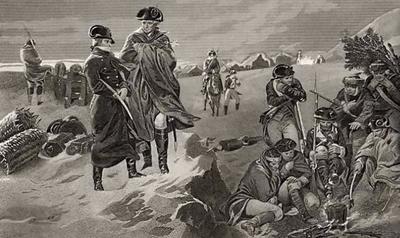
In Morristown, New Jersey during one of the winters that the Continental army bedded down in that geographically critical hamlet, General George Washington ordered the inoculation of his forces for smallpox. This was the first instituted innoculation of American forces and the requirement proved effective. Smallpox would claim more lives–both British and American–during the American Revolution than any other single cause or disease.
With the world today facing a pandemic, the historians at Emerging Revolutionary War invite you to take a step back into time, to the 18th century, as they discuss diseases during the war, including at such winter encampments as Morristown and Valley Forge, in the southern colonies and the campaigning that traversed the Carolinas and Georgia, along with an outbreak of yellow fever that changed the course of American political history and played a major role in the permanent placement of the United States capital.
Join us at our usual time, 7 p.m. EST, on our Facebook page, as the next installment of “Rev War Revelry” discusses diseases and investigates illnesses of the Colonial America during the American Revolutionary era. Since alcohol was considered medicinal, there is no excuse to not bring your favorite brew as you watch, listen, chime in, and comment.
Emerging Revolutionary War welcomes guest historian Dwight Hughes
The recent disastrous conflagration aboard the USS Bonhomme Richard (LHD-6) in San Diego harbor brings to mind the original warship by that name and its fiery fate, a tale excellently told in a previous post by Eric Sterner (“I Have not Yet Begun to Fight!” or Words to that Effect (September 23, 1779)). “Bonhomme Richard” means “good man Richard” in French. So, who is Richard? What was good about him? Why is his name on a man-of-war?
The United States Navy likes to carry forward the labels of famous vessels. This is one of the oldest and most revered monikers in navy history, originally assigned in 1779 by Captain John Paul Jones to a rather decrepit French merchantman armed with a motley collection of guns. The French government donated the former Duc De Duras to Jones to sail against their mutual enemies, the British.
John Paul Jones
Jones famously engaged the powerful frigate HMS Serapis on September 23, 1779 in English waters off Flamborough Head, Yorkshire. The ships grappled together and blasted away at point blank range. Both were battered and ablaze in sinking condition with many casualties when the British captain surrendered. With Bonhomme Richard going down fast, the Americans took over Serapis and managed to save her.
John Paul Jones became the “Father of the U. S. Navy” (or one of them). Bonhomme Richard entered legend as the warship that won and sank. She and her successors also represent those rare U. S. Navy vessels whose names are rendered in a foreign language.
This is the first part of what will be a running series that will highlight the 240th anniversary of the events surrounding Benedict Arnold’s treason.
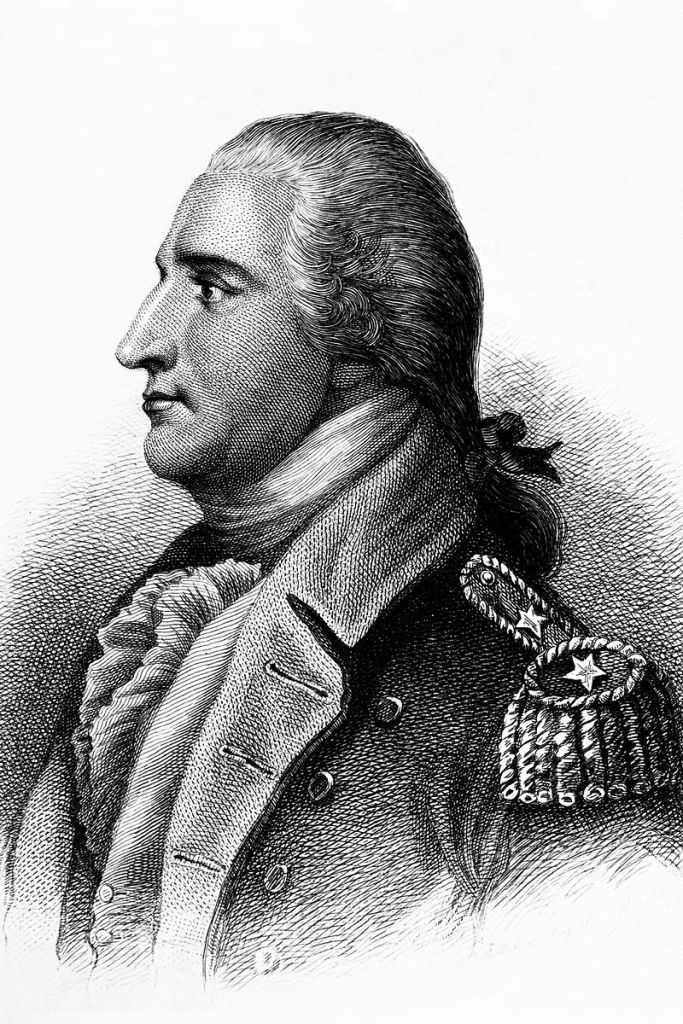
The story of Benedict Arnold’s treason during the Revolutionary War is one of the most infamous, yet tragic, in our nation’s history. He was the “American Hannibal,” the most brilliant battlefield commander during the conflict’s early stages. His patriotism, sacrifice, and commitment to the cause of independence were matched by few in the American high command, so too were his battle honors. Fort Ticonderoga, Quebec, Valcour Island, Ridgefield, the relief of Fort Stanwix, and the battles of Saratoga—he was always in the thick of things.
Maj. Gen. Benedict Arnold. Wikimedia.
Arnold’s treason was not something that was pre-determined. His ultimate defection to the British in 1780 was a result of many factors that continued to pile up as the war progressed, but it can be rooted in a long-running feeling of being underappreciated and a growing distrust in America’s political leaders.
Following his grievous leg wound at Saratoga on October 7, 1777, Arnold was appointed military governor of Philadelphia, never to command American troops on the battlefield again. While stationed there, his downward spiral towards treason began to accelerate. An open feud with Joseph Reed and Pennsylvania’s Supreme Executive Council led to a court martial and reprimand from George Washington, something beyond correction for a man with the personal honor of Benedict Arnold. The slippery slope became even more slippery. Continue reading “Arnold’s Treason: 240 Years Later”→
This Sunday, at 7 p.m. EST, Emerging Revolutionary War invites you to a “Rev War Revelry” dedicated to General Peter Muhlenberg. This Continental Army officer is the subject of a new biography, by historian Michael Cecere, who, along with Gabe Neville, will be joining us for the evening.
Gabe Neville, the author of the blog, The 8th Virginia Regiment in the Revolutionary War, returns to “Rev War Revelry” for a second time. General Muhlenberg, at the time a colonel, was the first commanding officer of the 8th Virginia Regiment. Click here to access Gabe’s blog.
Michael Cecere, the author of the biography, is an active American Revolutionary reenactor, author, and high-school history teacher in Virginia. He is making his debut on “Rev War Revelry.” For more information on this and his other works, click here.
We hope you can join us, this Sunday, as we discuss the life and military career of Peter Muhlenberg, the 8th Virginia Regiment, and the broader military history of the American Revolution.
Emerging Revolutionary War welcomes guest historian Joshua Shepherd
Mural of the action on November 4, 1791
For most history enthusiasts, a visit to a battlefield is simply a diversion that very often takes place during an annual vacation. But the pleasant surroundings of America’s historic parks belie the terrifying sights that greeted a battlefield’s first visitors.
On December 24, 1793, a detachment of American troops under the command of Major Henry Burbeck arrived at an insignificant knoll deep in the wilderness of present-day Ohio. Tasked with constructing a timber fortification on the site, the troops first had to attend to the unenviable task of clearing the remains of over six hundred men who had been killed there two years earlier. Burbeck reported that the battlefield “had a very melancholy appearance – nearly in the space of 350 yards lay 500 skull bones – 300 of which we buried.” Most of the skulls, it was reported, appeared to have been smashed by tomahawk blows.







 Emerging Revolutionary War Era