This Sunday, at 7 p.m. join Emerging Revolutionary War on our Facebook page for a happy hour historian discussion on the play. 1776. Joining ERW historians, will be historian Liz Williams from Historic Alexandria.
And making her debut on “Rev War Revelry” will be Rebecca Grawl from “DC by Foot” and a “Tour of Her Own.” Welcome Rebecca!
For those unfamiliar, the play, “1776” premiered on Broadway in 1969 but has a longer history than just that debut. One can easily guess the synopsis of the production; centering around the pivotal year in American history that same year. A revival of the play is on tap for next spring.
A few weeks ago we had a discussion on “Hamilton” so we hope you are ready for another discussion about American Revolutionary history on the stage and screen. Remember to grab your favorite brew and a place of comfort and sit back and enjoy your Sunday night with Emerging Revolutionary War as the historians harangue, mildly, the history and play “1776.”
One of the worst epidemics in American history occurred in the then capital of the United States, Philadelphia, in the late summer and fall of 1793. The yellow fever epidemic of 1793 killed almost 10% of the city’s population and forced the young government of the United States and President George Washington to seek shelter away from Philadelphia.
“Girard’s Heroism” depicts Philadelphian Stephen Girard personally taking victims of the 1793 yellow fever epidemic into his carriage to be taken to a hospital.
The 18th century was full of epidemics including smallpox, typhus, influenza, measles, and yellow fever. Yellow fever (also referred to as ‘the bilious fever’) was a brutal disease to contract and suffer. Once a person got yellow fever they would come down with aches and a fever. The disease would then attack the liver causing jaundice which turned the person’s skin a yellow color (hence the name yellow fever). Shortly after that, they would begin to bleed from the mouth, nose, and eyes and vomit black blood. It would usually only take a few days for the person to die from the disease. Almost 50% of all those who contracted the disease died.
Yellow fever arrived in Philadelphia in the spring of 1793 when a ship carrying French refugees from the Haitian Revolution arrived from the Caribbean. In an era before germ theory, there were numerous erroneous thoughts as to the cause of this epidemic and how it spread. Many people assumed the fever was caused by putrid air from rotting produce on the docks since this is where the first cases appeared. Others blamed the refugees for bringing the disease into the city.
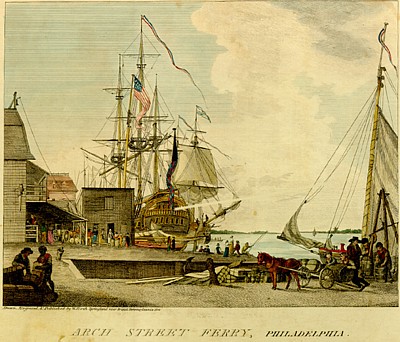
Arch Street Docks in Philadelphia
Among the early victims of the disease was a member of the President’s house. Polly Lear, the 23-year-old wife of George Washington’s secretary, Tobias Lear, died from yellow fever on July 28, 1793. Washington was personally devastated and attended her funeral the following day at Christ Church in Philadelphia, the only funeral he would attend during his presidency. Polly was given a funeral similar to a state funeral, with her pallbearers being Alexander Hamilton, Thomas Jefferson, and Henry Knox. Even though the fever would claim the lives of people close to George Washington, he, himself, never described fear or anxiety of catching the disease.
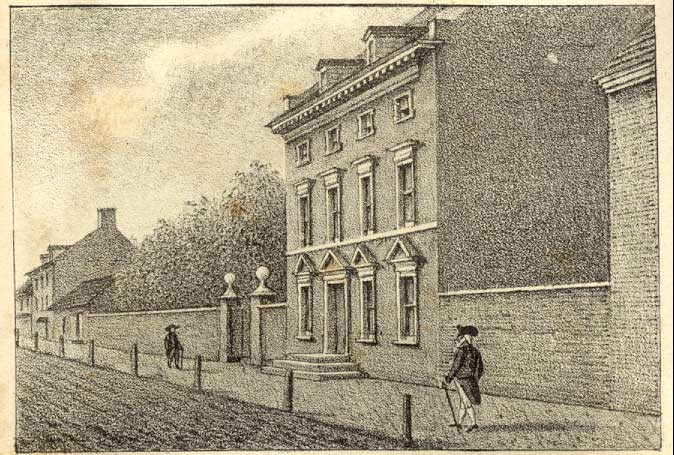
The President’s House in Philadelphia.
By August of 1793, cases of yellow fever in Philadelphia reached a point where local doctors declared an epidemic. About 20 people were dying every day of the disease. The College of Physicians in the city gave recommendations to slow the spread of the fever. They believed it was contagious from infected people and travelled through the air. People wore vinegar-soaked cloths around their mouths and noses, stayed in their homes, stopped shaking hands, kept distance on the streets from others, and lit bonfires in the city streets hoping the smoke would kill the disease in the air. People ceased to visit those afflicted with the fever, and the houses of those who had the fever were marked for all to avoid. They also sought to quickly bury people who died from the fever to try and stop the spread. People fled the city in droves. Nearly 20,000 people ultimately escaped the city. Washington described the city as “almost depopulated by removals and deaths.”
This Sunday, at 7 p.m. join Emerging Revolutionary War on our Facebook page as we interview William “Billy” Griffith, author of the latest volume in the Emerging Revolutionary War Series.
His book, A Handsome Flogging, The Battle of Monmouth, June 28, 1778 was just released by Savas Beatie, LLC this month. The book is so new that Amazon still has it listed for pre-sale, but don’t worry, you can purchase the book directly from Savas Beatie by clicking here.
Billy Griffith is a full-time contributor to ERW and is also the author of The Battle of Lake George: England’s First Triumph in the French and Indian War, which was released in 2016 by HistoryPress. A native of Branchburg, New Jersey, he has a family connection to the the Monmouth area; he graduated with a degree in history from Shepherd University and holds a graduate degree in military history from Norwich University. He currently works as a full-time Gettysburg Licensed Battlefield Guide. We would be remiss if we did not include his other passion, besides American military history, the New York Yankees. Feel free to join the Facebook Live to disparage his love of the Evil Empire!
ERW looks forward to seeing you, hearing your questions, comments, and what personalized message you want inscribed on your copy of Billy’s latest publication. Although this happy hour historian discussion centers on an author interview, it is still a “happy hour” so bring your favorite brew; we can guarantee the two historians on the program will be imbibing theirs!
Due to concerns related to the COVID pandemic, Emerging Revolutionary War and Historic Alexandria/Gadsby’s Tavern have decided to delay the 2nd Annual Emerging Revolutionary War Symposium until May 22. 2021.
Yet, don’t fret! Everything else will remain the same, including the subject of the one-day conference and the full-slate of historians scheduled to speak. To refresh the memory, here is the slate of historians and their topics.
Michael Harris – Misconceptions of the Battle of Brandywine
Vanessa Smiley – Myths of the Southern Campaign
Travis Shaw – American Loyalists
John U. Rees – African-American Continental Soldiers
Mark Maloy – Myths of the Battle of Trenton
Stay tuned as we continue to highlight the speakers and topics in the upcoming months. Besides circling May 22, 2021, please remember August 1, 2020, as that is the date tickets will go on sale for Hindsight is 2020: Revisiting Misconceptions of the Revolution.
We hope you all stay safe and healthy and we look forward to seeing you in person next May!
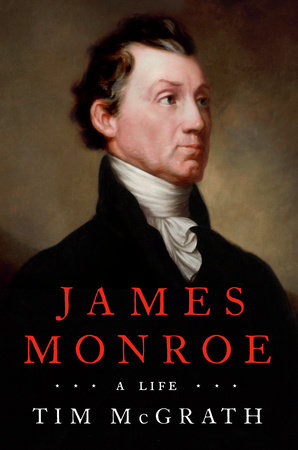
Tim McGrath has written two award-winning winning books about the early history of the United States Navy: Give Me a Fast Ship and John Barry. For his third book, he switched gears to tackle an oft-overlooked soldier, lawyer, politician, and president: James Monroe. In what will likely be the definitive Monroe biography, McGrath tackles the entirety of our fifth president’s life. Born in 1758, Monroe joined the American army in the Revolution’s early days until he was sidelined with a serious wound at Trenton.
As McGrath tells it, the story of Monroe’s early life was a constant search for a mentor and sponsor, which eventually landed him on William “Lord Stirling” Alexander’s staff. It was enough to bring him the attention and lukewarm friendship or support of many of the army’s leading lights and the country’s future leaders, but not enough to really launch his career. Eventually, he landed a legal apprenticeship with Virginia’s Governor Thomas Jefferson. It changed Monroe’s life, giving him a path forward professionally, politically, and intellectually.
There is much debate today about names of streets, buildings, and sports teams. One team that has been in the headlines for several years about their name is the Washington Redskins. Now, I have to be upfront…I have been a Redskins fan since I was a young child. I remember most of the glory years of John Riggins, Joe Gibbs and many other Hall of Famers. In the years of the 1980’s, not much was said about the name as a racist connotation. I am sure there were protests, but they were not mainstream and everyone in Virginia, Maryland and DC in those years followed the team. The name Redskins was not a racial connotation that their racially “challenged” owner George Preston Marshall (who had many issues with his own racism) came up with degrade Native Americans. It was a name that harked to a historical theme.
What we know today as the Washington Redskins began in 1932 as the Boston Braves. Now this new professional football team was not the only team in Boston named the Braves. At that time, the oldest baseball team in Boston were also called the Braves. This team began as the Boston Red Stockings and then the Boston Beaneaters, changing their name to the Boston Braves in 1912. Here is where the history gets murky. The owner of the Boston Braves, James Gaffney was a product of Tammany Hall, a powerful political machine out of New York City. Tammany Hall used as their moniker an American Indian Chief, with other Native American symbols in their imagery and media. With his connection to Tammany Hall, many believed Gaffney used the same imagery to rebrand his baseball team. Others in Boston believed Gaffney was playing to the local historical ties of the Boston Tea Party. During the Boston Tea Party, colonists dressed up as “Indians” (Mohawks to be more precise) to raid three tea ships at Griffin’s Wharf, destroying over 300 chests of East India Company tea. Most of them covered their skin in burnt ochre, which gave a dark reddish tint. We will never know if Gaffney chose the name “Braves” for Tammany Hall or the Boston Tea Party, but both were fitting historical ties.
Boston Tea Party, December 16, 1773
So, how does this tie into the football team? As George Preston Marshall brought professional football to Boston, he wanted to tie into the local sports lexicon of the region. Picking the name “Braves” for his team fit well as it matched the popular baseball team in town and also the football team played in the same stadium as the baseball franchise. Also, the previous team that played professional football in Boston was a traveling franchise named the Cleveland Indians. Though not sure, I believe Marshall had all of these in his mind in naming the team the Braves. Native American imagery and mascots were well known in Boston at this time, it seems that Marshall was trying to set his new team up for success. That first season the Braves finished .500 and Marshall moved the team to play their games at Fenway Park. Fenway was a state-of-the-art stadium at the time, built in 1934 and was the home to Boston’s other professional baseball team, the Boston Red Sox (which, also claimed their lineage to the same team the Boston Braves did, the Boston Red Stockings).
Boston Redskins vs. New York Giants
In moving the team, Marshall tried to distance himself from the Braves baseball team and changed the name to Redskins. There were no other professional teams called the Redskins, though some minor league and local teams used the name. This move was more marketing than anything else, trying to establish their own professional sports team identity. Also, Marshall was known for being economical, and by using the name Redskins he wouldn’t have to change uniforms. The Boston Redskins would go on to play in Boston until 1936, moving to Washington, D.C. in 1937. Marshall, for all his faults, was a smart businessman and believed there was money to be made in bringing professional football to the south. By moving the Redskins to Washington, they were the first NFL team in the south (how many of us would consider Washington, D.C. the south today?). Even the original song “Hail to the Redskins” had the lines “fight for old Dixie” which have been changed to “fight for old D.C.”
Part of me believes the name is more contentious today mostly because the team on the field has not been very good since the 1990’s. If this was a perennial winner like they were in the 1980’s, would this be a hot topic? Maybe it would as we look at all of our names and mascots, but I think it is highlighted by the losing and the current unpopular owner, making the current pressure unbearable. We know the name will change (though I have my own personal opinions of why they should not change the name), but the original name is rooted in American history and is more complex than you see on ESPN or other news outlets. Through this brief synopsis of the team’s name, I hope the basis for the name is clearer. I know we all won’t agree on what is offensive and not offensive and we will never know if Gaffney and Marshall named their teams to honor the colonists at the Boston Tea Party. But for one young kid who grew up in Virginia who loved history and the Redskins, its was a great match of history and sports.
Unless you have been living under Plymouth Rock, the play Hamilton has come across your radar screen in one form or another. Late last month Disney+ announced they would begin hosting the play on their streaming channel. Over the Independence Day weekend many historic sites had programs, watch parties, etc about the production.
So, why is Emerging Revolutionary War doing something similar this Sunday, at 7p.m. on our Facebook page? We wanted to do our own take on it, by presenting a mix of historians and fans of the play for an hour long discussion. For those that have been our faithful followers and thank you for your commitment, you will know how excited one of our historians is for this particular Zoom history.
If you guessed, Mark Maloy, you are correct! In fact, he is the one that made sure our title followed the correct vernacular for a Hamilton-esque post.
Joining Mark on Sunday will be the triumvirate of great historians, two that have been a part of past “Rev War Revelry’s” and one making her inaugural appearance.
Felicia Abrams is the Manager for Onsite Education at the Jamestown-Yorktown Foundation and a member of the Virginia Association of Museums. She will be joined by another great historian and co-worker, Kate Gruber, the Curator of Special Exhibits for the Jamestown-Yorktown Foundation.
Liz Williams, Director of Gadsby’s Tavern in Historic Alexandria will also be returning to the revelry this Sunday evening.
ERW invites you to attend our historian happy hour on Hamilton this Sunday, on our Facebook page. If you have not seen it, now is the time to catch up do you can have your questions and comments ready for Sunday evening. Don’t forget your favorite brew too!
As this posting goes live today, July 2, there is a link to the American Revolutionary War era. This was the day that John Adams, future president of the United States, believed would be the date Americans would celebrate as their independence day.
Yet, the day reserved for that celebration would fall two days later, on July 4, the date that John Hancock affixed his signature as president of the Continental Congress.
However, join Emerging Revolutionary War historians and three guest historians this Sunday, July 5, at 7 pm EST, on our Facebook page, as another date to talk “All Things Independence Day” including John Adams and Independence Hall.
Joining ERW to discuss John Adams and Thomas Jefferson, which will be the volume in the Emerging Revolutionary War Series, is Emerging Civil War co-founder and Stevenson Ridge historian-in-residence, Dr. Chris Mackowski.
Savannah Rose, a National Park Service ranger at Independence National Historical Park and the new layout coordinator for the Emerging Revolutionary War Series. You can see her work with the upcoming A Handsome Flogging, on the engagement at Monmouth Course House, which just shipped from the printer this week.
Rounding out the triumvirate of guest historians will be Dan Welch, who you may remember from his dramatic reading of “A Midnight Ride” the poem about Paul Revere’s Ride. Dan is also a seasonal historian with the National Park Service at Gettysburg National Military Park.
As you round out your holiday weekend, we hope that you include “Rev War Revelry” as one of the events you attend to commemorate Independence Day weekend. We look forward to toasting you as we enjoy our favorite brews and discuss “All Things Independence.”
Bernardo De Galvez, Governor of Louisiana (Wikimedia Commons)
Willing’s next target was the town of Manchack upon which he descended “so rapidly that they reached the Settlements without being discovered.”[1] On the 23rd, Willing’s advance parties captured the 250-ton British sloop Rebecca, with sixteen 4-pounders and six swivels.[2] It was a coup worthy of Navy SEALS. Rebecca was normally a merchant vessel, but had been armed and sent upriver to contest the Rattletrap’s advance by protecting Manchack. Instead, her presence had strengthened Willing’s force. Captured while lying against the levy opposite the town, she only had fifteen men aboard when an equal or superior force of Americans struck about 7 am.[3] With Manchack captured and the Rebecca renamed the Morris, Willing turned his attention to the end game at New Orleans, where he hoped to dispose of his booty and obtain supplies useful for the American war effort.
At New Orleans, the Congressional Agent, Oliver Pollock, was aware of Rattletrap’s advance and began making preparations to dispose of the property Willing and his raiders had taken, a growing portion of which constituted slaves. He organized a small force under his nephew, Thomas Pollock, to go up river and help Willing bring his vessels and cargo into port. Instead, Pollock and his men proceeded down the river, where they captured an English brig, the Neptune, eventually bringing her into New Orleans as a prize.[4] (The British would argue strenuously that Neptune and a private boat were not in fact legal prizes.)
This Sunday, at 7 pm, EST on our Facebook page, join Emerging Revolutionary War historians as they discuss “Epic Moments of the American Revolution.”
What is an epic moment? This umbrella term will be discussed by using examples from the eight-year conflict that spawned American independence. As ERW historian Mark Maloy relates, one such moment came in early 1777 at Princeton, New Jersey, as explained by a participant in that engagement:
“I saw [Washington] brave all the dangers of the field and his important life hanging as if it were by a single hair with a thousand deaths flying around him.” – Pennsylvania officer at Princeton”
Moments of bravery, of personal sacrifice, be it in a battle, skirmish, raid, siege, political moment or on a mission of importance, the American Revolution has a multitude of them. During the hour-ish long historian happy hour, the panel will describe the ones that they deem as important or noteworthy. Bring your own as well, as we encourage comments, opinions, and dialogue via the comments section of our Facebook live.
Looking forward to sharing a brew and an epic moment from the War of Independence with you, this Sunday, on Emerging Revolutionary War‘s “Rev War Revelry.”





 Tim McGrath has written two award-winning winning books about the early history of the United States Navy: Give Me a Fast Ship and John Barry. For his third book, he switched gears to tackle an oft-overlooked soldier, lawyer, politician, and president: James Monroe. In what will likely be the definitive Monroe biography, McGrath tackles the entirety of our fifth president’s life. Born in 1758, Monroe joined the American army in the Revolution’s early days until he was sidelined with a serious wound at


 Emerging Revolutionary War Era