The hottest part of the hotttest temperature engagement in the American Revolution happened on June 28, 1778 at Monmouth Court House in New Jersey. The portion that gets the most attention out of this entire battle was the supposedly heated exchange between General George Washington and his second-in-command, General Charles Lee.
What ensued was the end of an American military career, as Lee would face a court martial, a suspension from duty, and a fall into obscurity. Historians have sorted through the primary sources of the time period to reconstruct what exactly happened on that balmy June day.
Yet, for the first time, a dedicated study, from the lens of both a historian and a practicing attorney, brings into focus the details of that fateful day in New Jersey. That topic, his new book, and historian Christian McBurney will be the focal point of this week’s “Rev War Revelry” as a Facebook live, this Sunday at 7 p.m. EST.
McBurney, an attorney in Washington D.C. and president of the George Washington American Revolution Round Table of Washington D.C. will speak on his latest publication, George Washington’s Nemesis, The Outrageous Treason and Unfair Court Martial of Major General Charles Lee during the Revolutionary War. This book is one of five that McBurney has written on the subject of the American Revolution.
For more information on those books, click here. To read up or read the synopsis of the book at the center of the historian happy hour this Sunday, click here.
We look forward to welcoming you this Sunday; whether you read the book or on the fence about adding this volume to your expanding library or just want to know the history behind this last major battle in the northern theater in the American Revolution. Or all three! Remember to bring your comments, questions, and a favorite beverage to sip on as you tune in.
This Sunday, at 7 p.m. join Emerging Revolutionary War on our Facebook page as we interview William “Billy” Griffith, author of the latest volume in the Emerging Revolutionary War Series.
His book, A Handsome Flogging, The Battle of Monmouth, June 28, 1778 was just released by Savas Beatie, LLC this month. The book is so new that Amazon still has it listed for pre-sale, but don’t worry, you can purchase the book directly from Savas Beatie by clicking here.
Billy Griffith is a full-time contributor to ERW and is also the author of The Battle of Lake George: England’s First Triumph in the French and Indian War, which was released in 2016 by HistoryPress. A native of Branchburg, New Jersey, he has a family connection to the the Monmouth area; he graduated with a degree in history from Shepherd University and holds a graduate degree in military history from Norwich University. He currently works as a full-time Gettysburg Licensed Battlefield Guide. We would be remiss if we did not include his other passion, besides American military history, the New York Yankees. Feel free to join the Facebook Live to disparage his love of the Evil Empire!
ERW looks forward to seeing you, hearing your questions, comments, and what personalized message you want inscribed on your copy of Billy’s latest publication. Although this happy hour historian discussion centers on an author interview, it is still a “happy hour” so bring your favorite brew; we can guarantee the two historians on the program will be imbibing theirs!
Emerging Revolutionary War welcomes guest historian Gabriel Neville
Most of the enlisted men of the Revolutionary War are faceless and forgotten—just names on lists. Biographies and painted portraits are honors that were reserved for officers. Even so, it is possible to trace the lives of some common soldiers using original sources. Many of them applied for pensions after 1818, which required them to provide (usually brief) narratives of their service. Some gave similar attestations when they applied for military bounty land. A small number left detailed accounts of their experiences in interviews, letters, or diaries. Finally, and very rarely, we have photographs taken in the last years of some veterans’ lives. Virginian John Cuppy may be the only Revolutionary War soldier to leave us an artifact in each of these categories.
John Cuppy
Cuppy was born near Morristown, New Jersey on March 11, 1761. While still an infant, he was brought to Hampshire County, Virginia by his German parents. Their new home was on the South Branch of the Potomac River near the town of Romney, which is now in West Virginia. About forty miles west of the Shenandoah Valley, this was the very edged of settled Virginia territory. John was just fourteen years old when the war began—too young to be a candidate for service when Hampshire was directed to raise a rifle company in July of 1775. He was still too young when Dutch-descended Capt. Abel Westfall recruited a company there that winter for Col. Peter Muhlenberg’s new 8th Virginia Regiment.[1]
Emerging Revolutionary War welcomes guest historian Kieran O’Keefe.
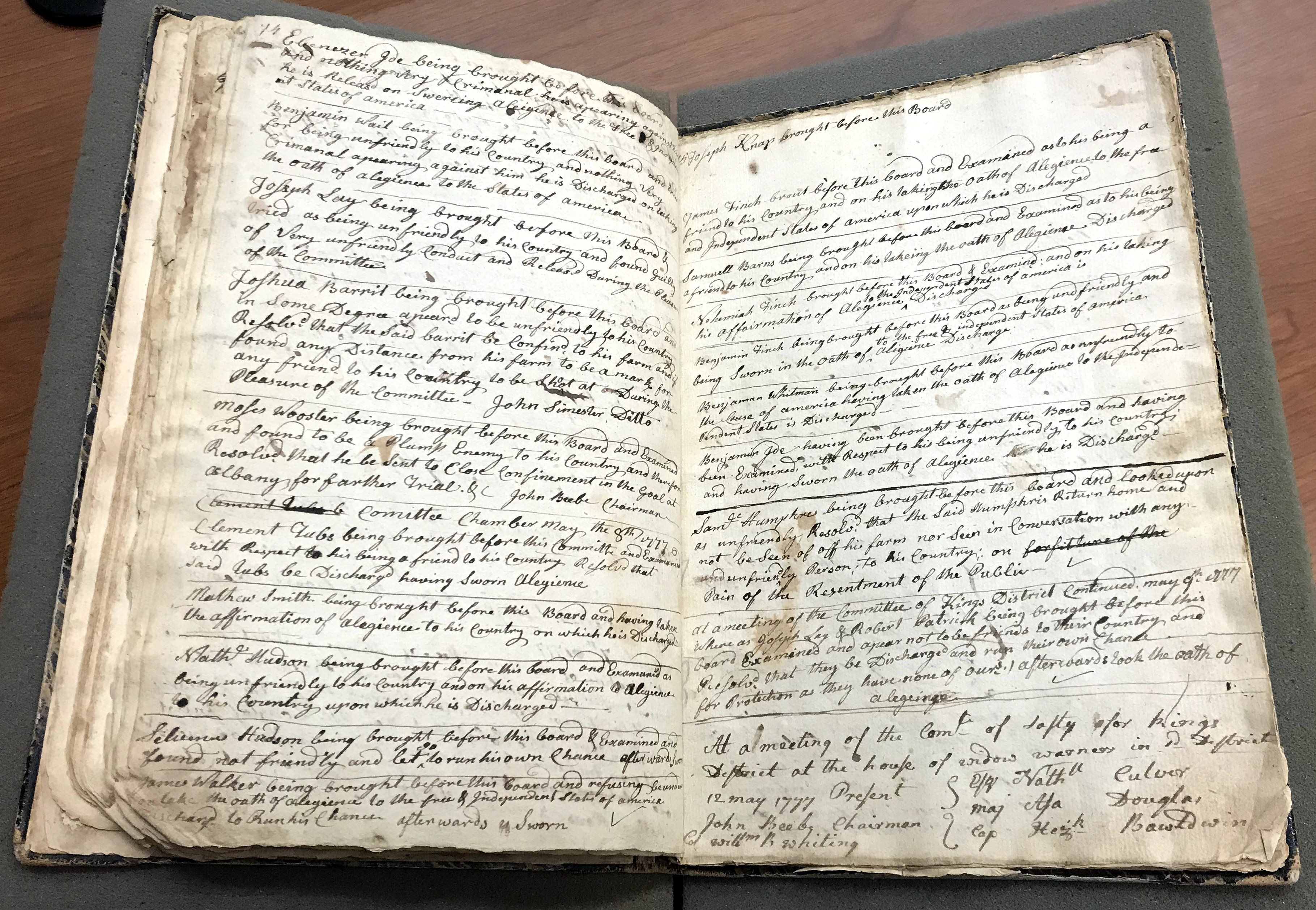
While the most famous scenes of the American Revolutionary War involve major battles or deliberations in Congress, the driving force behind the Revolution within small towns were committees of safety. As the war progressed and British authority dissipated, these committees became the effective government in most localities until the formal establishment of state governments. They had responsibilities such as regulating the economy, suppressing loyalists, procuring military supplies, raising revolutionary forces, and overseeing civil and criminal justice. Despite their ubiquity, it is rare to find the records of a committee completely intact. One such exception is the King’s District Committee of Albany County, New York, whose minutes survive in the Library of Congress.
The First Continental Congress created the committee system when it adopted the Continental Association in 1774. The Association called for the non-importation, non-consumption, and non-exportation of goods between the colonies and Great Britain, Ireland, and the British West Indies. This boycott was to put economic pressure on Britain to repeal the punitive Coercive Acts, which punished Massachusetts for the Boston Tea Party by closing the port of Boston and bringing the colony under tighter royal control with the aid of British redcoats. The Continental Association also stated that “a committee be chosen in every county, city, and town, by those who are qualified to vote for representatives in the legislature, whose business it shall be attentively to observe the conduct of all persons touching this association.” These committees were to ensure that all Americans adhered to the boycott stipulated in the Association. Committees began forming throughout the colonies in late 1774 and soon took on a greater role than originally designed, frequently seizing the reins of local government. The committees were unusually democratic. They generally consisted of about five men who were popularly elected, and many members were from the middling ranks of society with no prior political experience.
The King’s District Committee record book (author collection)
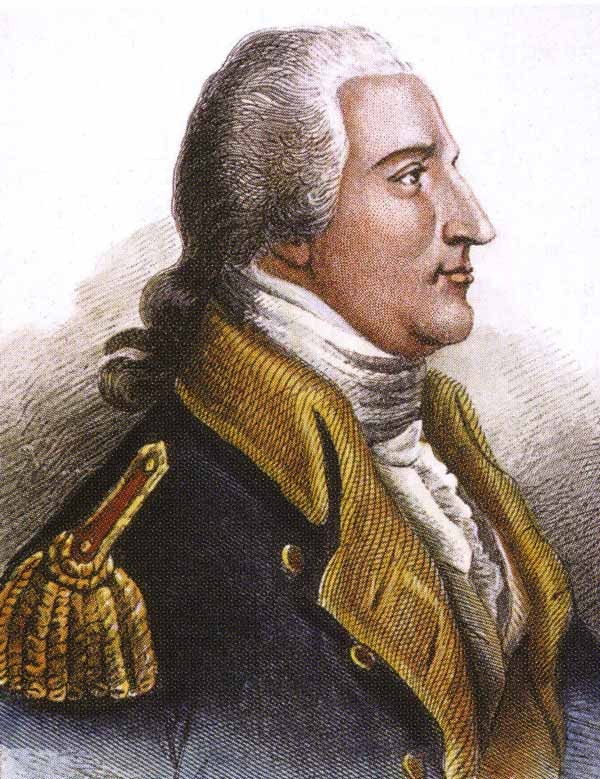
After turning coat, Benedict Arnold received a commission as a brigadier general in the British army as part of the deal that he made in order to betray his country.
In August 1781, George Washington decided to shift forces in order to attack the army of Lt. Gen. Lord Charles Cornwallis in Virginia. Washington began pulling troops from the New York area. Lt. Gen. Sir Henry Clinton, the British commander-in-chief in America, realized on September 2 that Washington’s tactics had deceived him, leaving him unable to mobilize quickly enough to help Cornwallis. Further, there was still a significant force of Continentals facing him in front of New York, and Clinton did not feel that he could detach troops to reinforce Cornwallis as a result.
Instead, Clinton decided to launch a raid into Connecticut in the hope of forcing Washington to respond. Clinton intended that this be a raid, but he also recognized that New London could be used as a permanent base of operations into the interior of New England. Clinton appointed Arnold to command the raid because he was from Connecticut and knew the terrain.
Arnold commanded about 1,700 British solders, divided into two battalions. Lt. Col. Edmund Eyre commanded a battalion consisting of the 40th and 54th Regiments of Foot and Cortland Skinner’s New Jersey Volunteers, a Loyalist unit. Arnold himself commanded the other battalion, made up of the 38th Regiment of Foot and various Loyalist units, including the Loyal American Regiment and Arnold’s American Legion. Arnold also had about 100 Hessian Jägers, and three six-pound guns. This was a formidable force anchored by the three Regular regiments. Continue reading “The Battle of Groton Heights, September 6, 1781: The Fort Griswold Massacre”→
Emerging Revolutionary War is honored to welcome guest historian Daniel Welch to the blog. A brief biography of Mr. Welch is at the bottom of the post.
Several weeks ago I decided to take my usual weekend off of visiting American Civil War battlefields to take a moment to explore some American Revolutionary War historic sites just several hours down the road. Since it was a rather last minute decision, I was not completely prepared before visiting other than some basic historical context and a vague idea of operating hours and things to do while at these historic sites. So, if you want to follow the Continental Army during their experiences in the fall and winter of 1777-1778 read on to help plan a great weekend day trip.
Battle of Brandywine
Sandy Hollow, Brandywine Battlefield
If you want to follow these events as they happened, and in chronological order, began your day at the Brandywine Battlefield Park Associates site. Walking the site is free, but there is a charge if you want to go through the museum or on a tour of one of two historic homes on the property. Their hours are constantly changing so make sure you check their website. (click here), before you plan your visit. To go on a house tour, view the film, and go through the museum there is an $8.00 charge; the museum and film alone is $5.00. I would suggest, if you have the time, to take in the film and museum. The film lasts approximately twenty minutes while a thorough look of the museum could take one an additional forty minutes. Between the film and museum, a firm foundation to the events of September 11, 1777 will be in place before you head out to other locations associated with the battle. The house tour is a guided tour through Washington’s headquarters on the property and is conducted by a volunteer at the site. The tour took over an hour and a half, and considering that the home had burned to the ground nearly 100 years ago and has been rebuilt and filled with modern reproductions, your time would be better spent going to other sites associated with the battle.
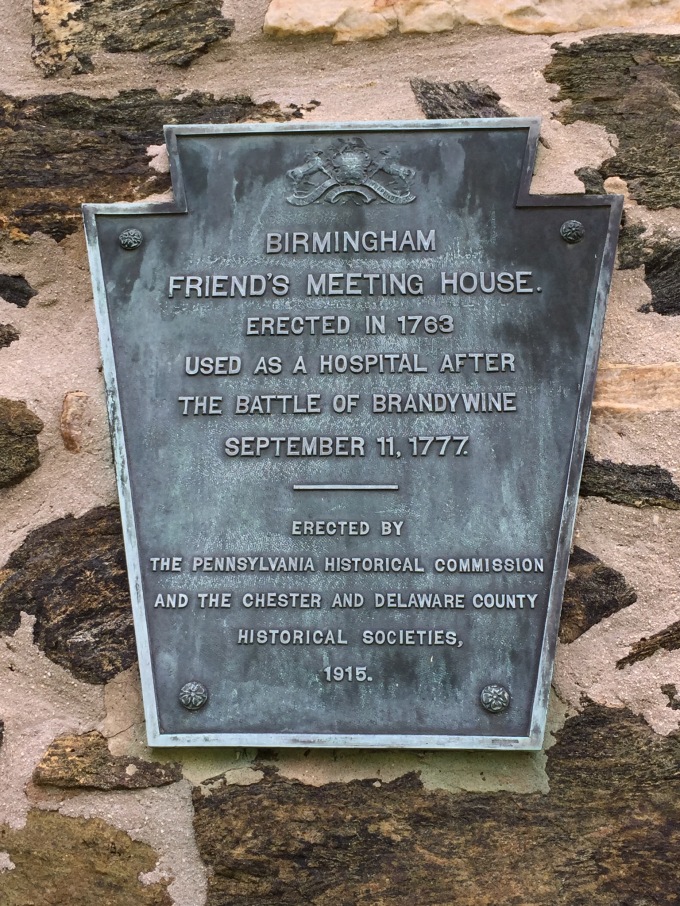
Birmingham Friend’s Meeting House plaque
Before leaving, make sure you pick up driving directions from the employees at the counter to get to Birmingham Friend’s Meeting House, and Sandy Hollow, the American’s second line of defense during the battle. Also, make sure to purchase the driving tour map of the battle of Brandywine. This map will take you to numerous other historic sites and homes within the Brandywine Valley that witnessed the events of that day. The cost is a mere $2.95. Plan an additional three to four hours to complete the driving tour.
Ultimately the battle proved to be an American defeat. Although he was defeated on the field, Washington and his generals were able to get large portions of the army to the rear through Polish General Pulaski’s assistance in covering the retreat. Despite the best maneuvers to save his army, Washington was unable to save Philadelphia and the city fell to the British just two weeks later on September 26, 1777. The British remained until June 1778.
Lunch
By now a late lunch would be in order. A great spot is the Black Powder Tavern. A tavern since 1746, it has a great Revolutionary War history, including a supposed visit by Washington himself. The restaurant’s name is related to a historical legend that none other than Von Steuben had ordered the tavern turned into a secret black powder magazine during the army’s pivotal winter at Valley Forge. The food here was great, as was the service and beer selection.
Valley Forge National Historical Park
Following the defeat at Brandywine in September, and another engagement at White Marsh in early December, General Washington looked to put his army into a more secure camp for the coming winter. Active military campaigning for 1777 in Pennsylvania was over. Just twenty miles northwest of Philadelphia, the Continental Army faced numerous challenges here including a lack of food and shelter. Disease also spread during their time at Valley Forge. By February 1778, approximately 2,500 soldiers had perished.
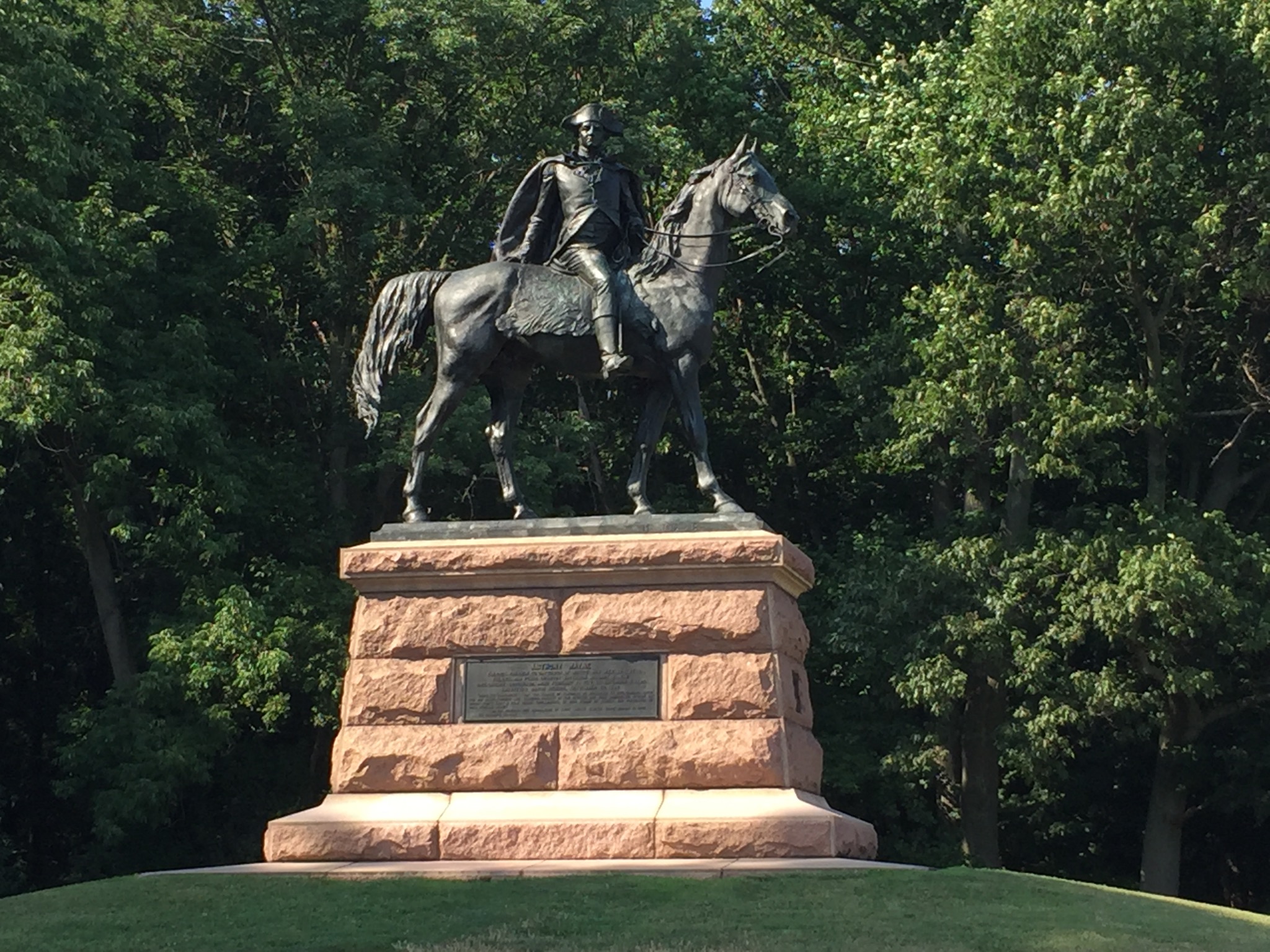
General Anthony Wayne Statue, Valley Forge National Historical Park
To begin your visit here, start at the visitor center. The museum has its challenges. There is no discernible narrative to the exhibits; rather, numerous cases with laminated pieces of paper hanging on the side with corresponding images and item descriptions. Although there are some unique items on display, if it is busy you could wait at a particular case for the laminated cards to know what you are looking at. After a perusal of the museum, take in the free film. Although it is rather dated it provides a great overview of the winter encampment, its challenges, and outcomes. Between the film and museum, plan on spending an hour at the visitor center.
If you have additional time, take in the one and only National Park Service Ranger program offered. It is a rather short program, in length and walking distance, from the visitor center to the reconstructed Muhlenberg Hut sites. The program also echoes what is presented in the film. Before leaving the visitor center, I recommend getting the auto tour cd, as well as any updates on road closures. The park is currently under a significant amount of construction that has closed some roads and altered the driving tour route. The suggested driving tour cd is two hours in length. This would be a time allotment for those visitors who do not stop at each site, get out of the car, and explore all the stops along the route. You will want to get out and explore monuments such as those to the New Jersey troops, National Memorial Arch, von Steuben, and Patriots of African American Descent. You will also want to explore the several historic homes within the park that were used during the encampment, such as Varnum’s Quarters, Washington’s Headquarters, and the Memorial Chapel. My explorations, coupled with the driving tour cd, lasted nearly five hours.
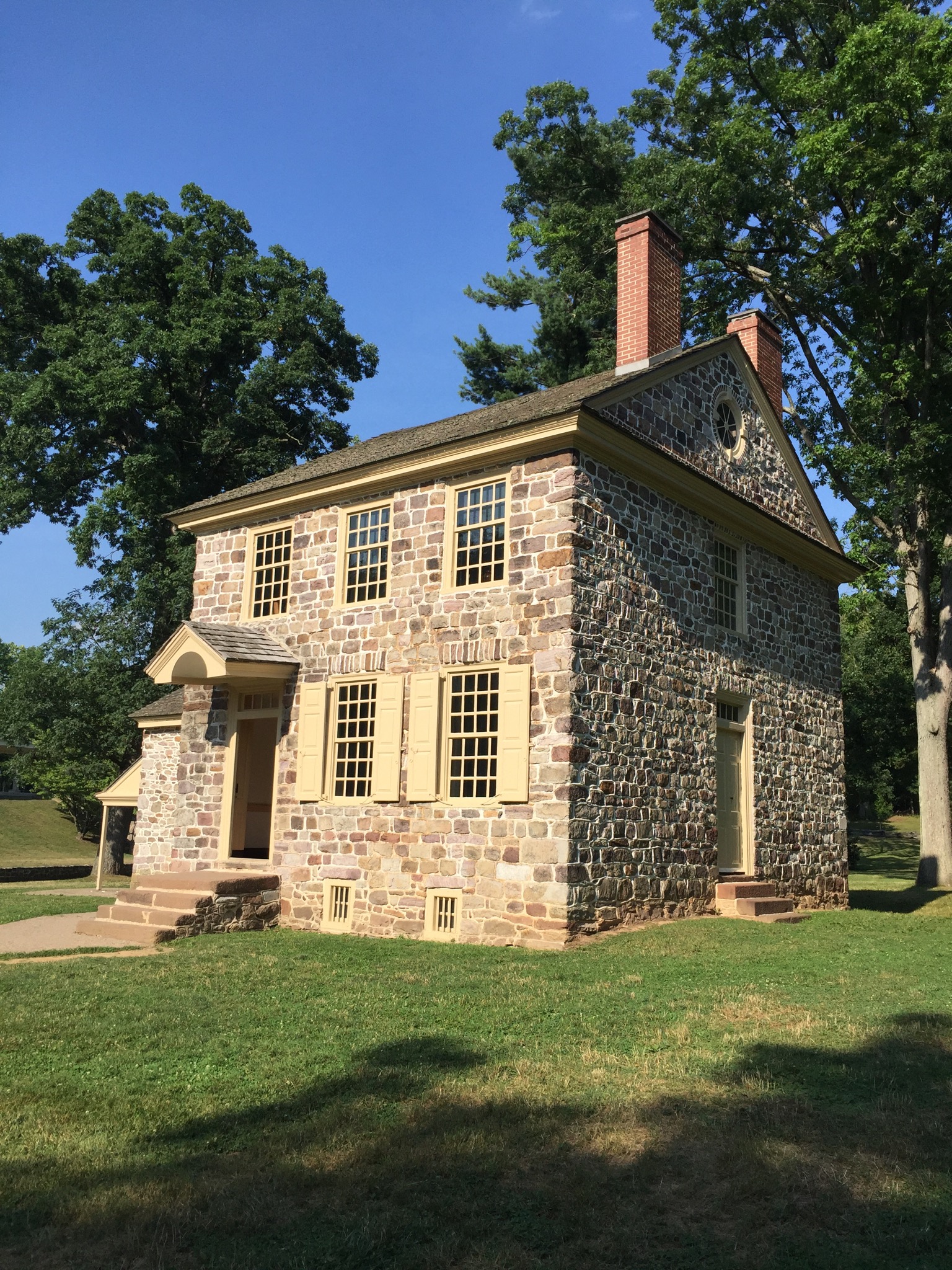
George Washington’s Headquarters (Isaac Potts House) at Valley Forge National Historical Park
Although it would be a long day, it can be done in one; however, if you wish to slow the pace of your visit, each site could be done on a separate day during your weekend. There is plenty of lodging in the area to accommodate this schedule. By visiting both of these historic areas and learning about the events of the fall through early spring 1777-1778, a greater picture can be viewed gleaned of military situation during the time period, as well as the tough composition of the Continental Army despite their defeats.
*Dan Welch currently serves as a primary and secondary educator with a public school district in northeast Ohio. Previously, Dan was the education programs coordinator for the Gettysburg Foundation, the non-profit partner of Gettysburg National Military Park, as well as a seasonal Park Ranger at Gettysburg National Military Park for six years. During that time, he led numerous programs on the campaign and battle for school groups, families, and visitors of all ages.
Welch received his BA in Instrumental Music Education from Youngstown State University where he studied under the famed French Hornist William Slocum, and is currently finishing his MA in Military History with a Civil War Era concentration at American Military University. Welch has also studied under the tutelage of Dr. Allen C. Guelzo as part of the Gettysburg Semester at Gettysburg College. He currently resides with his wife, Sarah, in Boardman, Ohio.
In the lowest depths of one of the coldest winters in the American Revolution, the Continental Army uncovered the dedication that the core of the military movement had.
Suffering was beyond comparison.
The cause was supply, the crux of many an army before and after the Revolutionary War. The issue started from the top, the quartermaster general position.
“The lack of a competent, effective quartermaster general for the period from October 10, 1777 to May 2, 1778 threatened the Continental Army’s existence more than the enemy” wrote author and historian Herman O. Benninghoff, II.
His bold proclamation is chillingly on-point.
That time frame coincided with the approximately same length of time George Washington’s forces were at Valley Forge.
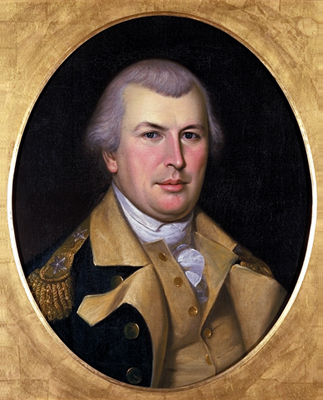
Nathanael Greene would become Quartermaster General in March 1778 during the encampment at Valley Forge
On January 5, 1778, Nathanael Greene, who would soon be tapped as quartermaster general of the Continental Army, wrote to fellow officer General Alexander McDougall;
“The troops are worn out with fatigue, badly fed, and almost naked. There are and have been thousands of the Army without shoes for months past. It is difficult to get sufficient supplies to cloath the Army at large.”
Moving directly to Valley Forge from active campaigning, the soldiers arrived with their supplies in a deplorable condition. Shoes had been torn to shreds with the long marches and many of the men had nothing but rags to wrap feet in. Shortly after arriving, the army numbered approximately 12,000 men under arms, yet 4,000 of these men, 1/3rd of Washington’s entire force, was deemed “unfit for duty” because a lack of supplies.
Another 1,100 would desert because of the horrid conditions of the winter encampment; no food, no pay, and barely clothes to keep warm.
Another 2,000 died of disease, including typhus, pneumonia, and other “camp fevers” which categorized a whole assortment of various ailments. Medicine was almost non-existent and lack of proper sanitation played a major role as well.
A delegate to the Confederation Congress was informed by an informant in Valley Forge that “a great portion of the soldiers are in a very suffering condition for want of necessary clothing, and totally unfit for duty.”
The suffering of the soldiers for a want of simple, basic clothing, becomes even more painful with the following realization by John Marshall, serving as an officer at Valley Forge, and the same Marshall who would become the Supreme Court Justice.
“In a desert which supplies not the means of subsistence, or in a garrison where food is unattainable, courage, patriotism, and habits of discipline, enable the soldier…..but to perish in a country abounding with provisions, requires something more than fortitude.”
One artist’s depiction of what the encampment at Valley Forge looked like
That is what is most astonishing, that there were surpluses to be attained, but Continental currency had depreciated to the point that by late 1777 and early 1778 it was at an exchange rate of four Continental dollars to one dollar of hard specie. By 1779 that ratio would be 30 to 1.
To further complicate matters, the Continental Army did not even have the wagons to gather the materials. In mid-February, a report from camp to Henry Laurens, president of the Confederate Congress, deplored of the “want of Waggons & the like.”
Out of the depths of this despair, where cries of “No Meat, No Meat” rent the air as soldiers voice their frustration, came a self-proclaimed baron.
This man would leave a lasting impression on the make-up of the army, second only to George Washington.
His assessment of the army upon his arrival amazed him, the “fortitude of the common soldiers and that no army in Europe would hold together and endure under such deprivations of food and clothing and shelter.”
That prognosis shows the depth of commitment that boiled in the hearts of the dedicated survivors of the cold, hunger, and privations of Valley Forge.
The army was ready to be molded and with his arrival, Baron Friedrich Wilhelm von Steuben would turn out to be the right guy at the right juncture in time. The Continental Army, held together by George Washington, would be transformed by this new inspector general.
Valley Forge would be the elixir of change for the army and the revolution.




 Instead, Clinton decided to launch a raid into Connecticut in the hope of forcing Washington to respond. Clinton intended that this be a raid, but he also recognized that New London could be used as a permanent base of operations into the interior of New England. Clinton appointed Arnold to command the raid because he was from Connecticut and knew the terrain.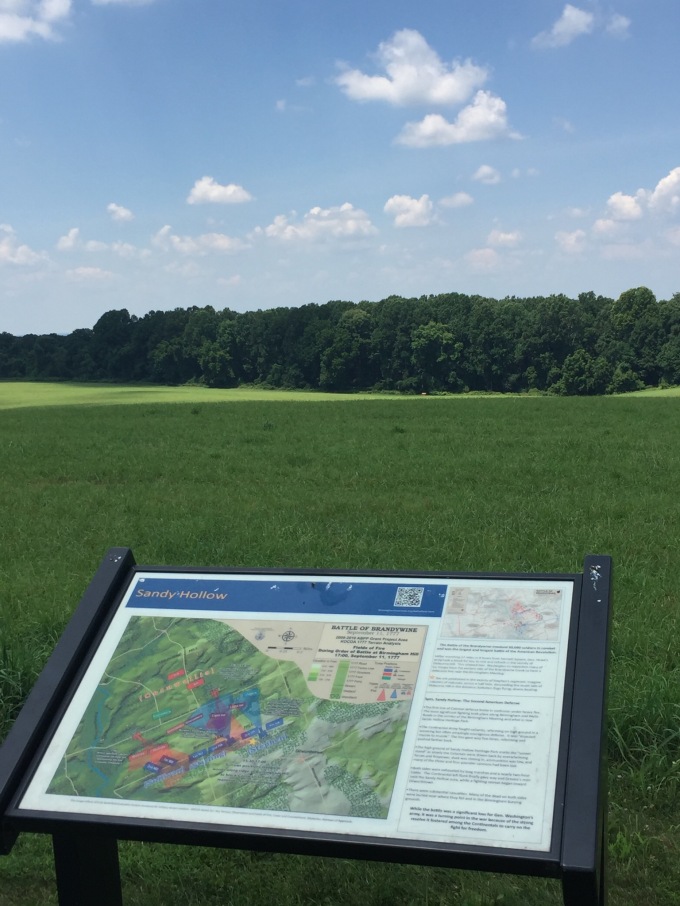

 Emerging Revolutionary War Era