Interview with Michael Troy from American Revolution Podcast

Emerging Revolutionary War recently had the pleasure, via e-mail, to interview historian Michael Troy who is the man behind the popular American Revolution Podcast site. A link to his page follows this interview.

TROY_new-250x300
Mike Troy
  1. What was the reasoning behind starting American Revolution Podcast?

I have been a big fan of American history my whole life.  The American Revolution has always held a fascination for me.  I had originally planned to produce a blog on the topic, simply out of my love of reading and writing about it.  I decided to turn the project into a podcast because I’ve enjoyed listening to other history podcasts myself. I figured others might appreciate a thorough podcast that covered this topic.

  1. Where did your personal interest in this time period of American History begin?

I’m old enough to remember the bicentennial celebrations as a boy.  I also grew up in the Philadelphia area, where there are so many locations with memories of the era.  I always felt an attachment particularly to that time in our history. Beyond that, the Revolution was more than American independence.  It was about creating a new country based on the ideals of representative democracy, at a time of the world was still ruled by hereditary monarchies.  It was a bold experiment that really changed the world in which we live today. Continue reading “Interview with Michael Troy from American Revolution Podcast”

Another American in Paris

IMG_0931So, vacation time rolls around again and this year my family and I had an opportunity to travel to Paris, France for a few days.  Riding into the city from Charles de Gaulle Airport, our taxi driver, by chance, took us past an old, green-corroded bronze statue, set in the middle of a little flowered square.  From my vantage, I could only see the bottom portion of the statue; what appeared to be the lower portion of a man in buckled shoes, seated in a wooden chair, atop a marble pedestal.  My wife happened to be in the right spot in the vehicle as we quickly drove by.  “Looks like Benjamin Franklin, I think.” she said, and with those words, she sent me on a journey to find that statue again and, hopefully, other sites in Paris associated with Mr. Franklin.
Unlike his colleague from New England, John Adams, who was from good, plain Puritan stock, the pulse of a city like Paris, with its decadence, opulence and social intrigue, fit Benjamin Franklin like a glove.  As ambassador to France after the signing of the Declaration of Independence, Franklin was instrumental in helping to obtain for our fledging nation the financial and military support necessary for bringing our war for independence to a happy conclusion.  To the people of Paris, he was somewhat of a celebrity, due to his experiments with electricity. He spoke French and endeared himself to the people by displaying, in his dress and speech, what they considered his “rustic” demeanor.  In a word, they were charmed by Benjamin Franklin.  The fur cap he was fond of wearing only added to his disguise of “homespun rusticity”.  So, finding a monument to him in this city was not much of a surprise.  Continue reading “Another American in Paris”

Uncovering the Continental Army in Morristown

Part of an ongoing series about the Continental Army in Morristown, New Jersey. To read previous posts, click here.

IMG_3370
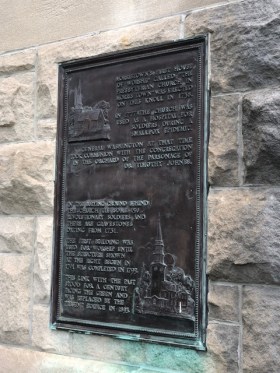
Plaque on wall of the Presbyterian Church

During the winter encampment, in 1777, at Morristown, George Washington ordered the inoculation for smallpox of the Continental Army. Although knowing the probability that some of his men would succumb to the disease when infected with even a small dosage of the puss, the commander-in-chief knew that the necessity of the process. By the end of the American Revolutionary War, more American soldiers would die of smallpox than British shot and shell.


With a population of 700 people and less than 70 dwellings, any public space of size was utilized to treat and quarantine the soldiers undergoing the smallpox inoculation. One of the religious establishments that was used was the Presbyterian Church across the street from Morristown Green, the center of town.

The Presbyterian Church already had a long history in Morristown, being the first congregation founded in the town, dating back to 1733 (the one you see today is actually the third to grace the same site).

IMG_3369

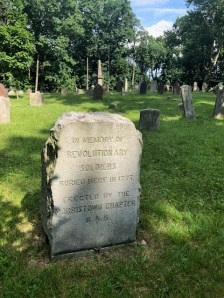
Behind the church is a graveyard referred to as “The Burying Ground” which holds the remains of over 1,700 individuals. Included in that number are the remains of numerous soldiers that succumbed to the smallpox inoculation during the winter encampment of 1777. From the burials that are known, 138 remains are those of soldiers from the American Revolution.IMG_3383

During the annual commemoration of Independence Day, the town of Morristown will offer guided programs of “The Burying Ground.” At other times throughout the year, the church itself will offer tours. You can find information about the church programs of the  cemetery here.

Whether you visit on a guided tour or independently stroll the ground, the though to keep in mind is; the men who died whether on the field of battle, succumbed to smallpox, or lived a long life as a veteran, the all helped make Morristown the placed where “America Survived.”

Uncovering the Continental Army in Morristown

Part of an ongoing series of about the Continental Army in Morristown, New Jersey. For the first post, click here.

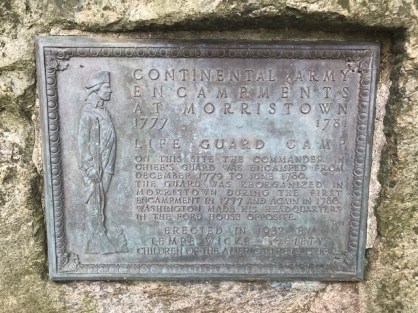
Across the street from the Ford Mansion, the elegant home of the Jacob Ford, Jr. and his family, and the headquarters for George Washington during the winter encampment of 1779-1780, sits a small boulder with a iron plaque plastered on the side.IMG_0027

Erected in 1932 by the Tempe Wicke Society Children of the American Revolution, the monument commemorates the Life Guards that served as Washington’s headquarters command during the American Revolution. Although the unit went by different names and reorganized at least twice, including once during the winter encampment at Morristown, the company, numbering approximately 150 men, would be around for the duration of the war. Continue reading “Uncovering the Continental Army in Morristown”

Washington’s Marshals

Emerging Revolutionary War welcomes back guest historian Michael Aubrecht

September 24 of each year is the anniversary date of the Judiciary Act of September 24, 1789. It also means that the United States Marshals Service is a year older. Along with the first federal law enforcement agency in the United States, President George Washington signaled the start of the entire federal judicial system with his signature on that date. It was a broad document covering many positions from judges to prosecutors. Sections 27 and 28 were specific to the U.S. Marshal’s roles and responsibilities. A segment of Section 27 specifically outlines their general powers. It states:

And be it further enacted, That a marshal shall be appointed in and for each district for a term of four years, but shall be to attend the district and circuit courts when sitting therein, and also the Supreme Court in the district in which that court sit. (b) And to execute throughout the district, all lawful precepts directed to him, and issued under the authority of the United States, and he shall have the power to command all necessary assistance in the execution of his duty, and to appoint as shall be occasion, one or more deputies… Continue reading “Washington’s Marshals”

Origins of a Revolutionary Orator

Studley state historical marker
State of Virginia historical marker for Studley

Nestled in Hanover County, VA, near where modern residential communities meet farm fields that have been worked for centuries, is the site of a colonial-era plantation home called Studley.  It was here on this site that Patrick Henry, the “Voice of the Revolution”, was born.

A 600-acre tobacco plantation, Studley was built in the 1720’s for its original owner, Colonel John Syme and his bride, Sarah, the former Sarah Winston.  The surrounding community, as it does today, took its name from the site. (By the mid-19th century, the Studley area was called Haws Shop, after a nearby blacksmith shop.  In the latter part of May, 1864, Union and Confederate cavalry units fought a dismounted action here just prior to the battle of Cold Harbor.  Prominent among the Union commanders engaged was Brig. Gen. George Armstrong Custer.)

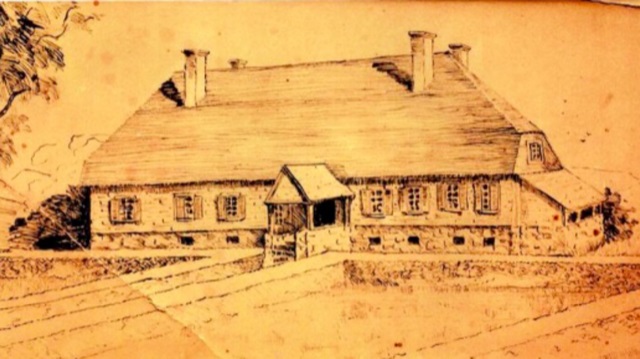
Sketch of Studley
Sketch of Studley

Continue reading “Origins of a Revolutionary Orator”

Uncovering the Continental Army in Morristown

Part of an ongoing series about the Continental Army in Morristown, New Jersey. To read previous posts, click here.

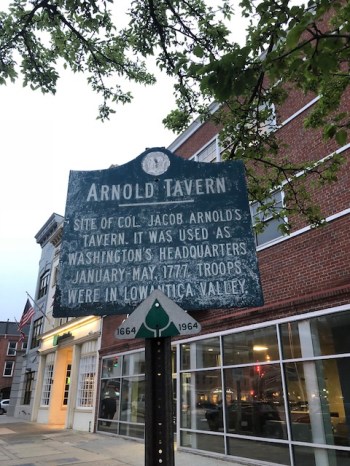
All that remains is a historical marker, on the side of North Park Place across the street from Morristown Green. For a few months, between January 1777 and May 1777, in this location, the headquarters of the Continental Army was located. Within that headquarters, obviously, was George Washington.

IMG_3024
Arnold’s Tavern historic sign (author’s collection)

Although no specific date of construction exists, it is believed that Arnold’s Tavern was built by Samuel Arnold between 1735 and 1750. By the time of the American Revolution owned by the son, Colonel Jacob Arnold. The structure was three stories high, with a wide hallway that bisected the building, a front and back parlor, barroom, dining room, and kitchen. Continue reading “Uncovering the Continental Army in Morristown”

Uncovering the Continental Army in Morristown

Part of an ongoing series of about the Continental Army in Morristown, New Jersey. For the first post, click here.

“The smallpox has made such head in every quarter that I find it impossible to keep it from spreading thro’ the whole army the natural way.” General George Washington wrote in February 1777.

By the time the Continental Army was encamped in Morrristown, Washington had become a firm believer in the inoculations for smallpox for the entire army. The inoculation process would entail the following: Continue reading “Uncovering the Continental Army in Morristown”

Uncovering the Continental Army in Morristown

Approximately one month ago, I took a temporary detail assignment to Morristown National Historical Park. The national park preserves the winter cantonments of the Continental Army during the American Revolution; including the harshest winter, weather-wise, of the entire war, in 1779-1780.

For parts of multiple winters and even during the campaigning season, Washington’s forces would come to Morristown, situated behind the Watchung Mountains, which provided safety but also a perch to monitor the British in the New York City.

The town still bears witnesses to this rich legacy of housing soldiers, with historic buildings and signs dotted around the spiraling town. On a walk the other day, I came across the house below, with a small plaque situated on the front of the dwelling.

IMG_2771

The home saw soldiers use it for their encampments throughout the majority of the war years. On his return to the United States the Marquis de Lafayette was welcomed with a reception in the building as well, which is in the photo below.

IMG_2772

Morristown is filled with tidbits of history from the American Revolution and I as spend the next few months there as a park ranger, I will share what I come across. So, stay tuned as I uncover the history of the place that “Saved America” according to the park’s unofficial slogan.


A Very Special Message

A special announcement in the preservation world was made public today. The Civil War Trust, which the Campaign 1776 initiative spawned from, officially changed their name to the American Battlefield Trust. You can see their video announcement of the name change and what it means, here.

logoEmerging Revolutionary War sent an email inquiry to our friends at American Battlefield Trust to elaborate a little further on what this name change means and the impact to their current and future preservation efforts. Continue reading “A Very Special Message”