We are excited to announce that ERW historians Rob Orrison and Mark Maloy will be leading a four day tour of Boston and sites associated with the opening of the American Revolution. Part of BGES’ Field University Program, this tour is part of a series of tours that BGES is hosting focusing on the American Revolution.
From the BGES website: “Long considered the “Cradle of the Revolution,” Boston, Massachusetts, was home to many of the era’s leading figures—Dr. Joseph Warren, Samuel Adams, Paul Revere, John Adams, and many more. Its streets and wharves fostered the revolutionary spirit that would ignite a continent. In December 1773, tensions escalated dramatically when dozens of Bostonians and others boarded three ships at Griffin’s Wharf and dumped East India Company tea into the harbor in defiance of the Tea Act. Parliament soon responded with the punitive “Intolerable Acts,” placing Massachusetts under military control.
The powder keg exploded on April 19, 1775, when British Regulars and American colonists clashed on Lexington Green, spilling the first blood of the American Revolution. That day, a running battle raged from Concord to Cambridge—an opening salvo immortalized as the “shot heard ‘round the world.”
Join us during this 250th anniversary year for a multi-exploration of Boston and the nearby villages of Lexington and Concord. We’ll visit the pivotal sites and relive the moments that launched the Revolution, concluding with the dramatic engagements along the now-famous Battle Road.”
To purchase tickets, visit: https://blueandgrayeducation.org/tours/cradle-of-the-revolution-boston-to-lexington-and-concord/ Blue and Gray Education Society is a 501c3 created in 1994 to promote understanding of battlefields and other historic sites through the conduct of field study tours and seminars. BGES has sponsored many education and interpretive focused projects across the country.
Following the initial skirmishes at Lexington and Concord on April 19, 1775, colonial militias from throughout New England converged around Boston, with the area of Cambridge and Roxbury serving as the epicenters of the camps. These New England militia effectively layed siege to the city where British General Thomas Gage concentrated after April 19th. The British, cut off from the countryside, relied heavily on supplies brought in by sea. At the same time, American forces were eager to secure resources and deny the British any additional supplies from nearby coastal areas.
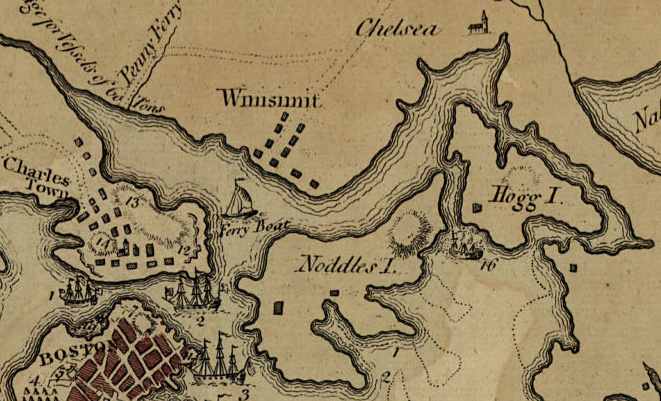
The location of the HMS Diana is marked with “16” on the map
One such resource-rich area was Noddle’s Island and Hog Island both located in Boston Harbor. These islands contained valuable livestock and hay, which the British had been attempting to secure to feed their troops and horses. American intelligence reported that the British were planning to remove these resources, prompting a proactive operation by the colonial forces to beat them to it.
In early May, Dr. Joseph Warren led a group inspecting the islands and recognized their imporance. As part of the Massachusetts Committee of Safety, Warren led the effort for a reslolution to be passed to either capture or destroy the supplies on the islands. On May 14th, the Committee stated “Resolved, as their opinion, that all the live stock be taken from Noddle’s Island and Hog Island, and from that part of Chelsea near the sea coast, and be driven back; and that the execution of this business be committed to the selectmen of the towns of Medford, Malden, Chelsea, and Lynn, and that they be supplied with such a number of men, as they shall need, from the regiments now at Medford.” Soon the commander of the New England army around Boston, General Artemas Ward, put a plan in motion to quickly strike both islands.
The American expedition was led by Colonel John Stark and Colonel Israel Putnam, both future generals in the Continental Army. The colonial forces, primarily composed of New Hampshire and Massachusetts militias, planned a nighttime amphibious raid to remove the livestock and destroy hay supplies that might benefit the British. On the night of May 27, colonial forces quietly moved onto Hog Island and began driving off livestock and burning haystacks. British forces, stationed in Boston and alerted to the colonial activity, responded by dispatching marines and the British schooner HMS Diana, a lightly armed but maneuverable vessel well-suited for operations in the shallow waters of the harbor.
As the colonists worked to transport livestock to the mainland, they encountered resistance from British marines who had landed on Noddle’s Island and began advancing toward their position. A sharp skirmish ensued, during which the American militia used the terrain to their advantage, fighting from behind trees, stone walls, and other natural cover. The colonial forces managed to repel the British marines, inflicting casualties and forcing a retreat.
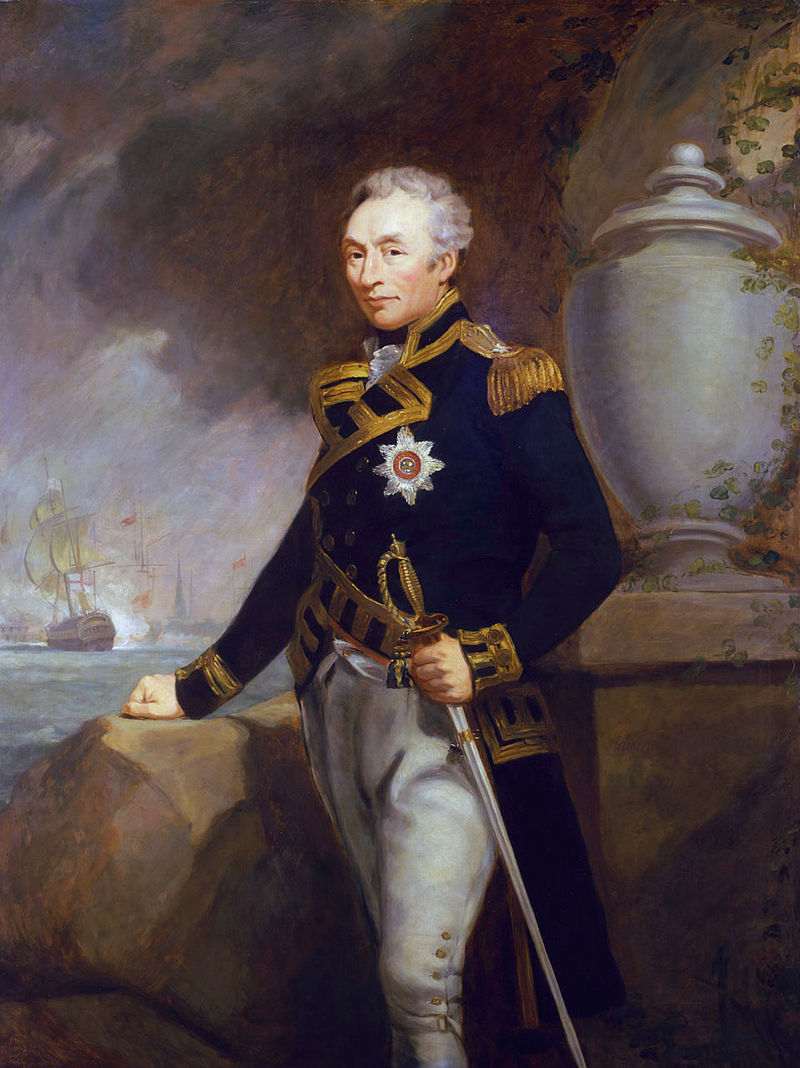
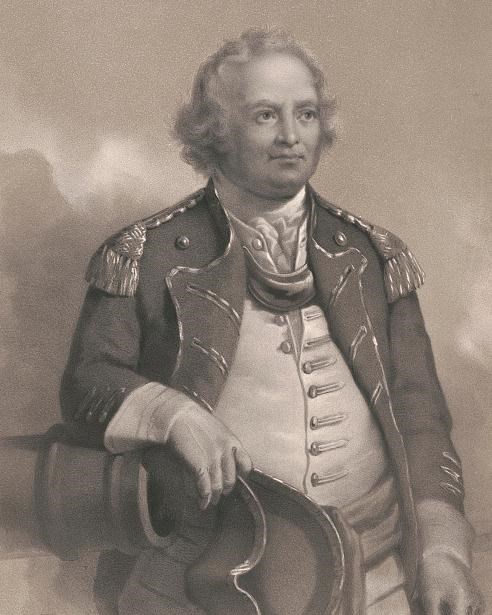
Lieutenant Thomas Graves (nephew of Vice Admiral Samuel Graves) commander of the HMS Diana. Shown in his rear admiral uniform in ca. 1801. Often confused with Lord Thomas Graves, British commander during the Battle of the Capes
The turning point of the engagement came with the involvement of the HMS Diana. The schooner attempted to support the marines by moving up the narrow Chelsea Creek to engage the colonial militia and cut off their withdrawal. However, as the tide receded and the ship ventured too far inland, it became grounded in the shallow, muddy waters.
Seeing an opportunity, the colonists brought up field artillery from shore and opened fire on the stranded vessel. Over the course of the battle, they subjected the Diana to intense musket and cannon fire. Unable to refloat the ship due to the falling tide and increasing colonial pressure, the British crew was forced to abandon it. American forces quickly boarded the vessel, stripped it of usable supplies, weaponry and its 76 foot mast, and then set it ablaze, destroying the schooner completely.
The Battle of Chelsea Creek resulted in a clear American victory, both strategically and psychologically. The destruction of the HMS Diana marked the first loss of a Royal Navy vessel in the Revolutionary War, dealing a symbolic blow to British morale. For the colonists, it was a tangible demonstration of their ability to challenge British authority not only on land but at sea.
Major General Israel Putnam said after the fight on Chelsea Creek “I wish we could have something of this kind to do every day,”
Tactically, the victory helped to solidify American control of the Boston-area islands and limited the British army’s ability to forage for supplies. This contributed to the worsening conditions inside besieged Boston and increased pressure on General Gage. The morale boost for the colonial militias was significant; it reinforced the notion that British troops and naval forces were not invincible and that well-coordinated militia operations could succeed.
In addition, the battle was notable for showcasing early instances of American military ingenuity and leadership. Figures like Israel Putnam and John Stark went on to distinguish themselves in later battles, and the ability of the militia to effectively coordinate a land-sea operation foreshadowed the more sophisticated tactics that would develop over the course of the war. A few months later on August 1st, the mast of the HMS Diana was raised on Prospect Hill as a liberty pole. A symbol that was seen by not just the Americans around Cambridge but also the British in Boston. This location was also where legend states that George Washington ordered the first American flag, the Grand Union, to be raised on January 1, 1776.
While over shadowed by Lexington, Concord, or Bunker Hill, the Battle of Chelsea Creek played a crucial role in the early war. It helped secure the outer perimeter of the Siege of Boston, denied the British critical supplies, and emboldened the colonial cause at a time when confidence was still fragile. The success of the operation, including the destruction of the Diana, offered a dramatic image of colonial resistance and ingenuity that resonated beyond New England.
Today, the location of Noddle’s and Hog Island are gone. Nineteenth century and modern infill has completely reshaped the area from mudflats and tidal marshes to buildable land. Modern day East Boston, Winthrop and Logan Airport cover the area. The community of Somerville contines to commemorate the raising of the Grand Union flag on January 1 Diana‘s mast with a flag raising ceremony. Though mostly forgotten, the fighting along Chelsea Creek continued to embolden men like Joseph Warren and Israel Putnam and encourage their agressiveness a few weeks later on the Charlestown peninsula.
Dr. Joseph Warren is considered by many “the lost hero of the American Revolution.” Warren was the brainchild of the revolution movement in Boston. Warren was involved in almost every major insurrectionary act in the Boston area for a decade, from the Stamp Act protests to the Boston Massacre to the Boston Tea Party, and his incendiary writings included the famous Suffolk Resolves, which helped unite the colonies against Britain and inspired the Declaration of Independence.
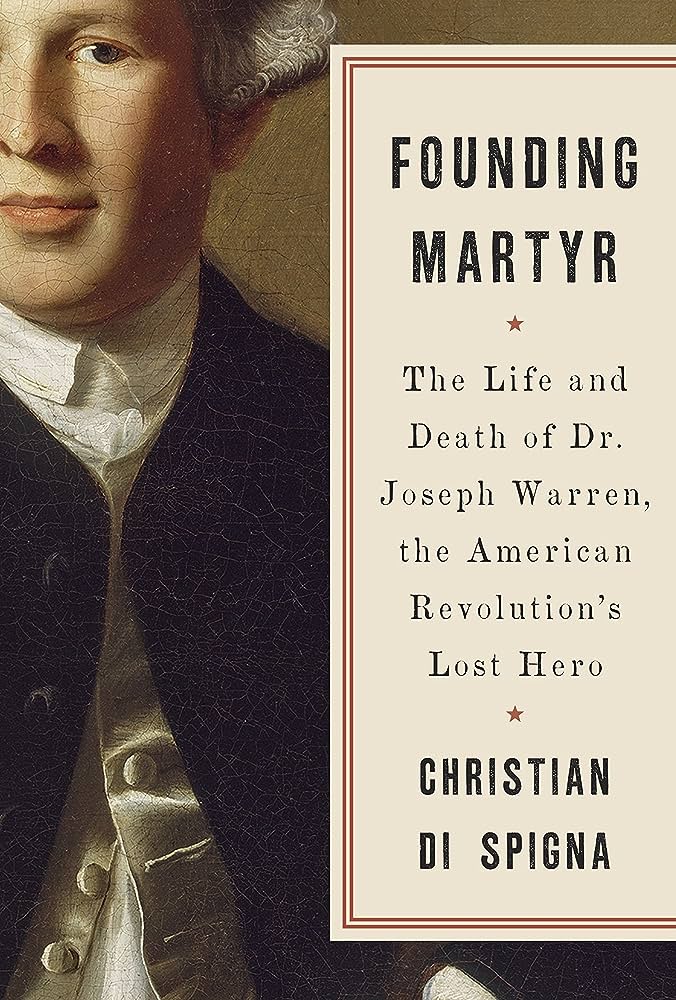
Joining Emerging Revolutionary War will be historian and author Christian Di Spigna. He is the author of Founding Martyr: The Life and Death of Dr. Joseph Warren, the American Revolution’s lost hero. He is the Executive Director of the Dr. Joseph Warren Foundation and is the vice chairman for the Revolution 250 committee of Massachusetts Freemasons. He also serves on the board of the Bunker Hill Monument Association.
As we approach the 250th commemoration of the Boston Tea Party, we will focus on Warren’s life, his role in the Boston Tea Party and his lasting impact on the Revolution. Grab a drink and join us as we talk with author and historian Di Spigna about Warren, the patriot who once said…
“When Liberty is the prize, who would shun the warfare? Who would stoop to waste a coward thought on life?”
See you Sunday at 7 p.m. EDT on Emerging Revolutionary War’s Facebook page!
Our monthly recap of what our good friend and fellow historian Tom Hand has written on his blog, AmericanaCorner.
The Legacy of Paul Revere November 2, 2021
Paul Revere began his famous ride from Boston to Concord, around 11:00pm on April 18, 1775, informing the residents and militiamen that the British were on the march. He arrived in Lexington, a town about 10 miles from Boston, around midnight. Read more here.
Lexington and Concord: Minutemen in Arms November 9, 2021
The Battles of Lexington and Concord, fought on April 19, 1775, marked the start of America’s war for independence from England. The story of that fight is an inspiring account of how everyday Americans came together to resist the power of Great Britain. Read more here.
Lexington and Concord: The Shot Heard Round the World November 16, 2021
The fight between our Minutemen and the British regulars at Lexington was over in a matter of minutes, and the British began the seven-mile march to Concord. By now, reports of the shooting had reached the minutemen in the surrounding area, and they began to assemble. A bad day for the British was about to begin. Read more here.
The Battle of Bunker Hill November 23, 2021
The Battle of Bunker Hill, fought on June 17, 1775, is one of the most iconic and familiar events in American history. It was our first pitched battle against the British army and, although technically a defeat, the efforts of the American militiamen were inspirational. Read more here.
Emerging Revolutionary War welcomes back guest historian Michael Aubrecht
John Trumbull
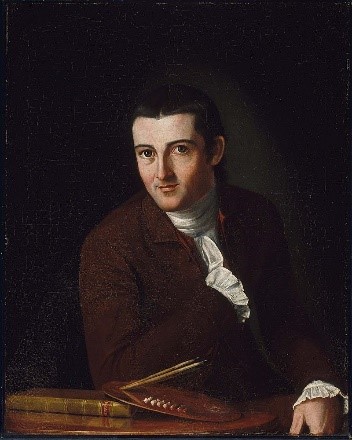
John Trumbull’s paintings represent some of the most familiar depictions from the time of the American Revolution. Trumbull was a graduate of Harvard University and the gifted son of the Governor of Connecticut. As a child, Trumbull showed a remarkable talent for an attention to detail. This aptitude set his drawings apart from his contemporaries. Trumbull traveled to London in 1784 to study painting under the master Benjamin West. It was then that he started painting some of his most notable pieces. There he honed his expertise for realistic painting. A year later later Trumbull traveled to the City of Paris to do commissioned artworks. He later did portraits of George Washington, John Adams, Alexander Hamilton and Thomas Jefferson. In 1816, he was selected as the president of the American Academy of the Fine Arts where he would serve for 20 years. Emphasizing classic traditions Trumbull attempted to teach the skills he had acquired while overseas. Following his death in 1843 at the age of 87, Trumbull was buried beneath the Art Gallery at Yale University which he had designed. In 1867, his collection of artworks were displayed at the Street Hall building on the same grounds. He and his wife’s remains were later re-interred and buried on the grounds of that building. Trumbull’s approach to painting has been studied by art students around the world. Today Trumbull’s paintings remain some of the most cherished ever to be painted by an American artist. Continue reading “The Brush of John Trumbull”→
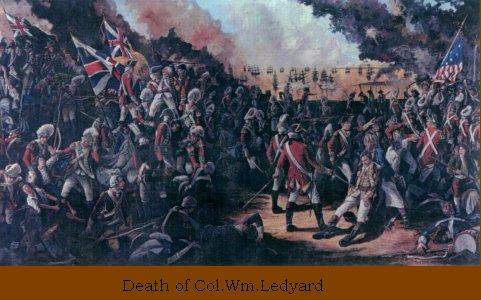
With British soldiers pouring into the fort, Colonel Ledyard ordered a ceasefire, and prepared to surrender Fort Griswold to the victorious British. However, the British disregarded the ceasefire and continuing pouring fire into the American garrison, killing or wounding nearly all of the fort’s defenders. “I believe there was not less than five or six hundred men of the enemy on the parade in the fort,” claimed American soldier Rufus Avery. “They killed and wounded nearly every man in the fort as quick as they could.”
Maj. Stephen Bromfield, the ranking British officer after Montgomery fell, called out, “Who commands this fort?” Ledyard stepped forward and responded, “I did, sir, but you do now.” Another American, Jonathan Rathbun, watched Bromfield run Ledyard through the heart and lungs with Ledyard’s own sword:
“…the wretch who murdered him [Ledyard], exclaimed, as he came near, “Who commands this fort?” Ledyard handsomely replied, “I did, but you do now,” at the same
moment handing him his sword, which the unfeeling villain buried in his breast! Oh, the
hellish spite and madness of a man that will murder a reasonable and noble-hearted officer, in the act of submitting and surrendering!”
Emerging Revolutionary War welcomes back guest historian Katie Turner Getty.
Towering over Charlestown, Massachusetts, its foundation set in sacred battleground soil, the Bunker Hill Monument is a 221 foot obelisk commemorating the Battle of Bunker Hill. The cornerstone of the monument was laid by the Marquis De Lafayette in 1825, fifty years after the battle was fought on June 17, 1775.
Bunker Hill Monument (author collection)
Although the land surrounding the monument has been greatly developed since the battle, visitors today can get still get a sense of the 18th-century landscape just by walking through Charlestown and climbing the hill to reach Monument Square. Approaching visitors are greeted by the statue of Colonel William Prescott, the gray granite of the monument serving as an impressive backdrop behind him. Continue reading “ERW Weekender: Bunker Hill Monument & Museum”→
Revolutionary War Wednesday and Emerging Revolutionary War is pleased to welcome guest historian Mark Maloy this week.
African-Americans fought for the Americans during the Revolutionary War, right? Many of us remember learning about Crispus Attucks dying during the Boston Massacre or have heard the oft-repeated saying that the Continental Army was the last integrated American army until the Korean War.
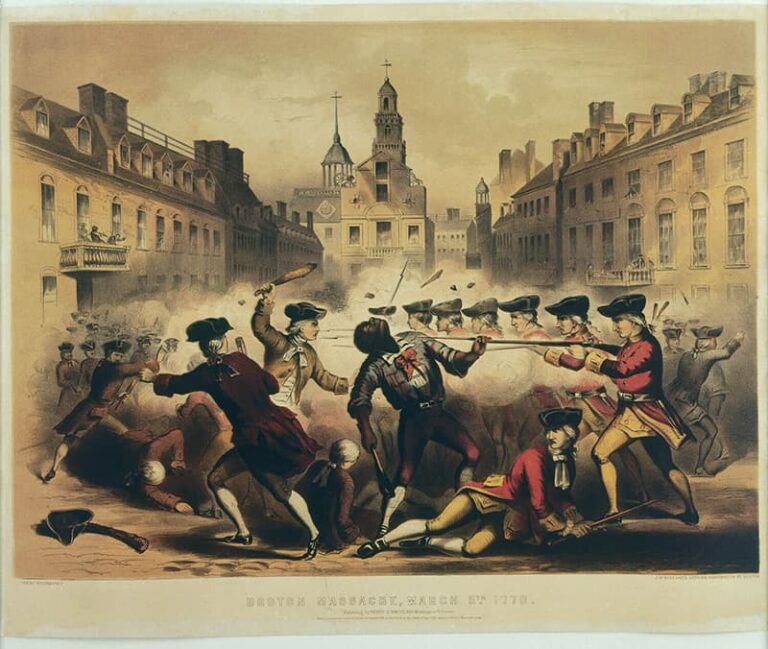
In this lithograph published in 1855, Crispus Attucks is portrayed front and center. Crispus Attucks was lauded as the first martyr in the War for Independence much from the insistence of abolitionists like William C. Nell. A Crispus Attucks Day was created in Boston in 1858 and a memorial placed for him and the other victims on Boston Common after the Civil War. Despite all this, according to John Adams (who defended the British soldiers in court), Attucks was a rabble-rouser who actually helped precipitate the massacre.




 Revolutionary War Wednesday and Emerging Revolutionary War is pleased to welcome guest historian Mark Maloy this week.
 Emerging Revolutionary War Era