250 Years Ago: The Boston Massacre Oration: March 6, 1775

“To-morrow an oration is to be delivered by Dr. [Joseph] Warren,” Samuel Adams wrote on March 5, 1775, the fifth anniversary of the infamous Boston Massacre. “It was thought best to have an experienced officer in the political field on this occasion, as we may possibly be attacked in our trenches.”

Around every anniversary of the Boston Massacre, the people of the city and surrounding countryside sat to reflect on the events of that frigid March night and the current situation between themselves and their mother country. Chosen to deliver the 1775 commemorative oration, his second time doing so, was one of Boston’s most prominent physicians and chairman of the committee of safety, Dr. Joseph Warren. Because March 5 fell on a Sunday, the event was held the following day.
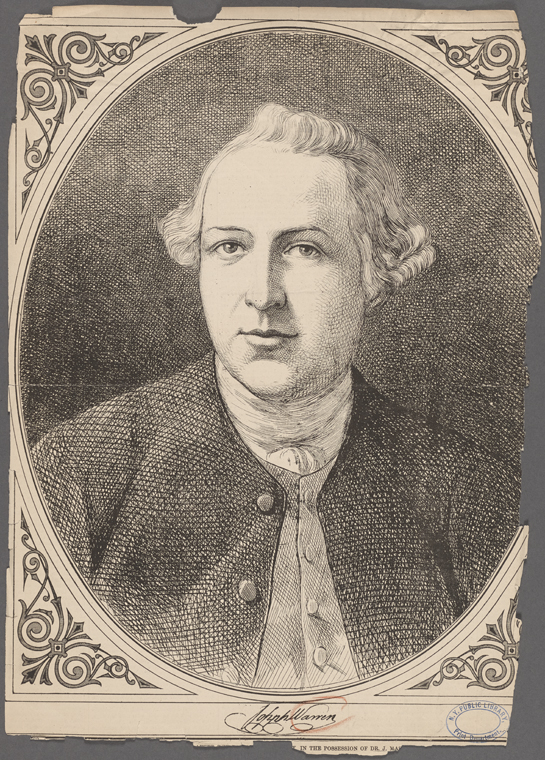
Dr. Joseph Warren. NYPL.

Warren was known to be a passionate and fiery speaker, able to invoke the raw emotion necessary to drive his listeners to action. The political climate surrounding that year’s event was never more incendiary. While no one could have known it at the time, though many anxiously anticipated something coming, the first shots of the Revolutionary War at Lexington and Concord were only a little more than a month in the future. The events on March 6 within the walls of the Old South Meeting House did nothing to ease those anxieties.

Accounts vary on the numbers and makeup of the attendees, but thousands flocked to the commemoration, including a large group of British Army officers garrisoned in the city. The presence of His Majesty’s soldiers was a sure sign that the building would be thick with rigid tension. The sight of the scarlet-coated men seated and standing around the pulpit did not deter the organizers. John Adams showed civility towards the officers, while his cousin Samuel saw an opportunity to enflame sentiments.

Old South Meeting House, Boston, MA. Courtesy of Robert Orrison.

Dr. Warren, 33 years old in March 1775, took the stage garbed in a toga, a symbol of the free men of Rome. His oration only touched upon the events five years prior, but the remainder oozed with patriotic fervor and a call to resist Great Britain’s rule until grievances were met. “I mourn over my bleeding country,” Warren lamented. “With them I weep at her distress, and with them deeply resent the many injuries she has received from the hands of cruel and unreasonable men.” As if a premonition of his own demise in battle at Bunker Hill several months later, he declared, “Our liberty must be preserved. It is far dearer than life.” The speech in its entirety can be read here.

Met with some low hisses and sighs of disapproval from the front rows, Warren’s oration was nonetheless received with emotion and the admiration of his fellow colonists. It was not until he stepped down from the pulpit that pandemonium began to ensue. Samuel Adams rose to appoint a speaker for next year’s commemoration. In doing so he also took the opportunity to reinforce the belief that the events on March 5, 1770 were not an accident, but a “Bloody Massacre.” Even Warren had refused to use this rhetoric. In response, the British officers began to jeer, shouting “Fie! Fie!” and “To Shame!” The already uneasy crowd mistook the shouts as “Fire! Fire!” and many began rushing for the windows, scrambling down the outside gutters and walls. As if this was not enough, the 43rd Regiment of Foot, returning from exercise, happened to be marching by with fife and drum. Their presence threw the crowd “into the utmost consternation,” who may have believed another “bloody massacre” was about to unfold.

Cooler heads prevailed, and any serious confrontation was avoided. Had it not been, one officer attested that it “wou’d in all probability have proved fatal to [John] Hancock, Adams, and Warren, and the rest of those Villains, as they were all up in the Pulpit together.”

March 6, 1775, proved to be another example of the swiftly deteriorating climate in Massachusetts. The influence of the “rebel” leaders continued to grow, while the image of a tyrannical monarch and his blood-thirsty soldiers was reinforced. Open hostilities seemed inevitable. Any day could bring bloodshed. As history exited the Old South Meeting House that day, it continued its accelerated journey down the road from Boston and on to Lexington Green.

Alcohol in the American Revolution

Emerging Revolutionary War welcomes guest historian, Nathaniel Parry, a brief bio follows this post.

The American Revolution was a victory of liberty over tyranny made possible by a mixture of courage, grit, and virtue. It was also, however, a morally ambiguous affair with some of the main participants motivated as much by ambition as they were by idealism. While many of the founding generation prided themselves on their virtue, vice also played an important role in their rebellion against the British, and to fully appreciate this reality, it is useful to examine the role of alcohol, which turns up at many of the revolution’s key moments.

In ways sometimes subtle and often quite important, alcohol provided the impetus for the nation’s founding, belying the pristine image of an honorable rebellion of virtuous patriots against liberty-hating tyrants. From John Hancock celebrating the repeal of the Stamp Act in 1766 by “treat[ing] the Populace with a Pipe of Madeira Wine,” as one newspaper reported,[i] to militiamen wetting their whistles at Buckman Tavern before the Battle of Lexington and Concord,[ii] to General George Washington ordering “an extra ration of liquor to be issued to every man”[iii] in celebration of Britain’s recognition of America’s independence in 1783, alcohol pops up again and again during the revolutionary era. This was a reflection of the fact that drinking was an integral part of daily life in early America.     

John Hancock and the Liberty Affair

With heavy drinking habits widespread among all classes and regions, the rum distillery industry flourished in the colonies, made possible by cheap imports of molasses from the West Indies. By one count, there were more than 150 rum distilleries in New England before the revolution, and throughout the colonies some five million gallons of rum were being produced.[iv] In order to ensure access to the cheapest molasses available and to bypass restrictive English regulations such as the Navigation Acts and 1733 Molasses Act, smuggling became rampant in the colonies, a problem that Parliament sought to address with the adoption of the Sugar Act in 1764. An attempt to crack down on smuggling and increase revenue, the Sugar Act had the effect of increasing the price of manufacturing rum and negatively affected the exporting capacity of New England distillers, leading to consternation among merchants. It also heavily taxed the formerly duty-free wine from Madeira, Portugal, which was popular throughout the colonies. This angered both merchants and consumers.[v]

Continue reading “Alcohol in the American Revolution”

Why Tea? Events Leading up to the Boston Tea Party

As we move towards to the 250th anniversary of the Boston Tea Party, we at ERW have gotten a lot of questions with a central theme…” why was it tea that led to revolution?” Was tea so central to colonial life that it was worth risking war or was it something else? The answer is somewhere in the middle and as with most history, there is nuance to the story (and yes, tea WAS a big part of everyday live in British America).

On May 10, 1773, Parliament passed the Tea Act, this act was a way for the British government to help bail out a major corporation, the British East India Company. The British East India Company was one of the largest global companies and faced immense debt and financial trouble. Furthering their troubles, they held a large amount of tea stored in warehouses in London. The British East India Company sought a way to offload this tea, which was considered some of the best tea in the world. The company’s success was directly tied to Great Britain’s international strategy, as the company spread British influence across the globe especially in India where they basically managed the British colony. The Tea Act reduced the cost on the tea (cutting out the “middleman” in Great Britain), and now the colonists could buy the tea directly from the British East India Company.

The British colonies in North America consumed on average of 1.2 million pounds of black tea annually. In 1773, about 1/3 of the population drank tea at least twice a day. It was a common luxury among most middle- and upper-class colonists. They preferred black tea but also drank green tea. Black tea varieties included Bohea, Congou and Souchong and common green tea varieties included Singlo and Hyson. All the tea that the British East India Company sold was grown and imported from China. Tea from China was preferred by most for better flavor, but it tended to be more expensive. The North American colonies consumed a lot of smuggled tea from the Dutch, the quality of the tea was not the same but much cheaper. A large market grew for smuggled tea with most British port officials looking the other way. All of this changed when the Tea Act was passed.

Nineteenthcentury lithograph depicting a tea plantation in Qing China 

Many in Parliament believed the colonists would have little opposition to this new act. They could now purchase their preferred tea for a cheaper price than the smuggled tea from the Netherlands. Unfortunately for Royal leaders, this was not the case. As word reached the colonies Whig leaders such as Samuel Adams called it nothing more than a British authorized monopoly of the tea market, cutting into the pockets of colonial merchants (though their tea smuggling business was illegal to begin with). The Tea Act also highlighted a British policy that the colonists opposed for many years, the Townshend Acts. The Townshend Acts imposed duties on imported lead, glass, paper, paint, and tea. This “tax” was payable at ports and funded the salaries of colonial judges, governors, and other government officials. This angered many colonial leaders for two reasons. First, it levied another tax on the colonists without having their own representation in Parliament. Secondly, it made the government officials more beholden to the British government (and the tax) than the colonial governments.

Whig groups like the Sons of Liberty used local taverns as places for their meetings. The most famous being the Green Dragon Tavern in Boston. It no longer stands today.

As the news of the Tea Act reached the colonies, the reaction was mixed. Whig leaders in major cities such as Charleston, New York, Philadelphia and Boston saw it as a way to reinvigorate their cause of opposing British rule. Recently things were mostly quiet with little interest by the public for protest. But now the Whig spin machine went into full affect. The Tea Act was a direct affront to colonial self-rule and economic interest. The taxes paid for the tea went to British officials in the colonies and the cheaper priced (and better quality) tea would put many American merchants out of business. Whigs were able to control the message that the Tea Act was just another way for Parliament to make money off the colonists, who did not have representation in Parliament.

As part of the Tea Act, consignees were appointed to oversee the sale of tea and the collection of the taxes on behalf of the British East India Company. As the tea began to arrive in colonial ports, public pressure was put on consignees to resign. This pressure was successful in New York, Philadelphia and in Charleston. Each of these cities were able to either stop the tea from being offloaded or, as in the case of Charleston, they confiscated the tea and didn’t allow any duties to be paid on it. All of these were direct affronts to the law but the events in Boston proved to be the most dramatic.

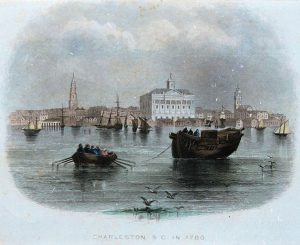
Ca, 1780 view of Charleston Harbor, and the Exchange Building where the confiscated tea was locked away by Whig leaders.

Unlike in other port cities, the consignees in Boston refused to resign. Richard Clarke, leading merchant in Boston and one of consignees faced a mob at his warehouse trying to pressure him and the other consignees to resign. Encouraged by the Massachusetts Governor Thomas Hutchinson (who had two sons serving as tea consignees) to stand their ground, the consignees refused to resign. Soon news arrived that the first ship carrying the tea, the Dartmouth, was arriving in Boston soon.

Hosting several town meetings, some hosting thousands of people, Whig leaders such as Samuel Adams, Dr. Joseph Warren and John Hancock were able to organize a strong opposition to the tea. Of course, Boston was already a tinderbox due to the “Boston Massacre” in 1770 and the large contingent of British regular troops stationed in Boston. Bostonians were reminded daily of Royal influence. The Whigs protested to the Governor to order the ships to return to England, but Hutchinson refused to do so and claimed he didn’t have that authority. Many historians believed Hutchinson, who recently had resigned as Governor and was awaiting his replacement, had grown tired and frustrated with the likes of the Whigs and Sons of Liberty in Boston and was trying to press the issue.

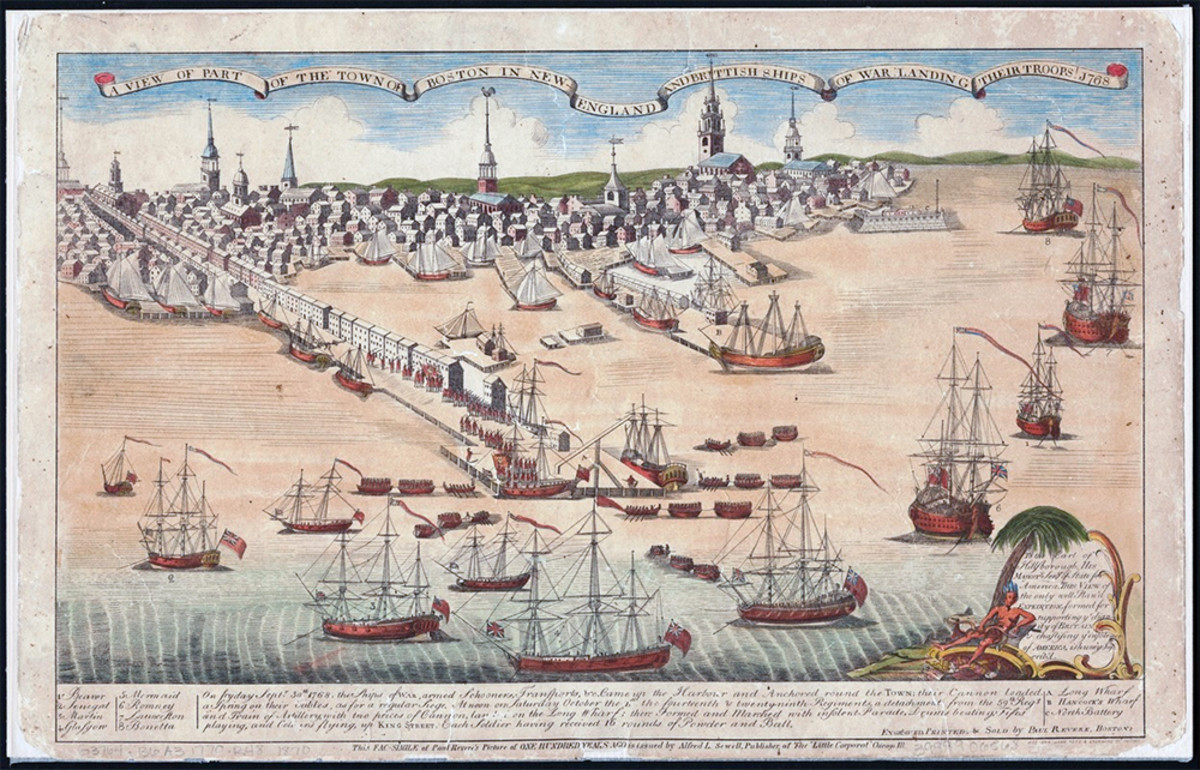
On November 28, the Dartmouth arrived in Boston Harbor. Captain James Hall was turned away at the first wharf he sailed too and was redirected to Griffins Wharf. Everyone knew that once a ship entered the harbor, the captain had twenty days to unload the cargo and pay the custom duties. Soon two more ships arrived at Griffins Wharf with more tea. With the Governor refusing to allow the ships to leave the harbor and local patrols watching the ships to make sure the tea was not offloaded, the stage was set for December 16th, the last day the ship’s captains had to unload their cargo.

Rev War Revelry: Old South Meeting House and the Boston Tea Party

Join us this Sunday, October 15th at 7pm as we welcome Matthew Wilding, Director of Education and Interpretation at Revolutionary Spaces. Revolutionary Spaces manages the Old South Meeting House and the Old State House in historic Boston. We will discuss the history of the Old South Meeting House and its important role in the revolutionary movement in Boston (especially during the Boston Tea Party). We will also cover their plans for the 250th anniversary of the Boston Tea Party, including their new exhibit on the destruction of property in public protests.

Grab a drink and follow along as we start to gear up for the 250th anniversary of the Boston Tea Party with Emerging Revolutionary War!

Reading Sam Adams…part 2

My recent comments about Stacy Schiff’s The Revolutionary Samuel Adams got me thinking about some of John Adams’s thoughts about his second cousin. In particular, John shared a neat story about Sam’s secretiveness—a problem that has bedeviled biographers, including Schiff, because Sam didn’t leave behind a trove of documentary evidence the way other Founders did.

“I have seen him . . .” said John, “in Philadelphia, when he was about to leave Congress, cut up with his scissors whole bundles of letters, into atoms that could never be reunited, and throw them out at the window, to be scattered by the winds. This was in summer, when he had no fire. In winter he threw whole handfuls into the fire. As we were on terms of perfect intimacy, I have joked him, perhaps rudely, upon his anxious caution. His answer was, ‘Whatever becomes of me, my friends shall never suffer by my negligence.’”[1]

John admired Sam, 13 years his senior, a great deal. The two were hardly acquainted growing up, but as John started off his legal career in Boston, Sam—a great cultivator of talent—pegged him as someone to develop. As tensions in Boston grew between the Sons of Liberty, British officials, and far-off Parliament, Sam brought John into the inner circle because of John’s sharp legal mind. The decision paved John’s eventual path to national politics.

“Mr. Adams was an original,” John said of Sam, saying he was “born and tempered a wedge of steel. . . .”[2]

In his common appearance, he was a plain, simple, decent citizen, of middling stature, dress and manners. He had an exquisite ear for music, and a charming voice, when he pleased to exert it.—Yet his ordinary speeches in town meetings, in the house of representatives and in congress, exhibited nothing extraordinary; but upon great occasions, when his deeper feelings were excited, he erected himself, or rather nature seemed to erect him, without the smallest symptom of affectation, into an upright dignity of figure and gesture, and gave a harmony to his voice, which made a strong impression on spectators and auditors, the more lasting for the purity, correctness and nervous elegance of his style.[3]

John spoke on several occasions of Sam’s “an air of dignity and majesty.” He admired Sam’s “harmonious voice and decisive tone” and his “self-recollection, a self-possession, a self-command, a presence of mind that was admired by every man present. . . .”[4] He also listed “his caution, his discretion, his ingenuity, his sagacity, his self-command, his presence of mind, and his intrepidity” as traits that “commanded the admiration” of friend and foe alike—friends who applauded him and foes who could not help but respect Sam Adams’s considerable populist powers.[5]

It is little doubt why John later said, “Without the character of Samuel Adams, the true history of the American Revolution can never be written.”[6]


[1] “From John Adams to William Tudor, Sr., 5 June 1813,” Founders Online, National Archives, https://founders.archives.gov/documents/Adams/99-02-02-6054. 

[2] “From John Adams to William Tudor, Sr., 5 June 1813,” Founders Online, National Archives, https://founders.archives.gov/documents/Adams/99-02-02-6054. 

[3] “From John Adams to William Tudor, Sr., 15 April 1818,” Founders Online, National Archives, https://founders.archives.gov/documents/Adams/99-02-02-6883.

[4] “From John Adams to William Tudor, Sr., 15 April 1818,” Founders Online, National Archives, https://founders.archives.gov/documents/Adams/99-02-02-6883.

[5] “From John Adams to Jedidiah Morse, 1 January 1816,” Founders Online, National Archives, https://founders.archives.gov/documents/Adams/99-02-02-6563. 

[6] “From John Adams to William Tudor, Sr., 15 April 1818,” Founders Online, National Archives, https://founders.archives.gov/documents/Adams/99-02-02-6883.

Review: Founding Martyr, The Life and Death of Dr. Joseph Warren, the American Revolution’s Lost Hero by Christian Di Spigna

ERW Book Reviews (1)

Doctor. Major General. President of the Provincial Congress. Author of political tracts. A true patriot. Forgotten.

41mPwaMUWfL._SX336_BO1,204,203,200_All these words, plus many more, are titles that depict the life of Dr. Joseph Warren. However, the last term is most synonymous with the Massachusetts doctor who fell in the Battle of Bunker Hill on June 17, 1775 in the early stages of the American Revolutionary War. That last word, forgotten, is exactly what author and historian Christian Di Spigna is hoping to expunge with his new biography, Founding Martyr. 
Di Spigna, an early American history expert and Colonial Williamsburg volunteer, focuses his account of Dr. Warren on not the events immediately surrounding his death at Bunker Hill and subsequent martyrdom but “to fill in the more obscure parts of Warren’s life” which will lead to understanding more of the “key period in the formation of his character, his special networks, and ultimately his medical and political careers” (pg. 7). Continue reading “Review: Founding Martyr, The Life and Death of Dr. Joseph Warren, the American Revolution’s Lost Hero by Christian Di Spigna”

Six Signing Signers

Part One of Six

On August 2, 1776, in Philadelphia, Pennsylvania, the majority of the 56 men who would forever be known as the “Signers of the Declaration of Independence” placed quill to ink and affixed their signature.

On September 17, 1787, the men who persevered, haggled, and agreed on the United States Constitution, dipped a quill into ink and placed their signatures on that famous document.

If one looks closely and reads the names of the signers, six gentlemen’s names would appear on both documents. If one hazarded a quick guess, Thomas Jefferson, John Hancock, John or Samuel Adams, George Washington, and Benjamin Franklin would most likely be the first names to spill off the tongue.

Only one of those names would be correct; Benjamin Franklin. This post, the first in the series, will shed light on whose these men were, who had the great fortune–or luck?–to sign both famous political documents. The first of the “Six Signing Signers” is…..

29aa0f03f572a6bf876557dca1c4db16

George Clymer. Continue reading “Six Signing Signers”

Immediate: Concord (MA) Museum Signs Historic Agreement to Operate the Wright Tavern

On Wednesday, June 8, a signing ceremony marked the beginning of an agreement between First Parish in Concord, owner of the Wright Tavern, and the Concord Museum. Starting this fall, the Concord Museum will provide educational programming to school groups in the Wright Tavern and open the historic building to the public for commemorative events in October and April each year. On hand for the signing were representatives of the Concord Museum and First Parish as well as members of the Wright Tavern Exploratory Committee (WTEC), appointed last fall to develop a sustainable, strategic plan to showcase the Wright Tavern as a National Historic Landmark.

IMG_0075
Plaque on the Wright Tavern (ERW collection photo)

“Opening the historic Wright Tavern to public and educational access will provide a true sense of place when learning about the historical events of the American Revolution,” said Mel Bernstein, member of WTEC and Chairman of the American Revolution Round Table of the Minute Man National Historical Park.

No building in this historic community was of greater consequence to the beginnings of the American Revolution than the Wright Tavern, built in 1747. The First Provincial Congress met in Concord at the Wright Tavern in October 1774, electing John Hancock as the Congress’s president and making provision for the collection of taxes. The Second Provincial Congress met there again in March and April 1775. Presided over by John Hancock with Samuel Adams and Dr. Joseph Warren in attendance, the Provincial Congress met in defiance of Royal and Parliamentary authority — creating a Massachusetts army, raising taxes, and performing other roles necessary to form its own government, independent of British authority.  Then, in the early hours of April 19, 1775, Concord’s Minute Men assembled in the Wright Tavern before setting off to repel the advancing British troops at the North Bridge.

Since 1886, First Parish in Concord has owned and maintained this historic structure. “The Wright Tavern is certainly one of the most important Revolutionary War-era buildings in Concord,” explained Tim Jacoby, Chair of the First Parish Trustees of Parish Donations. “Although the building is owned by the church, we truly feel it belongs to the people of Concord and to the American people. This agreement with the Concord Museum will establish greater public accessibility to the Tavern.”

In 1961, the Wright Tavern was designated a National Historic Landmark by U.S. Secretary Fred Seaton, declaring it “an historical site of exceptional value in commemorating and illustrating the history of the United States.”

Margaret Burke, Executive Director of the Concord Museum, said: “The Museum is thrilled with this partnership to bring the importance of the Wright Tavern to the fore. Concord is home to invaluable historical and cultural resources, and this is a wonderful example of how organizations within the town are working together to promote this history and make it relevant to residents and visitors.”

Leah Walczak, the Concord Museum’s Director of Education and Public Programs, explained the role the Wright Tavern will play in educating visiting school groups:  “The Museum currently provides specialized programming to over 10,000 school children each year. Along with hands-on history education using objects from the Museum’s collections, this agreement will allow us to provide programs within the setting of one of the finest historic buildings in Concord.”

This partnership was brought about through the work of the Wright Tavern Exploratory Committee, which convened from September 2015 through January 2016.  Members included:  John Boynton, Chair of the Exploratory Committee and a First Parish Trustee; Doug Baker, Sacristan and Curator of First Parish; Mel Bernstein, Chair of the American Revolution Round Table of Minute Man National Historical Park; Jim Cunningham, Project Manager for Barrett Farm Restoration, and Treasurer of Save Our Heritage; Sue Gladstone, Director of Development for the Concord Museum; Jayne Gordon, Public Historian for Robbins House, Thoreau Farm, and the Concord Museum; Tim Jacoby, Chair of the First Parish Trustees; Bob Morris, Chair of the Friends of Minute Man National Historical Park; and Tom Wilson, First Parish Treasurer.

A generous gift to the Museum from John and Johanna Boynton is funding this historic partnership.

*About the Concord Museum
The Concord Museum is where all of Concord’s remarkable past is brought to life through an inspiring collection of historical, literary, and decorative arts treasures.  Renowned for the 1775 Revere lantern and Henry Thoreau’s Walden desk, the Concord Museum is home to a nationally significant collection of American decorative arts, including clocks, furniture, and silver. Founded in 1886, the Museum is a gateway to historic Concord for visitors from around the world and a vital cultural resource for the town and the region.  Visit www.concordmuseum.org.*

*For More Information, contact:

Barbara Rhines, Director of Marketing and Public Relations
978-369-9763, ext. 229
Email: brhines@concordmuseum.org

Committees of Correspondence = 18th Century Social Media?

RevWarWednesdays-header

Information. Communication. Solidarity. Linkage. Friendship. Point-of-view. Identity. Current Events.

These words describe reasons in the 20th century why people joined and continue to join social media platforms, especially Facebook.

Approximately 240 years before Facebook was launched in February 2004, the first major attempt at achieving all the proponents above was the job function of the various Committees of Correspondence established in the thirteen American Colonies. Continue reading “Committees of Correspondence = 18th Century Social Media?”