Evacuation Day

Emerging Revolutionary War welcomes guest historian Christopher of The British-American Historian blog.

Almost two years after debating a joint French-American assailment of Lord Cornwallis’ precarious position in Yorktown, Virginia over Washington’s grand plan to recapture New York long after being swept from the city and its environs as independence was officially declared in 1776, the implacable Washington prepared to reenter New York in triumph.

Eight years after making New York the center of the British war effort in the American Revolution, the massive garrison was greatly reduced and preparing for its final retirement from the new nation. The new commander in chief of North America, Sir Guy Carleton, arrived in New York on May 5, 1782[1] to relieve Sir Henry Clinton. Carleton won accolades for holding Quebec City when the Continental Army struck during a late night blizzard, an accomplishment that was all the more vaunted now that the British were losing territory that did not include Canada. Carleton lost no time in notifying Washington of his arrival in an affable letter sent on May 7th, 1782 in which Carleton wrote “if the like pacific disposition should prevail in this country, both my inclination and duty will lead me to meet it with the most zealous concurrence”[2].

A notable disruption in the growing amity was the unresolved Asgill Affair. Exasperated with wanton assailments of loyalists in New Jersey, a prominent rebel militia commander named Joshua Huddy was plucked from the provost in New York by an American member of the Associated Loyalists[3]. The Associated Loyalists were presided over by William Franklin, the loyalist son of Benjamin who had endured arduous captivity before being exchanged[4]. In response to the wanton execution of Joshua Huddy, Washington ordered a British officer to await reprise. Charles Asgill was selected, but pleas from the French along with Washington’s honorable disposition prevailed and the captain was spared[5].

 The city and Long Island were swarming with thousands of loyal “Refugees” who had fled from every rebellious colony to seek the king’s protection. Ranging from itinerant tenant farmers to some of the largest landlords in America such as Beverly Robinson and Frederick Philipse, Carleton’s task of evacuating the troops could not be fulfilled until such persons were safely resettled in the empire. While many of the men joined provincial regiments that saw combat in the south (playing a pivotal role defending Savannah and being routed at Kings Mountain) and performed prodigious woodcutting on Lloyd Neck for the insatiable demand for firewood[6]flocks of women and children crowded the city. A subset of the refugees were former slaves who had flocked to the British cause for the promise of freedom under Dunmore’s Proclamation and the Philipsburg Proclamation, a promise Washington would vigorously contest in negotiations.

Continue reading “Evacuation Day”

2022 Symposium Speaker Spotlight: Kate Egner Gruber

We are happy to welcome Kate Egner Gruber to our Third Annual Symposium on the American Revolution, co-hosted with Gadsby’s Tavern Museum, The Lyceum and Emerging Revolutionary War. This year’s theme is “The World Turned Upside: The American Revolution’s Impact on a Global Scale. We asked Kate to answer a few questions about their talk and their passion for history.

Kate Egner Gruber is the acting director of curatorial services for the Jamestown-Yorktown Foundation, where she works with a team to grow the collection and broaden the interpretation of early American history at Jamestown Settlement and the American Revolution Museum at Yorktown. Kate is a graduate of the University of Mary Washington’s Historic Preservation program, where she focused on archaeology and material culture, and holds her masters degree in early American history from the College of William and Mary.

What first attracted you to the study of early American history? What keeps you involved in the study of this history? Do you find these things are the same or different?   

I never know how to answer this question. The past has always been a presence in my life—whether I was digging up holes in my mom’s backyard looking for buried treasure (sorry, Mom), enthralled with the stories behind the old things in my grandmother’s upstairs room, or lost in my imagination about the landscape I called home.

I like to say that history doesn’t change—but our relationship to it does. This is what keeps me involved in the study of history of today. There’s always something new to learn, new perspectives to consider, new lenses through which to view the past. This is what keeps me motivated and eager to keep diving in.

Why do you think it is important for us to study the Revolutionary Era?  

What we learn about the past helps us better understand our present and create a more perfect union for the future.

What do you think was the most significant foreign impact on the American Revolution? 

As someone who studies both 17th and 18th century history, my perspective on this question is flipped—I think the most significant impact on the American Revolution was the colonies’ shared 17th history in the growing English and (later) British empire.

What are some of the important lessons of the American Revolution do you think are still relevant today?

From England’s Glorious Revolution to America’s Glorious Cause, we’re still negotiating our rights to life, liberty, and the pursuit of happiness—or in the words of John Locke, life, liberty, and property!

What was it about the American Revolution that elicited such global interest

Some of the founders saw their American Revolution through the lens of the English Civil Wars and Glorious Revolution, all of which had global consequences. The American Revolution isn’t just American history—it’s world history! 

Join us for our Third annual Emerging Revolutionary War Symposium on September 24, 2022. Emerging Revolutionary War is excited to continue our partnership with Gadsby’s Tavern Museum and The Lyceum of Alexandria, VA to bring to you a day-long Symposium focusing on the American Revolution.

Registration fee is now only $60 per person and $50 for OHA members and students. If you feel more comfortable attending virtually, the fee is $30. To register visit: https://shop.alexandriava.gov/EventPurchase.aspx

Artistic License and the French Artillery Park at Yorktown, A Case Study

Emerging Revolutionary War welcomes back guest historian Karl G. Elsea

It is common for artists to use “artistic license” when painting historic events including American Revolutionary War art. The problem is this practice also

aids inaccuracies persisting. Here is one case study of one picture involving an historic event that is presented by the National Park Service (NPS) at Yorktown. Please note the staff is helpful and the grounds are beautiful. As for the severity of the problem, the reader can decide after reading the information.

The following picture is from the field at Yorktown where the French Artillery Park was located. The picture illustrates the idea of what an artillery park was.

The problem is this picture contains a number of images that are wrong. For example, the carriages, wagons, carts, and limbers should be painted light blue. The French Army artillery had been painted light blue prior to 1750. There is a lot of confusion to this day concerning gun and limber carriage colors. This confusion may have been generated by a current belief there was one French artillery color. The French used the color of the items to assist which department owned the material. The French Navy department [Ministry of Marine] was responsible for the colonies, including North America, and their cannon were on red carriages with, in all most all cases, iron barrels. The French Quartermaster’s department had their wagons were painted a brighter red. The French Army artillery was painted light blue with bronze barrels. Thus, the French Army barrels shown should appear to be “brass.”

Continue reading “Artistic License and the French Artillery Park at Yorktown, A Case Study”

Review: To The End of the World, Nathaniel Greene, Charles Cornwallis, and the Race to the Dan by Andrew Waters

Writing over thirty years after the fact, Henry “Light Horse Harry” Lee summed up the events of February 14, 1780 with the line, “Thus ended, on the night of the 14th of February, this long, arduous, and eventful retreat” (190). Upon hearing of General Nathanael Greene’s exploits in this movement, General George Washington wrote, “You may be assured that your Retreat before Lord Cornwallis is highly applauded by all Ranks and reflects much honor on your military Abilities.” (198).

What Lee would remember as “eventful” and Washington and fellow military ranks “highly applauded” is remembered today as the “Race to the Dan.” This retrograde movement, undertaken by Greene’s forces from South Carolina to the Dan River in southern Virginia, is sandwiched between the engagements at the Battle of Cowpens in January 1781 and the British pyrrhic victory at Guilford Court House in March 1781. Yet, this retreat may be on the turning points in the southern theater that led the British, under Lord Charles Cornwallis to his eventual demise at Yorktown in October 1781.

Great historians, such as John Buchanan is his monumental work The Road to Guilford Court House have covered with broad strokes this period of time but a dedicated study was much needed in the historiography of the American Revolution. Insert Andrew Waters, writer, editor, and conservationist, whose name may be familiar from previous works such as The Quaker and the Gamecock: Nathanael Greene, Thomas Sumter, and the War for the Soul of the South. His latest book, To The End of the World, Nathanael Greene, Charles Cornwallis, and the Race to the Dan, captures this important military movement while providing an expose on the leadership of Greene woven in. The title of the book is pulled from a quote by Brigadier General Charles O’Hara, Cornwallis’s second-in-command during this campaign. With a background in land conservation with a focus on river corridors and watersheds, Waters found a connection with Greene, who studied the various waterways—or ordered subordinates—to study the various rivers, to better understand the topography for military campaigns.

After a stint in Salisbury, North Carolina, Waters became fascinated with the Race to the Dan story and decided to plunge in to understanding this period of the American Revolution. He found that “the Race to the Dan is a remarkable tale, fit for cinema or an epic novel, and not only for its accounts of four narrow escapes across its four rivers” (xv). He was drawn “to its story” (xx) and any reader of the book is the beneficiary of that discovery.

Along with weaving in the innate leadership qualities of Greene, Waters brings to light the importance of military leaders not as well-known such as William Lee Davidson, William R. Davie, and Edward Carrington with more household names of Lee, Daniel Morgan, and Otho Holland Williams. Throw in the names of Cornwallis, O’Hara, and Banastre Tarleton, and the pantheon of American Revolutionary personas is complete.

In this approximate month-long retreat, Greene saved the American Revolution in the southern theater and set in motion the events that led to the climactic victory at Yorktown. Waters, with his 2020 publication, has now helped save the story of the Race to the Dan from its unintended lapse into obscurity.

Information:

Published: 2020 (Westholme Publishing)

264 pages, including index, footnotes, images, and maps

“Rev War Revelry” Tackles Virginia 1781

Mention the following words to any casual student or enthusiast of the American Revolutionary War and we can almost guarantee what the first word(s) or topic out of their mouths will be.

Virginia.

1781.

American Revolution.

If you are thinking, Yorktown, or Siege of Yorktown or Surrender of Yorktown, then our rhetorical question above is correct.

Most people know about the Siege and Surrender at Yorktown, but Virginia was a hot spot of activity the summer leading up to Yorktown. With British troops, led by the likes of Benedict Arnold, William Phillips, Alexander Leslie, and lastly by Lord Charles Cornwallis in the Old Dominion throughout the year and American leaders like the Marquis de Lafayette and Baron von Steuben, Virginia saw very active campaigning ranging through most of the central and eastern parts of the colony.

That is why you need to tune in and Join Emerging Revolutionary War this Sunday, on our Facebook page, at 7p.m EST for the next “Rev War Revelry” as we discuss the events leading up to Yorktown in October 1781.

We will cover actions such as Spencer’s Ordinary, Green Spring, Gloucester Point and of course Yorktown.

ERW will be joined by historians J. Michael Moore, Kirby Smith and Drew Gruber. All three live and work in the “Historic Triangle” of Virginia. The three gentlemen all have researched, led tours and have written published works about this important period of the American Revolution.

Map by Michel du Chesnoy (1746-1804) 

This will be a precursor to ERW’s annual fall trip, when we will visit Gloucester Point, Spencer’s Ordinary, Green Sping and Yorktown (which we invite you to follow along with on our Facebook page).

The Continentals’ Last Claimant: The Story of Lemuel Cook

Emerging Revolutionary War welcomes guest historian Kevin Pawlak

New York state has a rich American Revolution history. Battlefields at Saratoga, Oriskany, Fort Ticonderoga, Long Island, and more dot the state’s connection to our nation’s founding. But growing up in the western part of the state, those sites were at least a few hours’ drive.

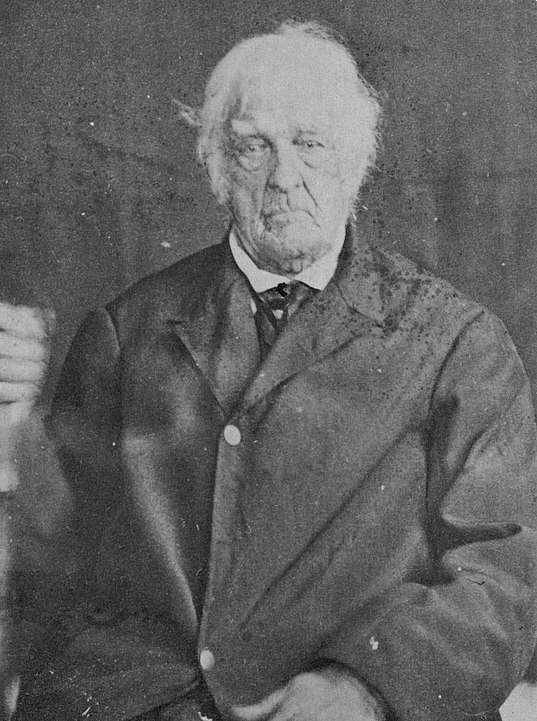
Recently, I discovered a neat story related to the American Revolution that was in my own home county—Orleans County. It is not a battlefield, though it is about a man who stood on those battlefields with George Washington’s Continental Army. Lemuel Cook, who died at the age of 107, spent the last thirty years of his life in the next town over from my hometown and died there. While he was not the last surviving veteran of the war for America’s independence, he was the last to claim a pension for his service.

Lemuel Cook

Ninety-one years prior to his death in 1866, the sixteen-year-old Connecticut native enlisted with the 2nd Continental Light Dragoons. He saw service with the dragoons at Brandywine and Yorktown.

Cook moved frequently after his service expired until he settled in Clarendon, New York in 1832. Cook’s devotion to the nation he helped create never waned until his dying days. He regularly attended town hall meetings and elections until a few years before his death. Souvenir seekers continually asked for the old veteran’s autograph, which he obliged. In 1861, a photographer captured this national treasure in a photograph.

Unfortunately, even Cook could not defeat Father Time. As he aged, his speech became “very fragmentary,” according to one newspaper. “He recalls the past slowly, and with difficulty, but when he has his mind fixed upon it, all seems to come up clear.” Despite his weariness, Cook’s spunk occasionally showed, “the old determination still manifesting itself in his look and words.” Specifically, during an interview in the midst of the American Civil War, Cook pounded his cane on the floor and proclaimed, “It is terrible, but terrible as it is the rebellion must be put down.” Incredibly, he lived to see the rebellion “put down” and died on May 20, 1866.

Cook’s grave, located in the Cook Cemetery on Munger Road in Clarendon, suffered damage in a windstorm in 2017 but was quickly fixed. In the same year, descendants and local historians unveiled a state historic marker alerting passersby to this unique niche of Revolutionary War history in a place far from the famous battlefields that achieved our nation’s independence.

Sébastien Le Prestre de Vauban

Sebastien Le Prestre de Vauban, Seigneur de Vauban, and finally Marquis de Vauban, as one of his biographies begins, is probably not a household name to many enthusiasts of American history. Especially since he died on March 30, 1707 and never set foot in the Western Hemisphere. However, he did have a nephew, Jacques Anne Joseph Le Prestre de Vauban who served as General Jean-Baptiste Rochambeau’s aide-de-camp during the war. So, there is a family connection.

Sebastien_le_Prestre_de_Vauban
Sébastien Le Prestre de Vauban (courtesy of Wikipedia)

Yet, he left his mark on places like Yorktown, Virginia, fought 74 years after his death and half-a-world away. French engineers, critical to eventual American victory in the American Revolutionary War, plied de Vauban’s craft and studied his text and learned from his exploits. Continue reading “Sébastien Le Prestre de Vauban”

The Brush of John Trumbull

Emerging Revolutionary War welcomes back guest historian Michael Aubrecht

Trumbull
John Trumbull

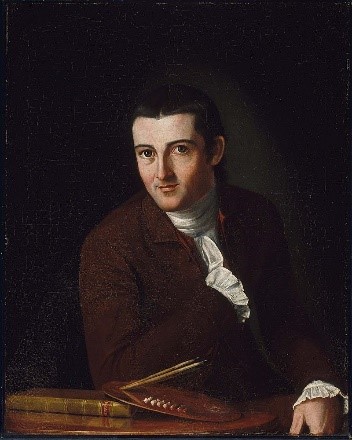
John Trumbull’s paintings represent some of the most familiar depictions from the time of the American Revolution. Trumbull was a graduate of Harvard University and the gifted son of the Governor of Connecticut. As a child, Trumbull showed a remarkable talent for an attention to detail. This aptitude set his drawings apart from his contemporaries. Trumbull traveled to London in 1784 to study painting under the master Benjamin West. It was then that he started painting some of his most notable pieces. There he honed his expertise for realistic painting. A year later later Trumbull traveled to the City of Paris to do commissioned artworks. He later did portraits of George Washington, John Adams, Alexander Hamilton and Thomas Jefferson. In 1816, he was selected as the president of the American Academy of the Fine Arts where he would serve for 20 years. Emphasizing classic traditions Trumbull attempted to teach the skills he had acquired while overseas. Following his death in 1843 at the age of 87, Trumbull was buried beneath the Art Gallery at Yale University which he had designed. In 1867, his collection of artworks were displayed at the Street Hall building on the same grounds. He and his wife’s remains were later re-interred and buried on the grounds of that building. Trumbull’s approach to painting has been studied by art students around the world. Today Trumbull’s paintings remain some of the most cherished ever to be painted by an American artist.  Continue reading “The Brush of John Trumbull”

George Washington; October 17, 1781

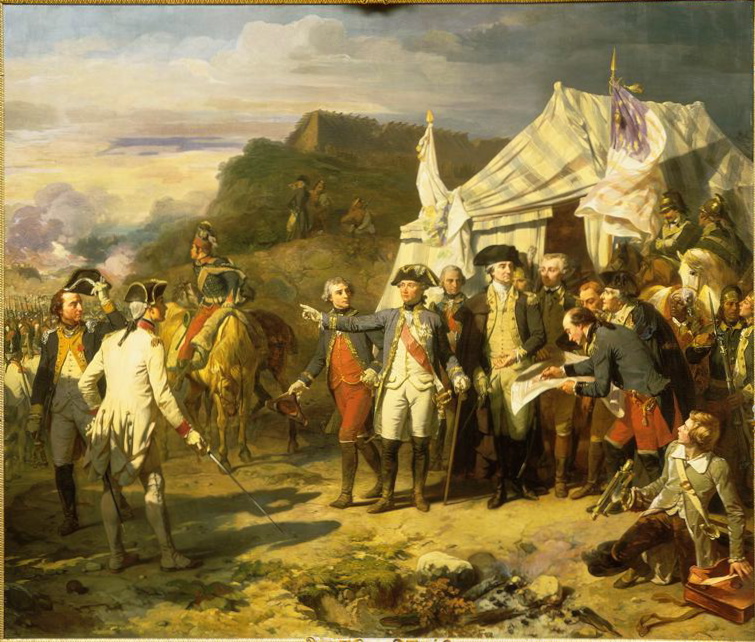
While reading background on the siege and victory at Yorktown, Virginia in October 1781, I came across the following passage written by historian Jerome Greene.

     “The officer was then quickly escorted to Washington’s headquarters in a nearby house,       where he delivered Cornwallis’s message: “I propose a Cessation of Hostilities for 24             hours, & that two Officers may be appointed by each side, to meet at Mr. Moore’s house         to settle terms for the Surrender of the Posts of York & Gloucester.” One can only                   imagine the emotions coursing through Washington’s body as he read these words.”

That last line is what really struck me.

Every image we have of George Washington depicts a stoic expression staring back out of us. Historians have a few instances from a long life of the Washington behind the marble, behind the self-imposed restraint, that he crafted for posterity.

However, he was human, he did have a fiery temper and he was a passionate person. One of the reasons he strove so hard to mask those emotions, to keep them in check, to keep perspective, and to persevere.

Those competing inclinations would have been bubbling at the surface on October 17, 1781, when that written communication was handed to him outside Yorktown, Virginia. What that moment must have been like, for Washington, for the French and American forces, and for all those fighting in favor of American independence.

Jerome Greene wondered about it. I am curious about it. Are you?


Siège_de_Yorktown_(1781)
Siege of Yorktown 1836

The Battle of Groton Heights, September 6, 1781: The Fort Griswold Massacre

Part Three
Click here for parts one and two.

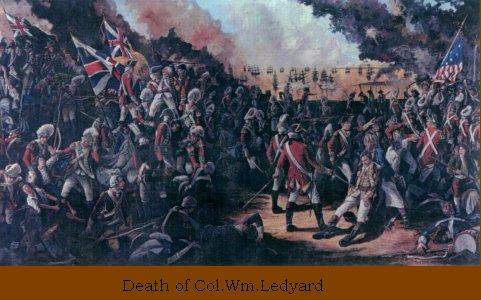
With British soldiers pouring into the fort, Colonel Ledyard ordered a ceasefire, and prepared to surrender Fort Griswold to the victorious British. However, the British disregarded the ceasefire and continuing pouring fire into the American garrison, killing or wounding nearly all of the fort’s defenders. “I believe there was not less than five or six hundred men of the enemy on the parade in the fort,” claimed American soldier Rufus Avery. “They killed and wounded nearly every man in the fort as quick as they could.”

battleofgrotonheights_giclee_p3y8

Maj. Stephen Bromfield, the ranking British officer after Montgomery fell, called out, “Who commands this fort?” Ledyard stepped forward and responded, “I did, sir, but you do now.” Another American, Jonathan Rathbun, watched Bromfield run Ledyard through the heart and lungs with Ledyard’s own sword:

     “…the wretch who murdered him [Ledyard], exclaimed, as he came near, “Who
    commands this fort?” Ledyard handsomely replied, “I did, but you do now,” at the same
moment handing him his sword, which the unfeeling villain buried in his breast! Oh, the
hellish spite and madness of a man that will murder a reasonable and noble-hearted
    officer, in the act of submitting and surrendering!”

Continue reading “The Battle of Groton Heights, September 6, 1781: The Fort Griswold Massacre”