Join us this Sunday as we welcome historian Patrick H. Hannum, as we discuss the events leading up to and including the Battle of Great Bridge, fought on December 9, 1775. Patrick will also share his research of the men who were there at the battle and the long lasting impacts his small battle had on Virginia in the American Revolution. With the 250th anniversary of the Battle of Great Bridge upon us, this is a great time to catch up on the events in Virginia during the fall of 1775.
Patrick H. (Pat) Hannum served for 45 years the Department of Defense, 29 years as a U.S. Marine (Assault Amphibious Vehicle Officer), including battalion command, and 16 years as a civilian professor at the Joint Forces Staff College, National Defense University, where he specialized in operational-level warfare and Phase II Joint Professional Military Education. He continues to study and promote the history and relevance of the American Revolution through membership in the Norfolk Chapter of the Sons of the American Revolution and the Great Bridge Battlefield & Waterways History Foundation, including staff rides, battlefield tours and other educational venues.
This Rev War Revelry will be recorded and placed on our Facebook page this Sunday at 7pm and subsequently on our You Tube and Spotify Channels. So after you fill up on turkey and football, tune in to catch a little history!
Emerging Revolutionary War welcomes guest historian Ben Powers
Introduction
Nathaniel Greene is renowned for leading the Southern Department during the American Revolution, achieving significant strategic results against Lords Cornwallis and Rawdon, even though he lost several battles. Historian Theodore Thayer called him “the strategist of the American Revolution.”[1] Greene carefully planned his army’s movements to maximize maneuverability, chose to fight in situations with roughly equal numbers, strengthened support from auxiliary and irregular forces, and put the British in increasingly worse positions. His main goal was to keep his army active—success meant staying in the field and avoiding severe losses. This led Cornwallis to make decisions that resulted in his defeat at Yorktown, Virginia, in October 1781. Greene’s careful coordination of military actions to achieve strategic results hinted at what would later be called “operational art,” a concept later connected to leaders like Napoleon Bonaparte and Soviet theorists.[2] Greene’s skills showed the main elements of operational art, making him more than a strategist—he was an early example of an operational artist.
Some Definitions
The “operational level of war” is a twentieth-century concept describing military activities between the tactical level (winning battles) and the strategic level (achieving national aims through armed force and other instruments of power). In current doctrine, tactics involve sequencing forces in time and space to accomplish missions like seizing terrain. Strategy is how national leaders and senior commanders use available means to achieve defined ends. The operational level connects these two, as theater commanders sequence campaigns to achieve strategic objectives, a concept relevant for analyzing Greene’s approach.
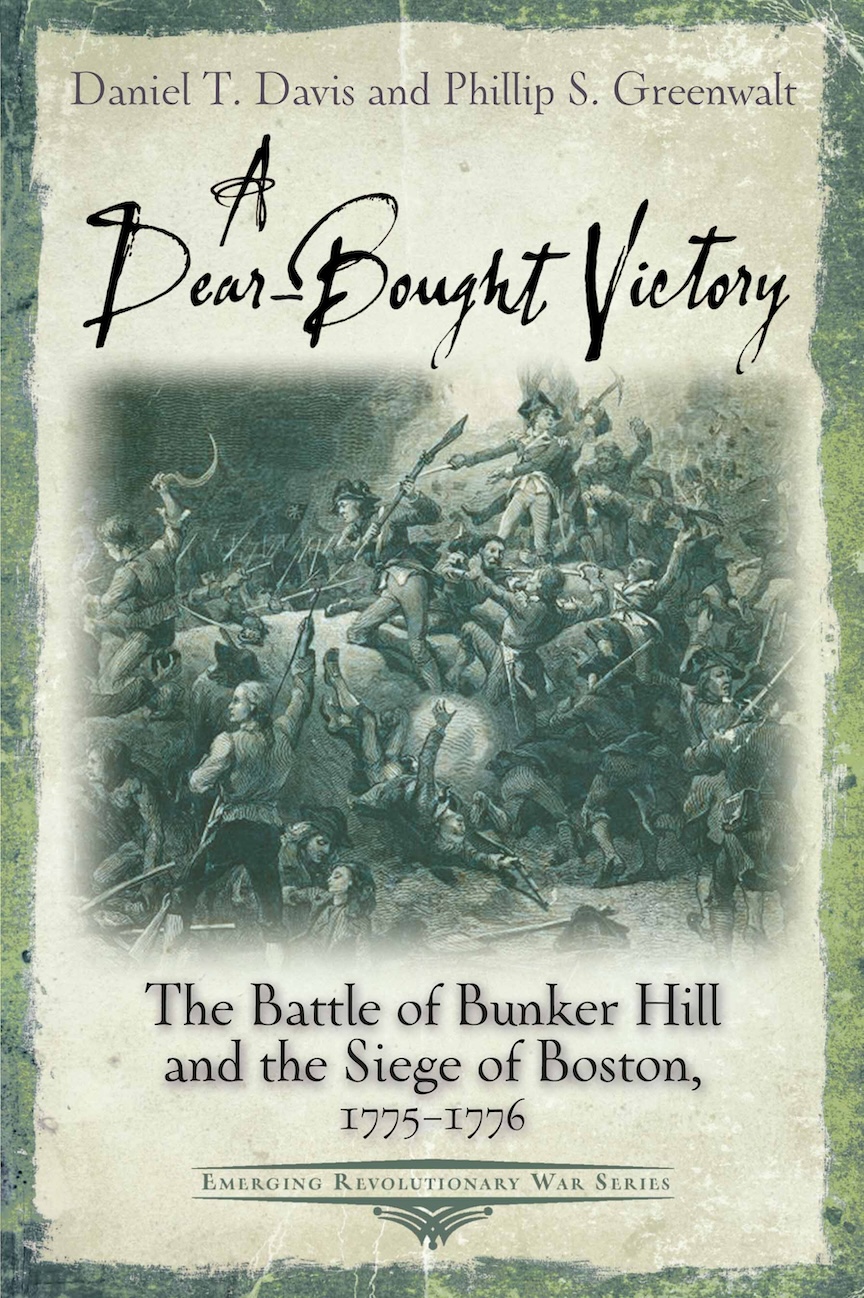
We’re excited to share one of the 2026 new releases in the Emerging Revolutionary War Series. Published by Savas Beatie, a sneak peek, including the cover, is below.
About the Book:
“I wish we could sell them another hill at the same price we did Bunkers Hill,” Nathanael Greene wrote to the governor of Rhode Island after the battle of June 17, 1775.
Actually fought on Breed’s Hill outside Boston, Massachusetts, the battle of Bunker Hill proved a pyrrhic victory for British forces. Confident in their ability to overwhelm the New England militia that opposed them, long lines of neatly uniformed British infantry and marines swept uphill toward a quickly built earthen redoubt defended by a motely collection of farmers, shopkeepers, and tradesmen.
“Don’t fire until you see the whites of their eyes!” the colonials urged each other—or did they?
By the end of the fight, the British gained the summit and Colonial forces scattered. One of the patriot leaders, Dr. Joseph Warren, lay dead—one of the first martyrs of the American Revolution. But for the British, the scene was far, far worse: it would be the greatest number of casualties they would ever suffer in any battle of the American Revolution. As British General Henry Clinton commented afterward, “A few more such victories would have surely put an end to British dominion in America.”
The siege of Boston would continue, but the sobering lesson of Bunker Hill changed British strategy—as did the arrival soon thereafter of a new commander-in-chief of Continental forces: General George Washington.
In A Dear-Bought Victory, historians Daniel T. Davis and Phillip S. Greenwalt separate the facts from the myths as they take readers to the slopes of Breed’s Hill and along the Boston siege lines as they explore a battle that continues to hold a place in popular memory unlike few others.
About the Authors:
Daniel T. Davis is the Senior Education Manager at the American Battlefield Trust. He is a graduate of Longwood University with a bachelor’s degree in public history. Dan has worked as a Ranger/Historian at Appomattox Court House National Historical Park and Fredericksburg and Spotsylvania National Military Park. He is the author or co-author of numerous books on the American Civil War. This is his first co-authored book in the Emerging Revolutionary War Series. Dan is a native of Fredericksburg, Virginia.
Phillip S. Greenwalt is the co-founder of Emerging Revolutionary War and a full-time contributor to Emerging Civil War. He is a graduate of Wheeling Jesuit University with a bachelor’s degree in history along with graduate degrees in American History and International Studies and Leadership from George Mason University and Arizona State University, respectively. He is the author of co-author of seven books on the American Revolutionary and Civil Wars. Phill has worked for the National Park Service for the last 17 years at numerous natural and cultural sites. He is a native of Baltimore, Maryland.
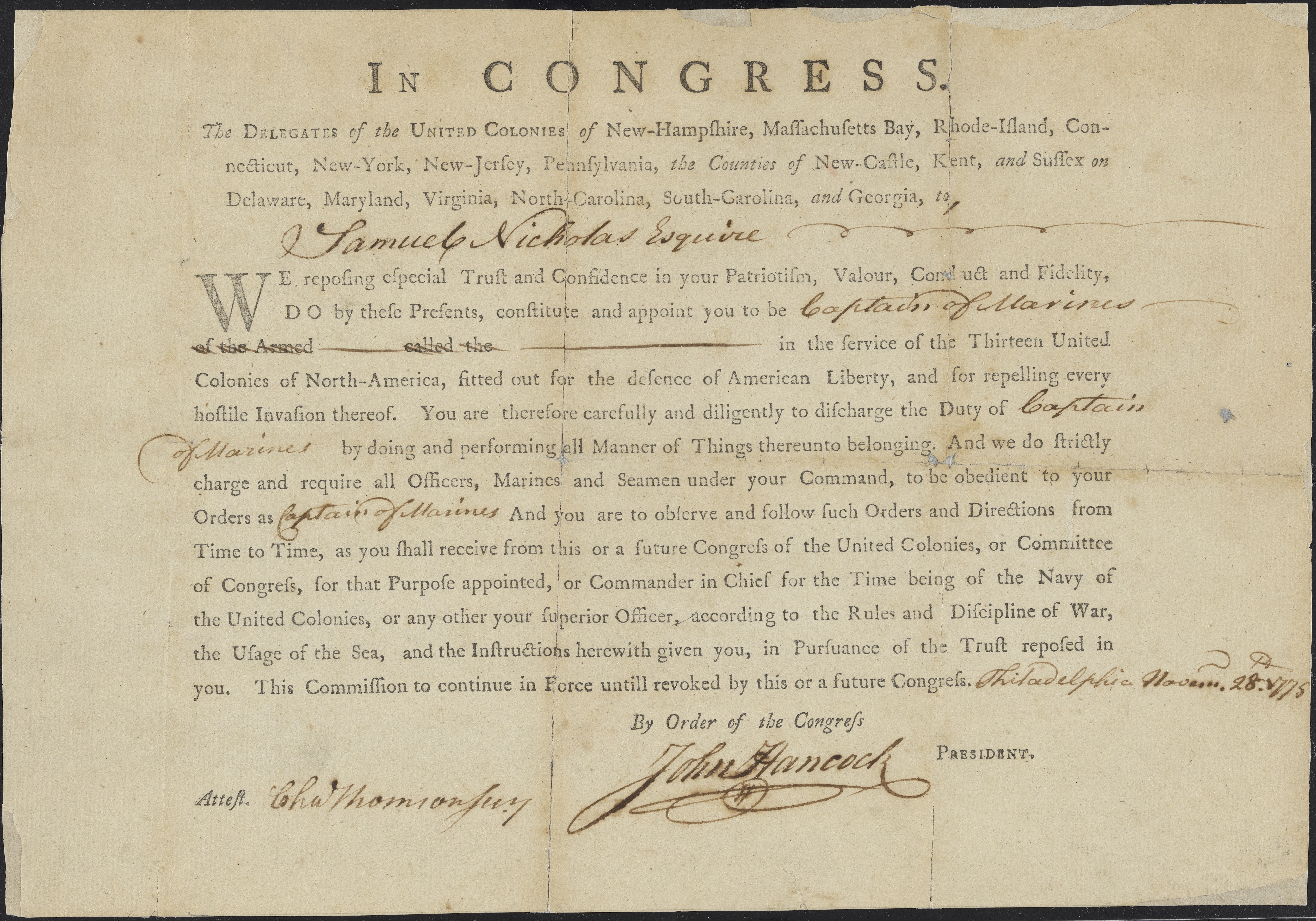
The Commission of Captain Samuel Nicholas, the first American Marine. (USMC)
Today marks the 250th birthday of the Marine Corps. November 10, 1775 was a milestone in the creation of American naval power, but the birthday story is a little more complicated.
The Continental Congress resolved to create a navy under its auspices on October 13, 1775, but much work remained to build American naval power to a point where it might serve a strategic purpose. Individual colonies had already begun creating naval forces and George Washington had leased ships under the army’s authority. Thus, the resolution served as more of milestone on a long road, rather than a fresh beginning.
On October 30, the Continental Congress considered the reports of its naval committee and confirmed recommendations for two vessels of 14 and 10 guns. Moreover, it resolved to add two more ships to its burgeoning navy, one of 20 guns and one carrying up to 36 guns. It also added four new members to the naval committee, bringing it to a total of seven. Stephen Hopkins (RI), Joseph Hewes (NC), Richard Henry Lee (VA), and John Adams (MA) joined John Langdon (NH), Silas Deane (CT), and Christopher Gadsden (SC).[1] On November 2, Congress gave the naval committee authority to call on the treasury for up to $100,000 to acquire a navy and delegated to the committee the authority to recruit officers and seamen, offering them prize money in the amount of one-half the value of all warships and one-third the value of transports made prizes.[2] It also took up a petition from a Committee of Safety in Passamaquoddy, Nova Scotia to join the association represented by the Continental Congress. Naturally, Congress appointed a committee—Silas Deane, John Jay, Stephen Hopkins, John Langdon, and John Adams to consider the matter. The naval expansion and Passamaquoddy petition sparked a new round of thinking about American naval power.
In November 1775, as the American colonies were deep in rebellion against Britain, General George Washington faced not only the British army but also the task of shaping a new American identity. One revealing moment came on November 5, 1775, when Washington, then commander-in-chief of the Continental Army, issued an order forbidding his soldiers from celebrating Guy Fawkes Day, also known as Pope’s Day in colonial New England. This event—often overlooked in histories of the Revolution—offers insight into Washington’s leadership, his moral sensibilities, and his vision for the cause of American independence.
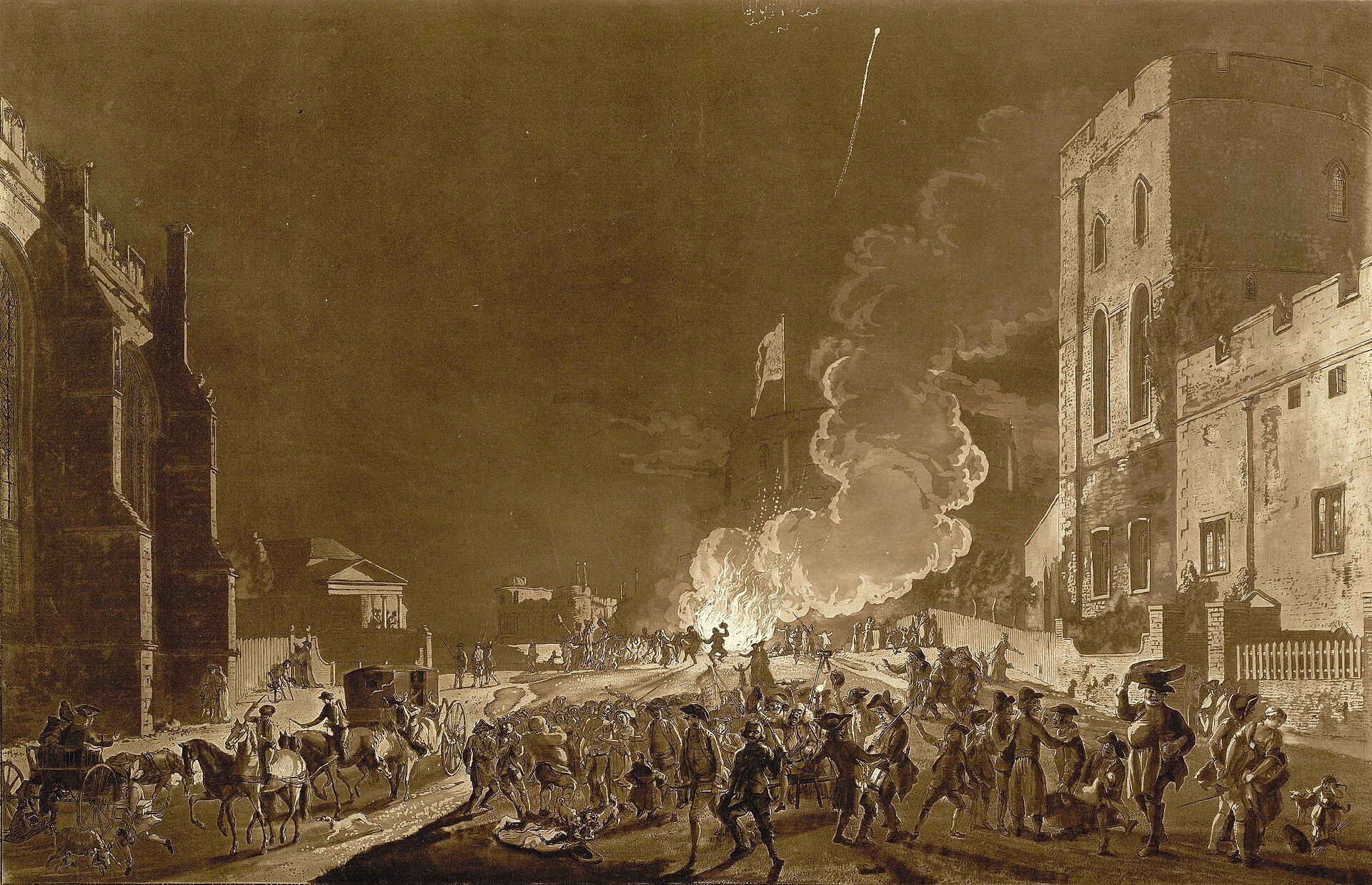
Guy Fawkes Night at Windsor Castle, 1775
Guy Fawkes Day had long been an English and colonial holiday commemorating the failed Gunpowder Plot of 1605, when Catholic conspirator Guy Fawkes attempted to blow up Parliament and assassinate King James I. In Protestant England and its colonies, November 5 became a day of noisy anti-Catholic demonstrations, bonfires, and the burning of effigies of the Pope and Fawkes. In Boston and other colonial towns, rival street gangs—often from the North and South Ends—would parade effigies, fight, and engage in destructive celebrations. It was, in short, a day of raucous Protestant triumphalism and sectarian hatred.
By 1775, however, the American Revolution had changed the stakes. The Continental Army, drawn from thirteen diverse colonies, was fighting not merely as British subjects in revolt but as Americans united against tyranny. Washington recognized that this unity could not rest on religious prejudice. Moreover, the colonies were seeking crucial support from Catholic France and from Catholic Canadians in Quebec. Anti-Catholic displays risked alienating potential allies. Thus, on November 5, 1775, Washington issued a General Order that firmly condemned the planned festivities.
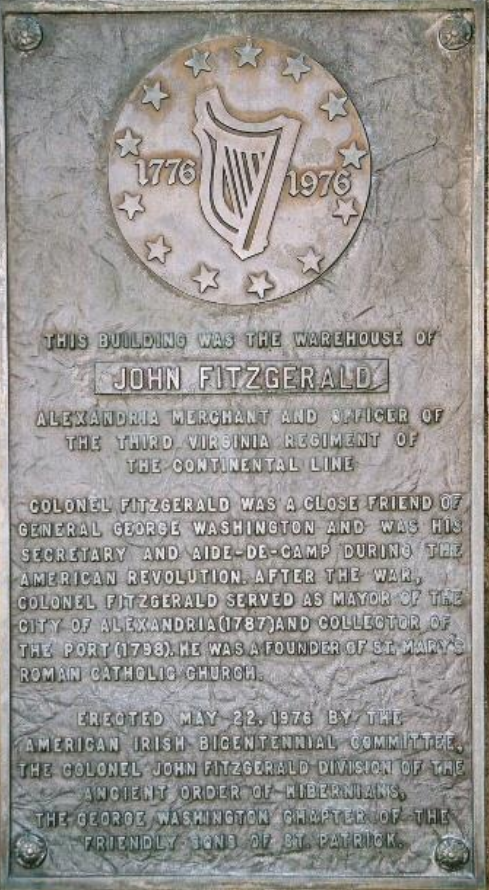
John Fitzgerald, an Irish Catholic immigrated to Alexandria in 1773. He became good friends with Washington and like many other Catholics, provided great service to Washington. For a time he served as an aide-de-camp to Washington.
Washington’s order read, in part, that “at such a juncture, and in such circumstances, to be insulting their religion is so monstrous, as not to be suffered or excused.” He called on his troops to remember that “we are contending for the rights of mankind” and that the cause required dignity and respect for all faiths. The general’s tone combined moral rebuke with strategic foresight. By discouraging Pope’s Day, he sought to replace narrow sectarian loyalties with a broader, inclusive patriotism.
This moment also reflects Washington’s character and leadership style. He understood the importance of discipline and order in an army composed largely of volunteers. The elimination of destructive, drunken celebrations helped reinforce his insistence on professionalism. But more importantly, Washington saw the American cause as grounded in universal principles of liberty and justice—principles incompatible with the kind of bigotry Pope’s Day embodied.
In retrospect, Washington’s handling of Guy Fawkes Day in 1775 stands as an early statement of religious tolerance in American political life. His decision to forbid anti-Catholic celebrations prefigured later American commitments to freedom of conscience and the separation of church and state. What might have seemed a minor disciplinary order was, in fact, a symbolic act of leadership: it transformed an old English custom of division into an American lesson in unity. Through it, Washington began to shape not just an army, but a nation.
Emerging Revolutionary War welcomes guest historian Kenneth Bancroft
“Nothing but War is talked of…This cannot be redressing grievances, it is open rebellion…”1
250 years ago on October 20, 1775 a 25 year old Englishman wrote these words in Alexandria, Virginia, noting that “everything is in confusion…soon they will declare Independence.”2.Nicholas Cresswell had arrived in America a year and a half prior to that entry in a journal that he kept to chronicle his venture to “shape his course in the world” and set up a new life inVirginia, “as I like the situation of that Colony the best.”3 He was aware of grumblings from colonials, but his focus was on land and his adventure had him traveling and trading with the Native Americans in the Ohio country and experiencing the slave culture in the colonies, especially the horrific sugar plantations in Barbados.
But what his journal is most known for is his observations and critique of the revolutionary world from Virginia to New York in 1774 through 1777. Cresswell’s misfortune, among others, was that he arrived in America seeking opportunity just as the Imperial Crisis over the Intolerable Acts had began. News of, and reaction to the closure of the port of Boston frequently disrupted his schemes and social life. As an Englishman still loyal to the Crown, his Revolutionary War journal offers a unique outsider look at the costs of the conflict in the country and towns as opposed to the more common tomes of soldier life.
“No prospect of getting home this winter, as I am suspected of being a Spy.”4 Cresswell’s tenure in America was tenuous. Unsuccessful in trying to establish himself with land and basically broke, he blamed his misfortune on the “Liberty Mad”5 political climate that considered him a ‘Tory’ who would not commit to the cause. His penchant for getting into drunken political arguments did not help and kept getting him in trouble with local Committees of Safety.
“Am determined to make my escape the first opportunity.”6By that point Cresswell knew it was time to forgo his quest and return to England, but the question was how, especially with non- importation measures and the war closing ports. What followed next for Cresswell was an amazing account of encounters with revolutionary notables and locations such as Thomas Jefferson, Patrick Henry, and British General Howe in Philadelphia, Williamsburg, and New York respectively. Ultimately, Cresswell was able to secure passage back to England where he reluctantly picked up where he left off by order of his father to “shear or bind corn.”7
1 Nicholas Cresswell, The Journals of Nicholas Cresswell, 1774-1777, (North Charleston, South Carolina: reprinted 2024), 97.
The Journals of Nicholas Cresswell was first published in 1924 and offers a candid account of the American Revolution from a viewpoint not typically explored. Its accounts of mustering militia, salt shortages, political pulpits, and anti-Tory riots and fights add color to our revolutionary origins. Add to that Cresswell’s experiences with the Native Americans in the Ohio country and the plantations in Barbados which further inform our understanding of our colonial past. Join Cresswell’s journey! To read more about Cresswell’s journey click here. The blog is an online platform and resource to follow his daily posts as they occurred 250 years ago. Keyword search features and research links are featured as well. Follow along on Facebook, too, at Nicholas Cresswell Journals.
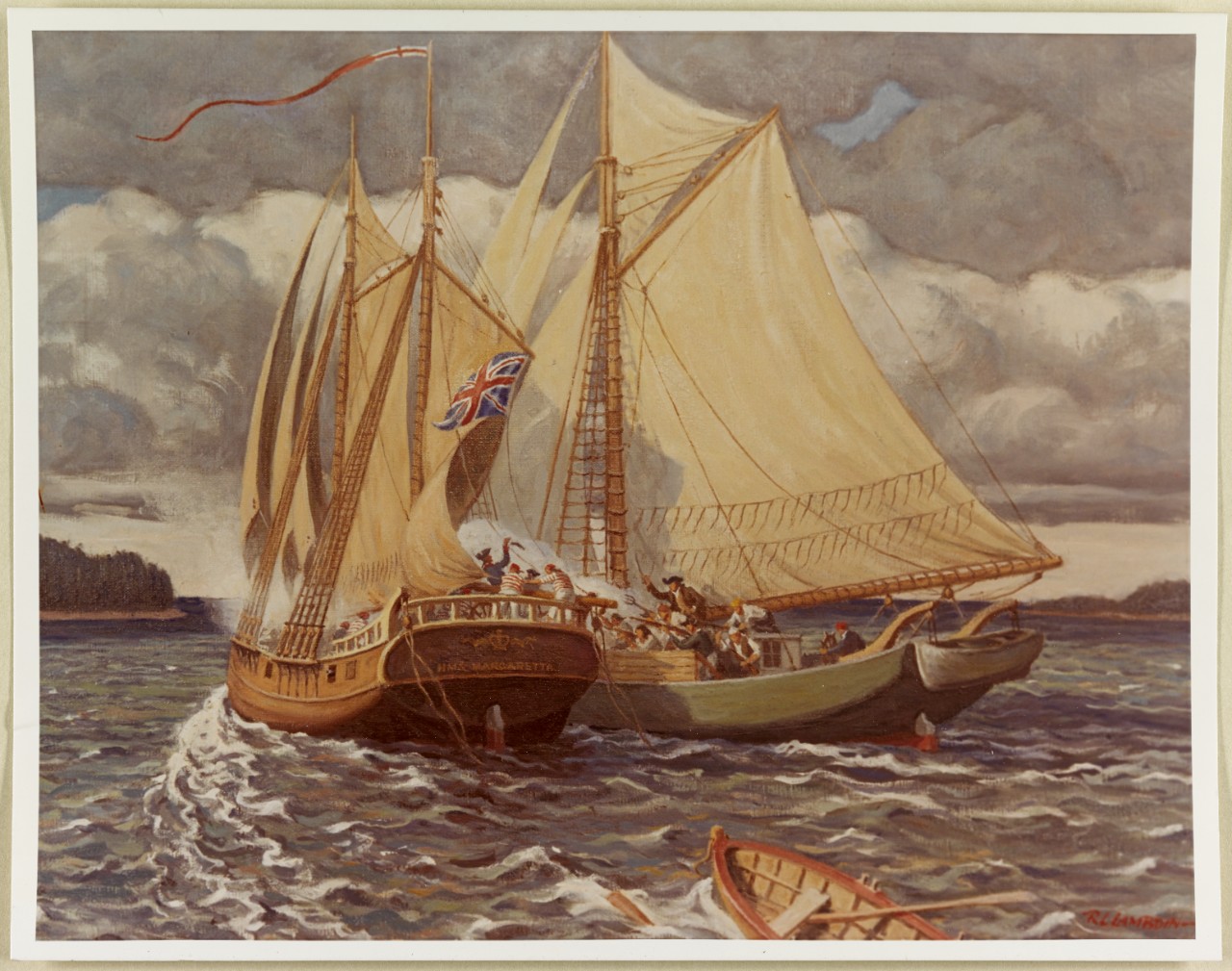
Unity vs. Margaretta, 12 June 1775 by Robert Lambdin (Naval History and Heritage Command). Margaretta was a Royal Navy vessel captured off Machias, then part of Massachusetts but now in Maine. The image illustrates the relatively small sizes of vessels involved in creating the early American navy.
During the first six months of the American rebellion, the colonies inched toward some means of dealing with Britain’s naval superiority. Over the summer the Americans had already waged a sort of whaleboat war among the estuaries and islands around Boston, mainly to deprive the British army couped up there of forage and fodder. Efforts escalated as the war continued. A confrontation between small Royal Navy vessels and the Massachusetts town of Machias over the summer serendipitously resulted in a small Massachusetts Navy created by capture in June 1775.[1] In June, Rhode Island’s General Assembly voted to charter two ships and outfit them for naval operations to protect the colony’s trade, essentially by contesting the Royal Navy’s control of Narragansett Bay.[2] In September, Colonel John Glover in the Continental Army offered his fishing schooner, Hannah, as a charter to wage war on the sea. George Washington naturally accepted, limiting its operations to capturing unarmed supply ships serving the British army.[3] The army had essentially created its own navy out of necessity.
One of the first infamous miltiary units in Virginia during the American Revolution was the Culpeper Minute Men. Remebered and memorialized throughout the years, we welcome James Bish back to discuss the history of the men, the unit and what role they played in the early days of the Revolution in Virginia.
Jim will also talk about some of the upcoming commemorative events planned around the 250th anniversary of the formation of the Culpeper Minutemen. To learn more about the events, visit: https://culpepermuseum.com/culpeper-minutemen-250th-anniversay-week/ . This Rev War Revelry is recorded and will be posted to our Facebook page on Sunday, October 5th at 7pm. It will also be posted to our You Tube and Spotify channels.
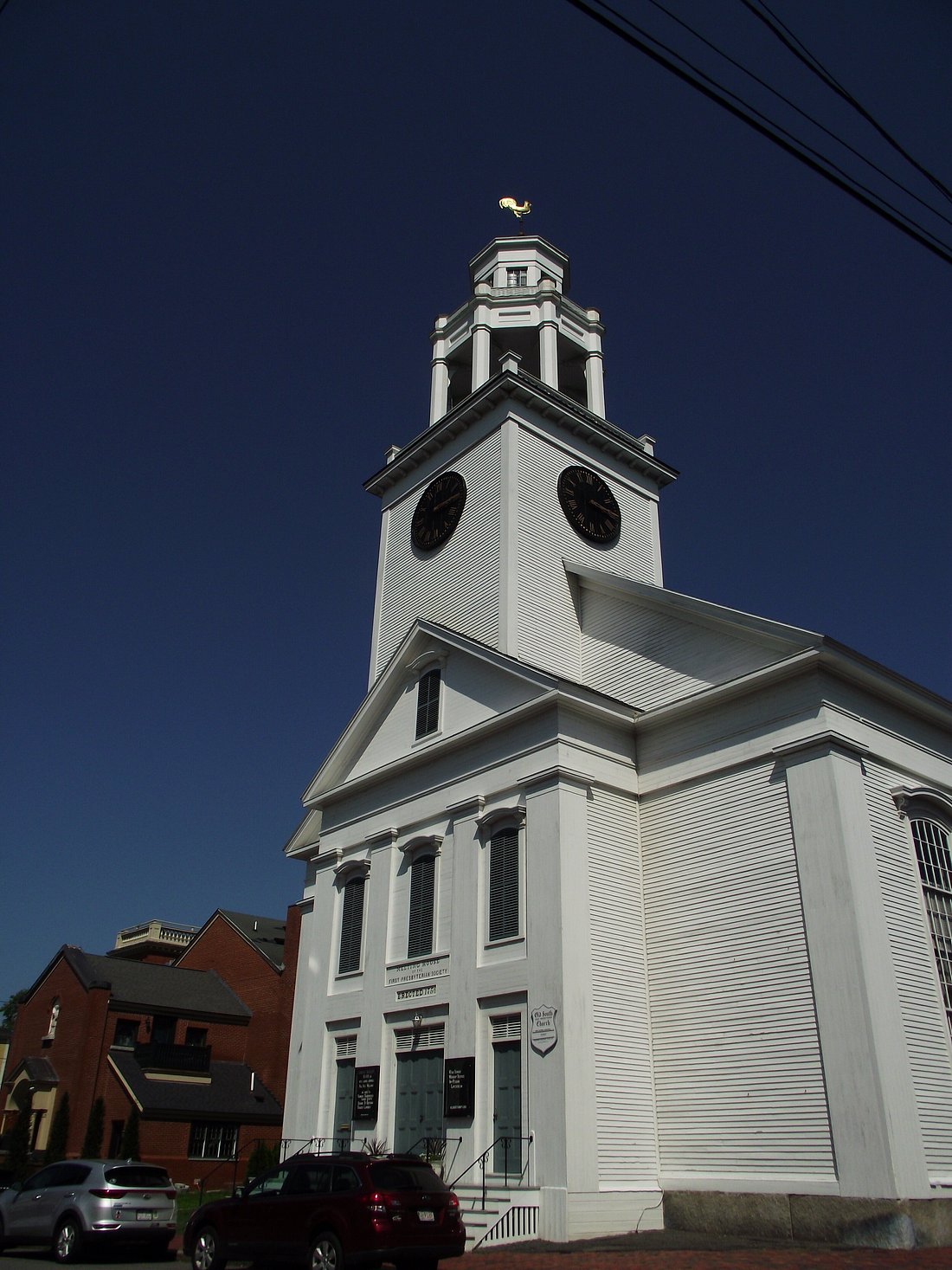
Modern view of the “Old South Presbyterian Church, Newburyport, MA
As Benedict Arnold assembled his small army of 1,100 men in Newburyport for his bold cooridinated strike on Canada (with General Richard Montgomery attacking via Montreal), there was one last stop before the men boarded the boats in the Merrimack River. From here they would hug the coast on their way to Maine, then overland to Quebec. It was a bold strategy for the inexperienced army and army commander. Though the was just started in April, and peace was still spoken by many political leaders, Washington approved this first American offensive. Strike the British forces in the Canadian colonies, with the hope of encouraging their northern colonial neighbors to join their cause.
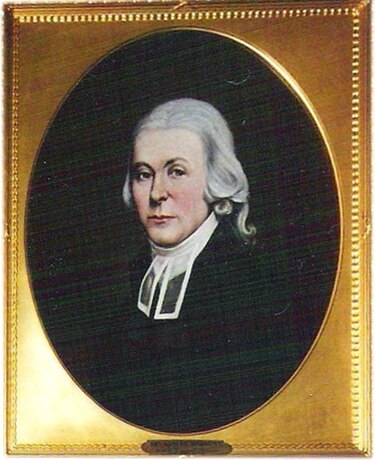
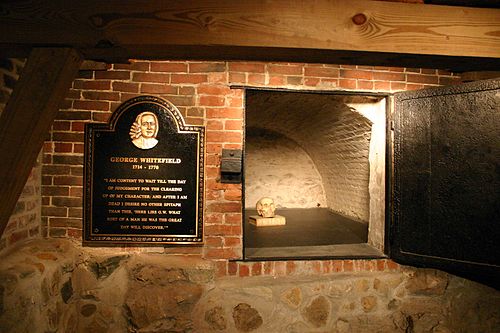
Arnold felt it was appropriate that his mission have the blessing of God, so hundreds of men squeezed into the First Presbyterian Church (now called Old South Presbyterian Church). One of the largest churches in the city, it was the spiritual home of the Great Awakening in New England. Here, evangelist preacher George Whitefield, preached from when the church was built in 1756 until his death in 1770. Whitefield was buried in the crypt of the church. His fame was well known to Arnold and others, Whitefield is considered one of the founders Methodism and a great public speaker.
What men could not fit into the church pressed up against the doors and windows. Today’s service, held on Wednesday, September 20, was a dedication service. To bless the men and their task at hand. Reverand Samuel Spring, a popular orator in his own right, and he was now to serve as chaplain of Arnold’s small army on its way to Canada.
The scene was recounted in J. T. Headley’s, 1864 “The Chaplains and Clergy of the Revolution“:
Reverand Samuel Spring
“There sat the fearless Arnold, the bold rifleman, Morgan, and a host of other brave men, who, notwithstanding their dauntless courage, felt that the perils of the untrodden, mysterious wilderness, they were about to penetrate, might be too great for human energy and endurance, and the hour come, that their only hope would rest in the God whose spirit the chaplain [Samuel Spring] invoked as their guide and stay. The citizens, who crowded the gallery, never forgot that sermon. It became the talk of the place, and was the cause of his eventually settling over them as their pastor.”
After the sermon, a surreal experience took place. Soon, someone on Arnold’s staff wanted to go to the crypt and see the tomb of Whitefield. Headley quoted Rev. Spring:
“I preached over the grave of Whitefield. After the service the general officers gathered around me. Some one requested a visit to Whitefield’s tomb. The sexton was hunted up, the key procured, and we descended to his coffin. It had lain in the tomb six years, but was in good preservation. The officers induced the sexton to take off the lid of the coffin. The body had nearly all returned to dust. Some portions of his grave-clothes remained. His collar and wristbands, in the best preservation, were taken and carefully cut in little pieces, and divided among them.”
A modern view of the crypt of Rev. George Whitefield
Headley continued; “The chaplain, with the haughty Arnold, the chivalrous Morgan, and group of officers, gathered in the dark vault around the tomb of Whitefield, formed a scene worthy of a painter. The clank of steel had a strange sound around the sainted sleeper, while the hallowed atmosphere filled all hearts with solemn awe and reverence.”
Now, with their good luck token from the grave of Whitefield, Arnold and his staff made their way to the shore where his men were boarding their boats in the Merrimack River. Arnold and his men saw their mission blessed by God, and wanted to tie their cause with that of the Great Awakening. They believed their cause was right and just. The process of visiting a tomb and taking pieces of a dead man’s clothing may seem a tad bit of “macbre” to us today, to Arnold it was a way to bless his mission. One that he believed would bring him and his men glory.
Two hundred fifty years ago Culpeper residents were uneasy. Virginians were in a war of words with their mother country, as evidenced by the published Culpeper Resolves of 1774 against England’s abuses. Little did they know that by the end of 1775 fighting men from Culpeper would be at the forefront to depose the British government from Virginia forever.
On March 23, 1775 Patrick Henry rose to speak at the Second Virginia Revolutionary Convention held at Richmond’s Saint John’s Church. The Convention’s presiding officer, Peyton Randolph, gave Henry the floor as debate swirled concerning approving a resolution forming and arming of Virginia Patriot militia forces. In attendance were Culpeper’s representatives Henry Pendleton and Henry Field Jr. as were Fauquier County’s representatives, and future Culpeper Minutemen, Thomas Marshall and James Scott. Henry stated:
Romanticsized version of Henry’s speech at St. John’s Church
“Gentlemen may cry, Peace, Peace but there is no peace. The war has actually begun! The next gale that sweeps from the north will bring to our ears the clash of resounding arms! Our brethren are already in the field! Why stand we here idle? What is it that gentlemen wish? What would they have? Is life so dear, or peace so sweet, as to be purchased at the price of chains and slavery? Forbid it, Almighty God! I know not what course others may take; but as for me, give me liberty or give me death!
Thomas Marshall later told his son, also future Culpeper Minutemen and U.S. Chief Justice John Marshall, that the speech was “one of the boldest, vehement, and animated pieces of eloquence that had ever been delivered.”
As Henry predicted a gale did come down from the north in the form of British troops trying to control arms and gunpowder stockpiles on April 19 in Lexington and Concord, Massachusetts, resulting in the first bloodshed of what Henry predicted as “the clash of resounding arms.” Just weeks earlier, William Legge, Earl of Dartmouth, Britain’s Secretary of State for the colonies, issued a warning to the Royal Governors and suggested they take control of such gunpowder and weapon strongholds. He especially targeted the governors of Massachusetts and Virginia.
News of the events in Massachusetts was still over a week away in Virginia when early in the morning of April 21, colonists in Williamsburg awoke to find royal marines removing the gunpowder from the public powder magazine. Virginia’s Royal Governor, John Murray, Earl of Dunmore, ordered the aggression respecting Dartmouth’s warning. This “Gunpowder Incident”, ignited the already simmering spark of discontent and suspicion between Dunmore and the patriot colonists.
Henry quickly formed some local militias into companies near Williamsburg and requested militia’s throughout the colony to muster. In northern Virginia, Fredericksburg became the rendezvous location for local militias. In Culpeper County men from throughout the area quickly assembled in their traditional muster and drilling location of Major Philp Clayton’s field by Mountain Run, today’s Yowell Meadow Park. Once organized, Culpeper Captain Edward Stevens marched his Culpeper militiamen to Fredericksburg joining other county militias.
Dunmore was well aware that Henry was actively recruiting militias to march on Williamsburg. Henry publicly called for Dunmore to return the powder or pay for its value, £330 (near $18,000 today) or patriot forces would march against him. As the situation escalated, Dunmore reportedly said, “I have once fought for the Virginians, and by God I will let them see that I can fight against them.” On May 3, after over ten days of maneuvering, Dunmore agreed to Henry’s monetary demands as peace was preserved. Militia’s throughout the colony, including those of Culpeper in Fredericksburg, were ordered to return to their home counties. The Gunpowder Incident proved to be a milestone event in Virginia’s turn towards revolution. As 1775 moved into summer open rebellion against royal authority began and Culpeper residents prepared for the upcoming conflict.
Earlier, in March 1775, Culpeper County representatives, Henry Field Jr. and Henry Pendleton, attended the Second Virginia Convention where Peyton Randolph, Richard Henry Lee, George Washington, Patrick Henry, Richard Bland, Benjamin Harrison, and Edmund Pendleton were selected as delegates representing Virginia at the Second Continental Congress. Field and Pendleton knew the representatives well from their years in the House of Burgesses. They especially knew George Washington who earlier served as Culpeper County’s first surveyor and Edmund Pendleton was Henry Pendleton’s uncle. On May 10, 1775, the Second Continental Congress convened in Philadelphia.
After the Battles of Lexington and Concord and Virginia’s gunpowder incident, the first order of business for the Congress was to prepare for war. On June 14, 1775, Congress voted to establish the Continental Army which incorporated patriot forces already in place in Massachusetts and New York while also raising the first ten companies of Continental Army troops on a one-year enlistment. These included two regiments of Virginia riflemen, one raised from Berkeley County (now in West Virginia) led by Captain Hugh Stephenson and the other from Frederick County led by Daniel Morgan, along with rifle regiments from Pennsylvania and Maryland. The very next day, Congress unanimously elected George Washington as commander-in-chief of the Continental Army and he immediately departed for Boston.
Meanwhile, Boston area patriots learned that the British were planning to fortify the unoccupied hills surrounding the city, which, if successful, would give the British control of Boston Harbor. Patriot leader William Prescott quickly responded, utilizing his 1,200 troops to occupy and build defense works on Bunker and nearby Breed’s Hill. At daybreak on June 17, the British mounted an attack against them. The Boston patriots fought gallantly, and enacted tremendous casualties upon the British, but eventually they ran out of ammunition allowing the British to control the high ground of the Peninsula. Newly assigned commander, George Washington, had just arrived in New York on his way to Boston when he received news of the battle and the death of patriot Major General Joseph Warren (for whom Warrenton, Virginia was later named).
Monument dedicated to the Culpeper Minute Men muster site in Yowell Meadow Park, Culpeper, VA
On July 8th, 1775, Congress directed each of the colonies to start forming land and naval military units. Virginia’s Third Convention assembled in Richmond on July 17, 1775 and began drafting legislation for the defense of Virginia titled, “An Ordinance for raising and embodying a sufficient force for the defense and protection of this Colony.” Following the guidance of Congress, an ordinance was worked upon to create a Committee of Safety to govern Virginia and to prepare for war. Although the details of the legislation took over a month to form, the earliest specifics created 16 military districts from Virginia’s 62 counties. Each military district was to support a 68-man regular, or rifle, company and a ten-company minute battalion of 500 men in preparation for war.
On August 21, 1775 “An Ordinance for raising and embodying a sufficient force for the defense and protection of this Colony.” was read for a third and final time and then passed unanimously by the delegates of Virginia’s Third Convention. On August 25th Alexander Purdie’s Virginia Gazette published the ordinance as directed by the Convention. Delegates worked strenuously on the ordinance for over five weeks before getting passage. George Mason wrote, “I have not since I came to this place, except the fast-day of Sunday, had an hour which I could call my own – this is hard duty.” This was by far the largest ordinance produced by any of the Conventions as it contained over 13,000 words and took up six pages of Purdie’s eight-page Gazette. Earlier readings of the ordinance alerted many leaders throughout Virginia to begin the process of recruiting, possibly as early as late July and certainly by the first week of August, to fulfill the legislation’s manpower needs. The ordinance created 16 military districts including the Culpeper District, which also included Orange and Fauquier County.
This legislation meant that the Culpeper Military District was now tasked with providing manpower of almost 600 men including officers. In August, the local delegates, Thomas Marshall and James Scott from Fauquier County, Field and Pendleton from Culpeper, and Thomas Barbour and James Taylor from Orange returned home to aid in the recruitment throughout their district. For the first time, Fauquier, Culpeper, and Orange County men were recruiting for war, not against the Native Americans, the French, or the Spanish. This time they were recruiting for war against their own British empire.
Each military district was to raise one 68-man regular or rifle company in addition to the 500 man minute battalion, rank and file, from the age of 16 to that of 50, to be divided into ten companies plus officers. Every man enlisted was required to “furnish himself with a good rifle, if to be had, otherwise a tomahawk, common firelock bayonet, pouch, or cartouche box, and three charges of powder and ball.” If the minute-man was not able to furnish his arms, they were to be supplied at public expense. Six privates were allowed one shared tent from the public supply. For pay, the Battalion Colonel was allowed 15 shillings per day, Lt. Colonel 12 shillings, and a Major 10 shillings. The pay for Captains and lower ranks was the same as Culpeper’s Regular Company at 6 shillings per day, Lieutenants at 4 shillings, Ensigns at 3 shillings and Privates earning one shilling and four pence per day. The difference in pay came from days a year in service. Both privates for the regular rifle company and the minute battalion were enlisted for a year’s service. However there was certainty that the rifle company would be away from home during the year while the minute battalion might not get called up, meaning that they would be paid for local drilling of 76 days per year instead of 360. As a result, the regular rifle company recruits expected to earn a yearly pay of 480 shillings/year while a minute battalion privates were guaranteed 101 shillings, that is of course unless the minute company was activated, which the Culpeper Minute Battalion was.
In the newly formed Culpeper Military District local leaders met and made commitments for recruiting individual companies and decided to meet on September 1st in the central county of Culpeper at the traditional militia muster site of Philip Clayton’s property just west of Culpeper Court House. It seems clear that some of the most experienced riflemen and former militia veterans would make up the district’s needs for the 68-man rifle company that would be incorporated into either Patrick Henry’s 1st Virginia Regiment or William Woodford’s 2nd Second Virginia Regiment. Certainly military district rifle competitions pushed the expert riflemen toward the rifle company. However, some expert riflemen appreciating the idea of remaining at home most of the time, chose to stay in the minute battalion. Because of its size, recruitment for the manpower needs for the ten-company minute battalion was going to be the greatest challenge.
In Fauquier County, Delegates Thomas Marshall and James Scott began recruiting officers and in turn, those officers were charged with recruiting the needed manpower for each company to fulfill Fauquier’s obligations. Besides Marshall and Scott, officers placed in charge of recruiting their own companies included William Pickett, John Chilton, William Blackwell, George Johnston, Elias Edmunds, Francis Triplett, and William Payne. Orange County leaders Lawrence Taliaferro, Richard Taylor, Joseph Spencer, John Williams, and Willliam Taliaferro began recruiting their own companies. In Culpeper County, highest ranking militia officers, John Green and Edward Stevens, took the lead in recruitment efforts. Other Culpeper leaders recruiting included Abraham Buford, John Jameson, William McClanahan, George Slaughter, Philip Clayton, and James Slaughter. Their upcoming muster on September first at Clayton’s Field would determine how effective their August recruitment efforts were.
As the September first rendezvous approached, recruiting captains from each of the three counties of Orange, Culpeper, and Fauquier made plans to meet at Clayton’s muster field along Mountain Run. It appears that the many recruitment captains had their specific areas in the region they had recruited. In Culpeper, Abraham Buford recruited in southwestern Culpeper County (today’s Madison County), John Jameson recruited close to the village of Culpeper Courthouse, William McClanahan northwestern Culpeper County into present day Rappahannock County. James Slaughter recruited in the area of Culpeper Courthouse and south and east to the Rapidan River. John Green recruited the northeastern areas of the county.
In Orange County Joseph Spencer recruited in southeastern Orange. His recruits journey to Clayton’s muster field has been recorded. Spencer made an initial rendezvous location of his recruits at “Porter’s Old Courthouse” probably on August 31st. In 1775 this property was owned by Charles Porter and it had been the site of the first Orange County Courthouse from 1738 until 1749 before the courthouse was moved to near present-day Orange. The first courthouse location today is on the eastern side of Route 522 just northeast, and on the hill, from E.V. Baker’s Store. From that location it is roughly 12 miles to Clayton’s muster field, roughly a half-day march. It is assumed that other recruiters made rendezvous in a similar fashion, however many of the recruits in Culpeper County probably just sent word to directly meet at Clayton’s field.
Most of the Culpeper Military District recruits likely arrived by September 1, but some probably lingered into the next few days. There the recruited men would have been sworn in, given rank, and told their paygrade. The Committee of Safety would have also been involved fulfilling the officer ranks and in reducing the number of minute battalion companies and captains to ten. Some of the recruiting captains filled senior officer ranks and their recruits were assimilated into other companies to complete their needed numbers. Certainly rifle competitions were held and most of those who were most skilled filled into John Green’s Rifle Company. There appears to have been enough good riflemen above the 68 needed for the rifle company and they were placed in a variety of the battalion companies. John Green of Culpeper County led the rifle company as Captain with Richard Taylor of Orange 1st Lt. and John Eustice of Fauquier as 2nd Lt. The senior leaders of the Minute Battalion were Col. Lawrence Taliaferro from Orange, Lt. Col. Edward Stevens from Culpeper, and Major Thomas Marshall from Fauquier. The 10 Battalion Company Captains included Abraham Buford, John Jameson, William McClanahan, and John Williams, all from Culpeper; William Blackwell, John Chilton, William Pickett, and James Scott from Fauquier; and William Payne and Joseph Spencer of Orange.
Sixteen year old recruit, Philip Slaughter penned a diary account of which we get an image as to what Clayton’s muster site appeared. According to Slaughter,
Modern interpretation of the Culpeper Minute Men Flag, courtesy of the Sons of the American Revolution
“Some had tents, and others huts of plank, etc. The whole regiment appeared according to order in hunting shirts made of strong, brown linen, dyed the color of the leaves of the trees, and on the breast of each hunting shirt was worked in large white letters the words, ‘Liberty or Death’ and all that could procure for love or money bucks’ tails, wore them in their hats. Each man had a leather belt around his shoulders, with a tomahawk and scalping knife. The flag had in the center a rattlesnake coiled in the act to strike. Below it were the words, ‘Don’t tread on me.’ At the sides, ‘Liberty or Death’ and at the top, ‘The Culpeper Minute Men.’
The According to Culpeper’s Ensign David Jameson, the Culpeper Battalion “was raised in less than three weeks.” The men on Clayton’s field proved to be special in liberating Virginia from the British. Leadership on the field was not in shortage. On that field was a brother (Ambrose Madison) to a future president (James Madison), a father (Richard Taylor) to a future president (Zachary Taylor) and future Chief Justice of the U.S. Supreme Court (John Marshall) among countless other state leaders. Slaughter also stated, “During out encampment an express arrived from Patrick Henry, commandant of the First Virginia Continental Regiment, by order of the committee of safety, then sitting in the city of Williamsburg, requesting the Minute Men to march immediately to that city. The Minute Men immediately made ready.” It is not known for sure when the Virginia’s Committee of Safety issued the request to “March immediately,” but John Green’s Regular Rifle Company certainly left Culpeper in late September for the 140-mile march of roughly six days arriving by October 4. The Culpeper Minute Battalion followed a few weeks later and arrived in Williamsburg by October 23.
Between late September and mid-October 1775, over 600 Culpeper Military District recruits marched from the muster and drilling site of “Clayton’s Old Field” in response to Patrick Henry’s request of immediate mobilization to Williamsburg for the protection of Virginia. The Culpeper deployment proved to be by far the largest deployment from any location in Virginia in 1775-76 to answer the call of defending the Commonwealth from the British. While every Virginia Military District fulfilled their requirements for a regular company, Culpeper’s “Minutemen” were Virginia’s only fully-manned minute battalion to respond in Virginia’s critical hour of need. After arriving at Williamsburg, Culpeper’s expert riflemen immediately moved into action against Lord Dunmore’s Royal and Loyalists forces. The rifle company was immediately pressed into action guarding James River crossings while the minute battalion was immediately ordered to protect the local magazine, and like the rifle company, James River crossings. Upon arriving Slaughter continued to tell about their arrival in Williamsburg stating, “Many people hearing that we were from the backwoods, near the Indians, and seeing out dress, were as much afraid of us for a few days as if we had been Indians; but finding that we were orderly and attentive in guarding the city, they treated us with great respect.”
Although there were many “riflemen” in the battalion, Slaughter also stated, “The Minute Men were chiefly armed with fowling-pieces and squirrel-guns.” Upon arrival, Col. William Woolford designated Captain Abraham Buford, and a hand-selected company of minute battalion riflemen, to move immediately, marching through the night of October 26, to defend Hampton from attack by a British naval squadron. Hampton would be there first of several weeks of fighting Lord Dunmore and his mixed force of Regulars, Loyalists and former slaves.
For more information on commemorative events this fall commemorating the Culepeper Minute Men, visit the Culpeper Museum at https://culpepermuseum.com/





 Emerging Revolutionary War Era