Emerging Revolutionary War welcomes guest historians Lori Amos Doss & Jarred A. Marlowe, bios follow part one.
Part 1: From Charlotte County to Washington’s Guard
James Johnston was born in Charlotte County, Virginia, around 1756, though no exact record of his birth has survived. Like many Revolutionary War soldiers, much of his early life remains in shadow. Even the identities of his parents are uncertain, despite Johnston referring to them in later accounts. What we do know begins in November 1776, when he made the decision to leave home and enlist in the Continental Army for a three-year term.
He joined the 14th Virginia Regiment under Colonel Charles Lewis and soon marched north to join George Washington’s army at Morristown, New Jersey. At that stage of the war, the Continental Army was still finding its footing. Enlistments were short, supplies were inconsistent, and discipline varied widely from unit to unit. Yet within a matter of months, Johnston distinguished himself.
On May 1, 1777, he was selected for the Commander in Chief’s Guard, an elite corps formed to protect Washington personally, as well as the army’s funds and official documents. This was one of the most trusted assignments in the army. Officers were instructed to select men known for their honesty, sobriety, and reliability. Washington also had a preference for appearance, requesting soldiers who were well built, neat, and presentable. Johnston’s selection tells us a great deal about how he was viewed by those who knew him. He was not simply capable. He was dependable.
Halifax in northeastern North Carolina is one of the state’s most significant historic sites. This small town in rural Halifax County can rightly claim to be North Carolina’s Independence Hall.
Royal Governor Josiah Martin had fled the capital at New Bern in 1775. Relocating to Fort Johnston on the Cape Fear River, he fled again to a warship and tried to run the colony from offshore. With the departure of the Royal Governor, legislators met in Halifax to run the colony. Following the battle of Moores Creek in February, 1776, their efforts took on new urgency. While they had survived a failed Loyalist uprising and an aborted British invasion, they knew war would return.
At Halifax in April, delegates from across North Carolina met to take part in the Fourth Provincial Congress. Previous Provincial Congresses had met to take on the role of running the state with the Royal Governor’s departure. Some of the prisoners captured at Moores Creek arrived and placed in the jail, tangible proof that war had come to North Carolina.
Many felt it was too late for compromise and the only recourse was independence. At the time the Continental Congress in Philadelphia was debating that very topic. On April 12, 1776, the 83 delegates of the Provincial Congress unanimously ratified the Halifax Resolves. It was the first official act by any of the thirteen colonies calling for independence from Great Britain. While Virginia’s delegates in the Continental Congress in Philadelphia proposed it, North Carolina was the first colony to authorize it.
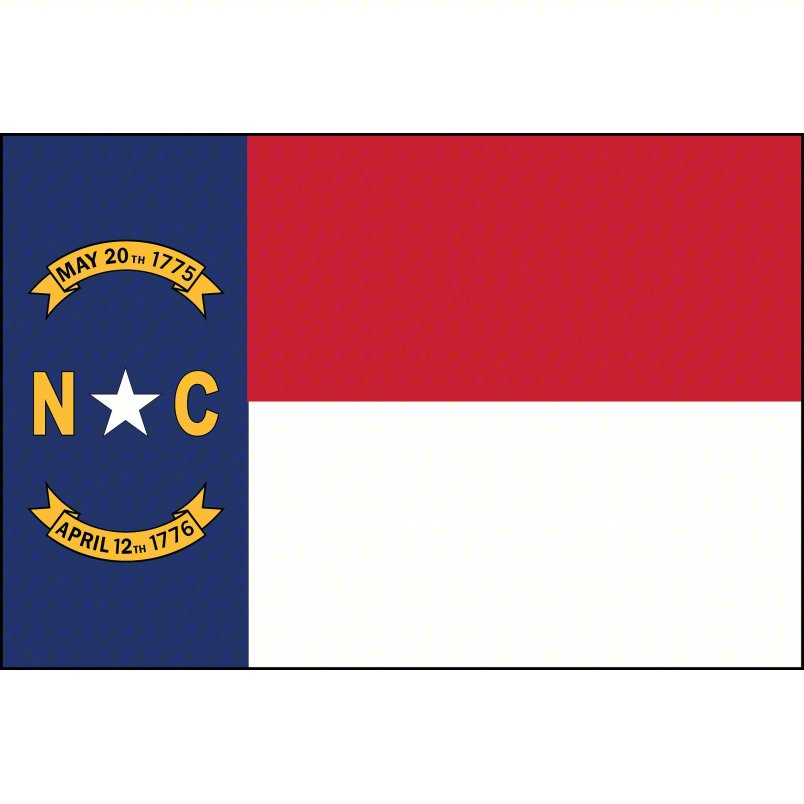
The date of April 12, 1776 is one of two on the state flag, the other, May 20, 1775 refers to the Mecklenburg Declaration, another Revolutionary event (though one whose accuracy is debated).
Since the 1960s a state historic site has preserved and interpreted the events in Halifax. A new visitor center with expanded exhibits opened last month to commemorate the 250th anniversary of the Resolves.
The exhibits cover a wide range of topics, including Halifax’s economy, Native American and African American perspectives on the Revolution, the village’s role in the war effort, and its early preservation and interpretation. A highlight is an original copy of the Halifax Resolves on display. Exhibits explore the document in detail, discussing what it calls for and how the delegates debated it.
The museum is outstanding, with a mixture of attractive panels, artifacts, and videos and sound. Outside, the site of the original courthouse, where the Resolves were discussed, is marked. Archaeologists verified the site and markers describe how it was located. The historic site also includes many other late eighteenth and early nineteenth century buildings. Guided tours are available.
Halifax State Historic Site is just five miles off Interstate 95, not far from the Virginia state line. The museum and grounds are well worth a visit if you’re passing by.
Emerging Revolutionary War welcomes guest historian Mike Busovicki
If the majority of American Colonists were from the British Isles, Africa, and Germanic States, why was Spanish currency so prevalent and how did it get here?
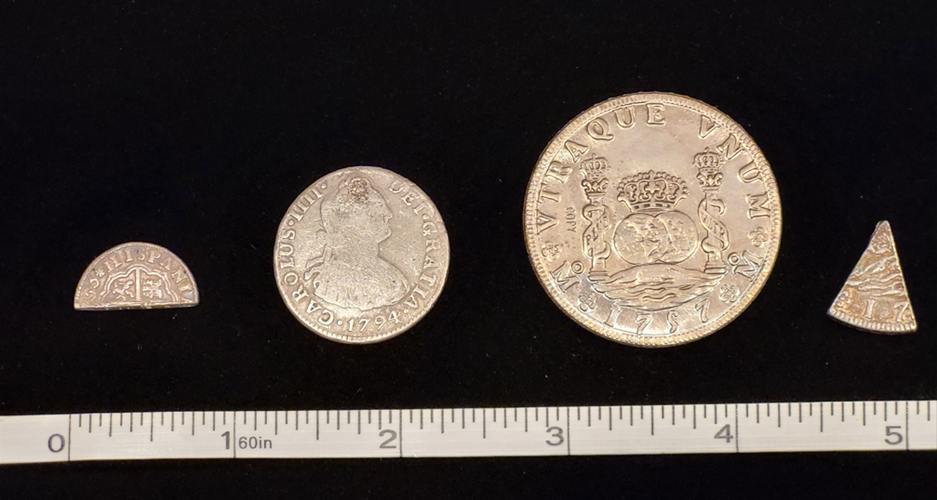
L-R: Silver half of a 1-reales coin, silver 2 reales, copy of an 8-reales (“piece of eight”) and copy of 1/8 (piece, or “bit”) of the 8-reales. Like cutting a pizza in half and cutting the halves again twice, it was easier to create a system based on “eighths” rather than a decimal one. (Photo by Mike Busovicki)
By the late 1400s, The Spanish had joined the kingdoms of Aragon and Castile through the marriage of Ferdinand and Isabela, wrested control of the Iberian Peninsula from the Islamic Moors and utilized the Catholic Church to enforce royal authority and justify brutal domestic and foreign policies.But these endeavors were expensive. Though successful in removing political opponents, it drove out or suppressed long standing medical, financial, and trade centers, especially in population hubs like Granada, Seville, and Toledo. Heavily in debt, the Spanish crown had to generate income from outside of Spain. Consolidating wealth and power into the hands of a few was expedient, but it excluded large segments of the population and resulted in domestic economic stagnation.
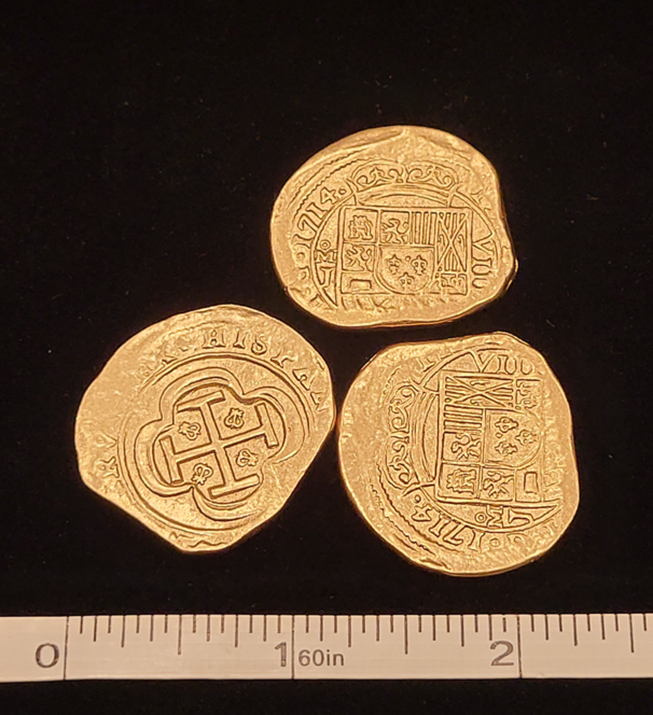
Copies of 4-Escudo coins. Escudo, meaning shield, referred to the coat of arms that validated coins. New world mines accounted for over 80% of the world’s silver and 70% of the world’s gold – it also funded conquest by the Ming, Qing, Mugul, Ottoman, and Safavid empires. (Photo by Mike Busovicki)
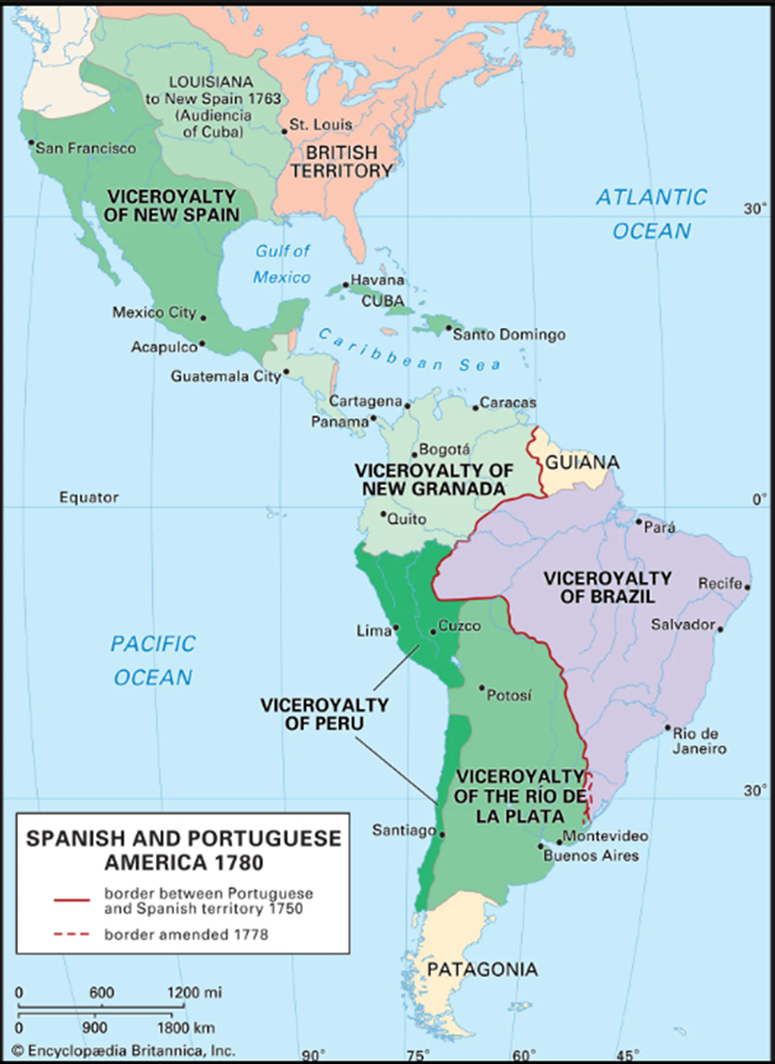
While French intervention, British politics, and German mercenaries constitute most discussions regarding European power during the Revolution, centuries of Spanish control of vast areas cannot be overstated.By courtesy of Encyclopædia Britannica, Inc., copyright 2016; used with permission.
“Without the character of Samuel Adams, the true history of the American Revolution can never be written,” John Adams once said of his cousin.
Well, someone better tell the United States Postal Service!
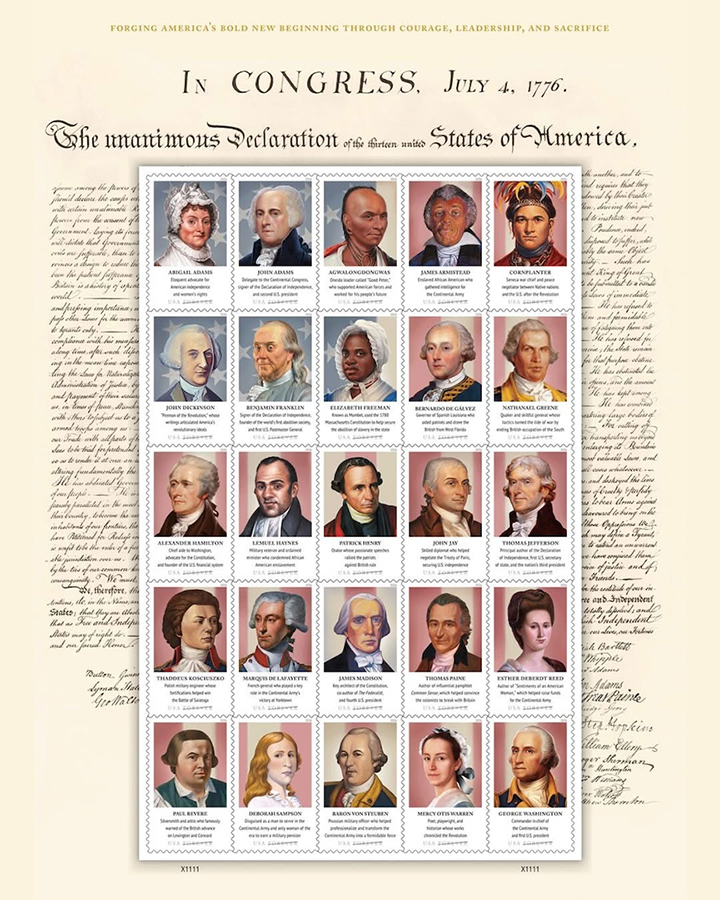
On April 10, the USPS issued a new set of stamps, “Figures of the American Revolution,” as part of its ongoing initiative to commemorate America’s 250th birthday. (See the USPS’s full press release below.) The set features 25 of the most important people related to the American Founding.
Sam Adams, apparently, isn’t one of them.
Never mind Sam’s instrumental role as an organizer in Boston’s Sons of Liberty or his role in managing public opinion. Never mind the Committees of Correspondence he helped organize throughout Massachusetts and across the colonies. Never mind his masterful use of propaganda to implant events like the Boston Massacre or the Boston Tea Party in American imagination—let alone the effective use of those events as tools of protest. Never mind the central leadership role he played at the First Continental Congress. Never mind Boston’s centrality in the start of open hostilities with Great Britain.
And yet, somehow, Sam didn’t leave enough of a stamp on the American Revolution!
In fairness to the Postal Service, a collection like the Figures of the American Revolution is like a retrospective “greatest hits” collection from a band: decisions have to be made about what gets included and what gets left off.
So, if you were to add Sam Adams to the collection, who’s currently on the sheet that you would remove to make room for him?
The figures appear in alphabetical order. Here’s the full list:
EDITOR’S NOTE: Emerging Revolutionary War has been pleased to co-sponsor a series of Monday-evening programs to commemorate the America 250th at St. Bonaventure University, where contributor Chris Mackowski teaches. In March, the line-up of programs featured a student research panel. We are pleased to present today the work of one of the “emerging scholars” from that panel, Alex Payne.
Alex is a junior Theology and Franciscan Studies and History double-major from Shinglehouse, PA, with a minor in classics.
———
Sailor’s ballads in the late 17th and early 18th centuries communicated revolutionary sentiment that influenced the ideological origins of the American Revolution. Sailors’ ballads from revolutionary Atlantic history show how labor culture intersected with protest, emerging revolutionary sentiment, and identity formation. These protest and revolutionary ballads are what I refer to as “records of thought” of oppressed people. By “records of thought,” I mean oral traditions in the form of songs sung by people who were religiously and civilly oppressed that have been written down and transmitted through centuries.
The starting point of the record of thought of oppressed people is with the “Diggers’ Song” attributed to Gerard Winstanley. Winstanley was the leader of the Diggers, similar to but separate from the Leveller movement that emerged during the English Civil Wars between 1641–1659. The Diggers, known to history as radical land reformists, were led by Winstanley. They believed in an agrarian socialism and would “dig up” the land that was unjustly and inhumanly taken from the English commoners. The oppression they endured is found in the record of thought appropriately named “The Diggers’ Song.” This ballad was sung on St. George’s Hill in Surrey around 1649 by 20–30 men. It reads:
As the Second Continental Congress in Philadelphia debated on next steps and the ultimate goal of the war with Great Britain, leaders in Virginia decided to push the needle. Virginia was the largest (population and economically wise) colony in the 13 rebellious colonies. Many of its leaders were seen as leaders in the Continental Congress and in revolutionary thought. Other colonial leaders, including John Adams, knew that for the war and independence to be successful, Virginia needed to be a leading participant in the effort.
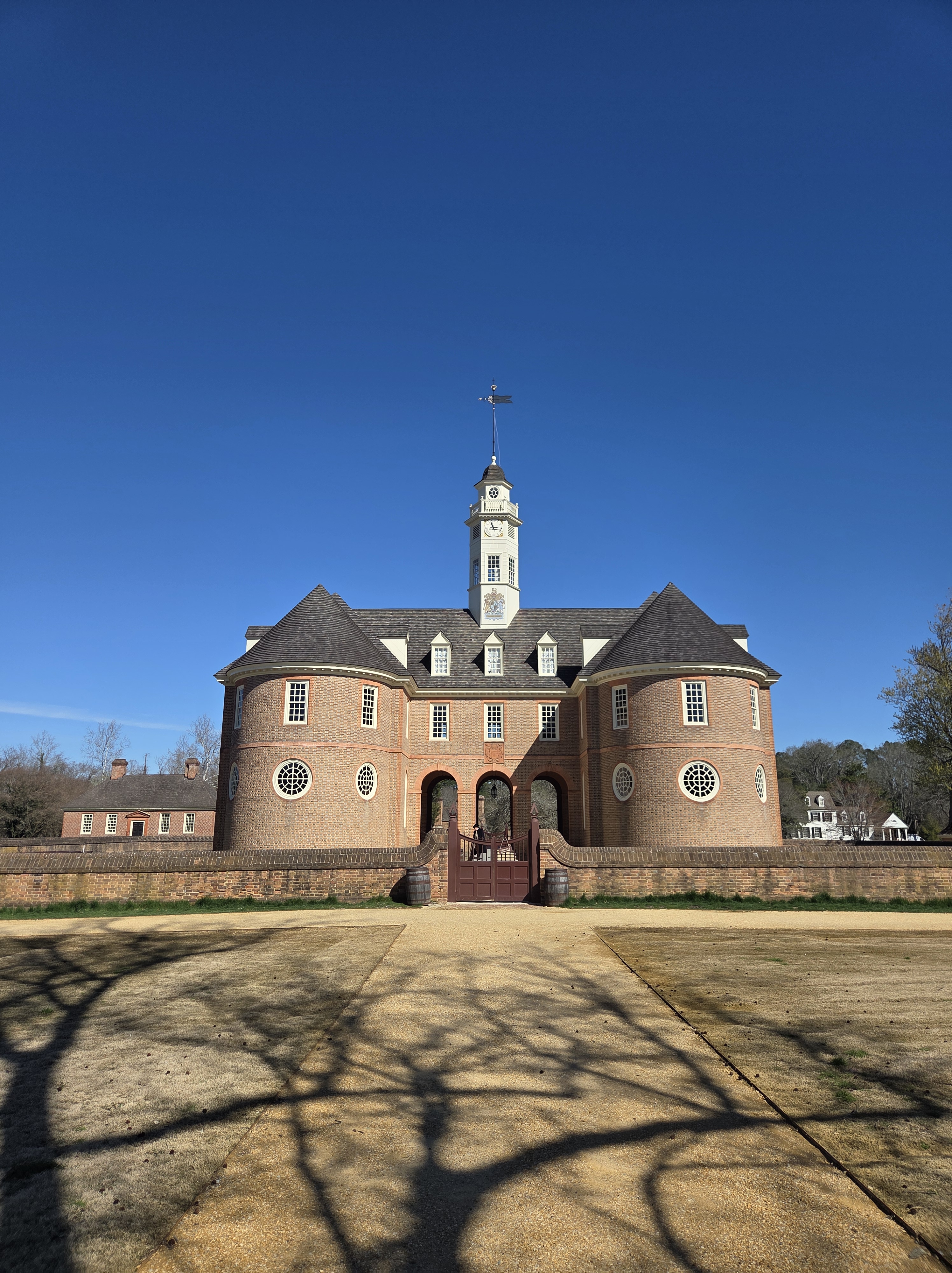
The Fifth Virginia Convention, the extra-legal body running Virginia in the absence of Royal authority, met in the Virginia Capitol in Williamsburg on May 6, 1776. There was a lot to discuss among the members. The Convention consisted of more conservative planters from the eastern part of the colony. These members tended to favor reconciliation with the mother country. Other members of the convention, that supported a more radical response were from the western part of the colony (west of the fall line) and many of its legal and philosophical minds (George Mason, James Madison, George Wythe). These men, who held the majority of the Convention, favored independence and also held the hearts and minds of most Virginians.
The most significant action of the Fifth Convention came on May 15, 1776, adopting groundbreaking resolutions. First the Convention directed Virginia’s delegates to the Continental Congress to propose a formal declaration of independence, to “declare the United Colonies free and independent states…” This directive was the first official call from any colony for a complete break with Britain. It signaled that reconciliation was no longer the goal; independence had become both necessary and inevitable in the minds of Virginia’s revolutionary leaders.
The resolution went even further. It not only urged independence but also called for the establishment of foreign alliances and confederation among the colonies. These measures demonstrated a sophisticated understanding of what independence would require: diplomatic recognition, military support, and political unity. Virginia’s leadership recognized that separation from Britain would not be sustainable without these elements in place. Soon, on June 7, 1776 in Philadelphia, Virginian Richard Henry Lee took the direction from the Fifth Convention and proposed that the Continental Congress declare independence.
Secondly, the Convention called for constructing its own independent government, taking concrete steps to replace colonial rule with a republican system. This new constitution of the “Commonwealth of Virginia’ would set up the system for which Virginia would be governed. Finally, the convention appointed a committee to draft a declaration of rights. This effort reflected the belief that independence was not just about rejecting British authority but also about creating a new political order grounded in principles of liberty and self-government.
One of the most influential figures in this process was George Mason. Mason drafted the Virginia Declaration of Rights, a document that would become one of the most important statements of political philosophy in the revolutionary era. Adopted in June 1776, it asserted that all men are by nature equally free and possess inherent rights, including the enjoyment of life and liberty, the means of acquiring property, and the pursuit of happiness and safety. It also emphasized that government derives its power from the people and must be accountable to them.
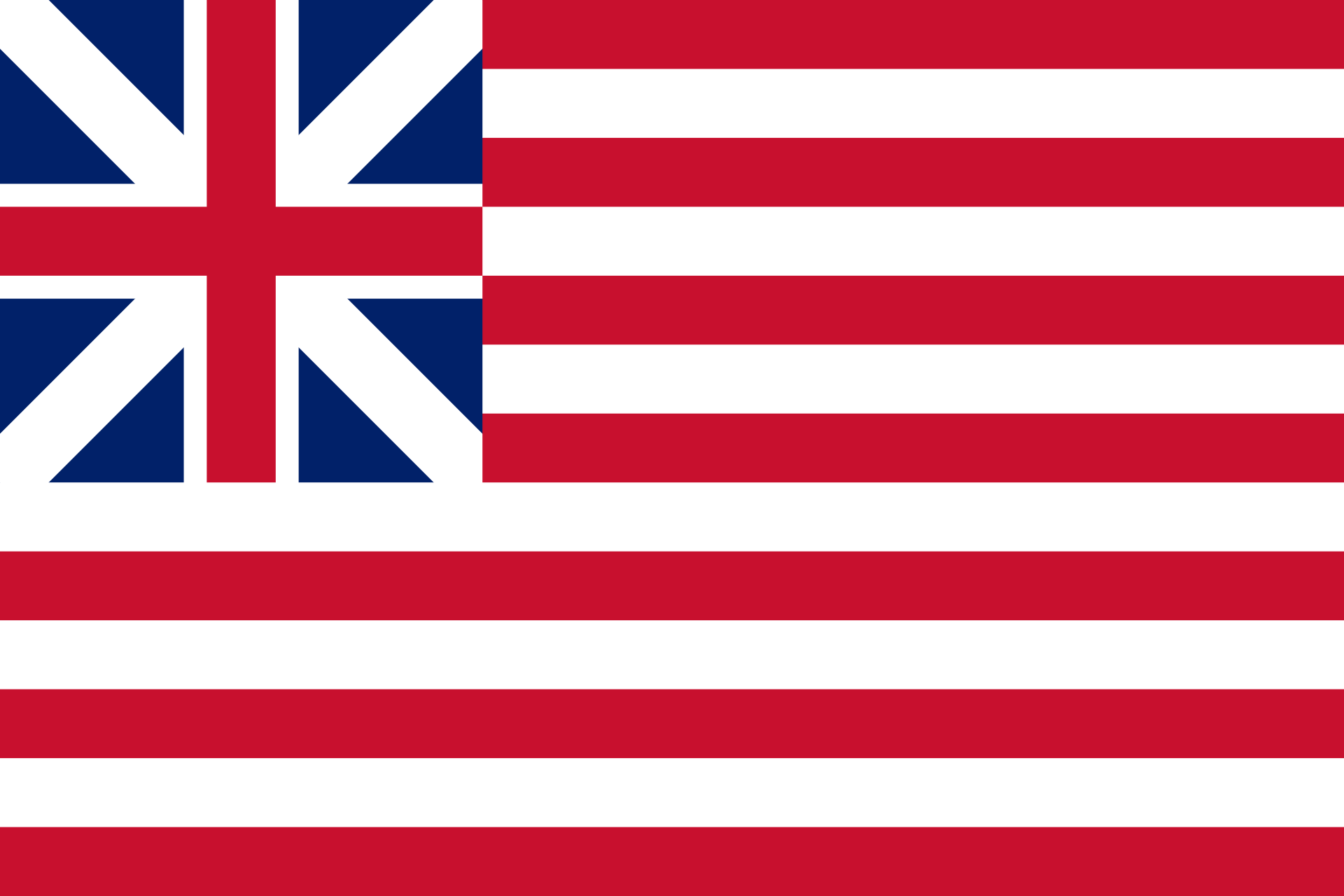
Delegate James Madison wrote townspeople in Williamsburg took down the Union Jack and replaced it with the Continental Union flag.
Another key figure connected to Virginia’s revolutionary leadership was Thomas Jefferson, who was serving in the Continental Congress. Although he was not present at the Virginia Convention in May, the instructions sent by Virginia directly influenced his work. When Congress appointed a committee to draft a declaration of independence, Jefferson drew heavily on ideas similar to those expressed in Mason’s document. The resulting United States Declaration of Independence, adopted in July, echoed Virginia’s emphasis on natural rights and the legitimacy of revolution against unjust government. The Convention also created a committee to design a state seal, this committee (led by George Wythe) adopted the seal of Virginia that is the basis for the seal used today.
Virginia’s actions in May 1776 also reflected broader social and political changes within the colony. The authority of the royal governor, Lord Dunmore, had effectively collapsed, and revolutionary institutions had taken control. Local committees and militias enforced the decisions of the convention, demonstrating that power had shifted from imperial officials to colonial leaders. This transition was not without conflict, but by May 1776, the revolutionary cause had gained widespread support among Virginia’s population. In the mind of Virginians, as of May 1776, Virginia was independent of the King and Parliament of Great Britain.
On June 12th, a follow up article will commemorate the 250th anniversary of the Virginia Declaration of Rights.
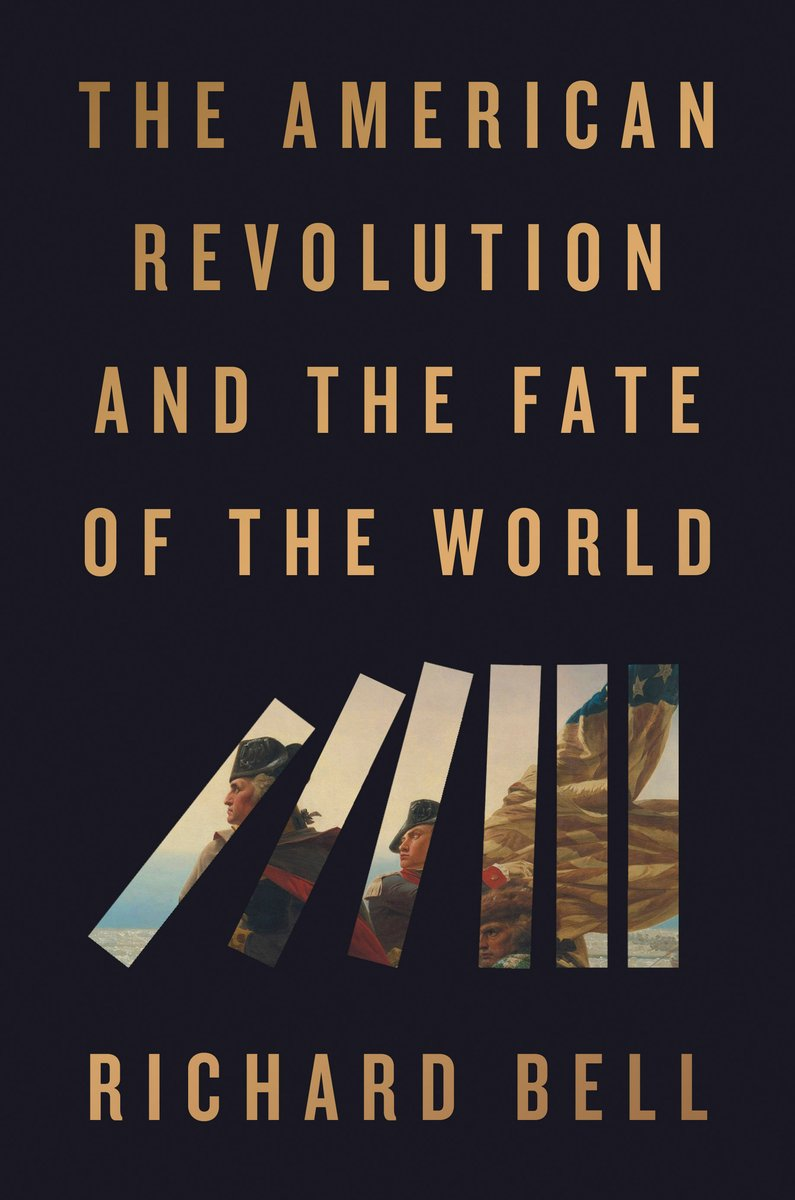
Dr. Richard Bell, historian and professor of history at the University of Maryland, will discuss his new book, “The American Revolution and the Fate of the World.” Published by Penguin Random House, this “revelatory and enthralling book, award-winning historian Richard Bell reveals the full breadth and depth of America’s founding event. The American Revolution was not only the colonies’ triumphant liberation from the rule of an overbearing England; it was also a cataclysm that pulled in participants from around the globe and threw the entire world order into chaos.”
We look forward to you tuning in to this Sunday evening, 7 pm EDT on our Facebook page for this discussion with Dr. Bell!
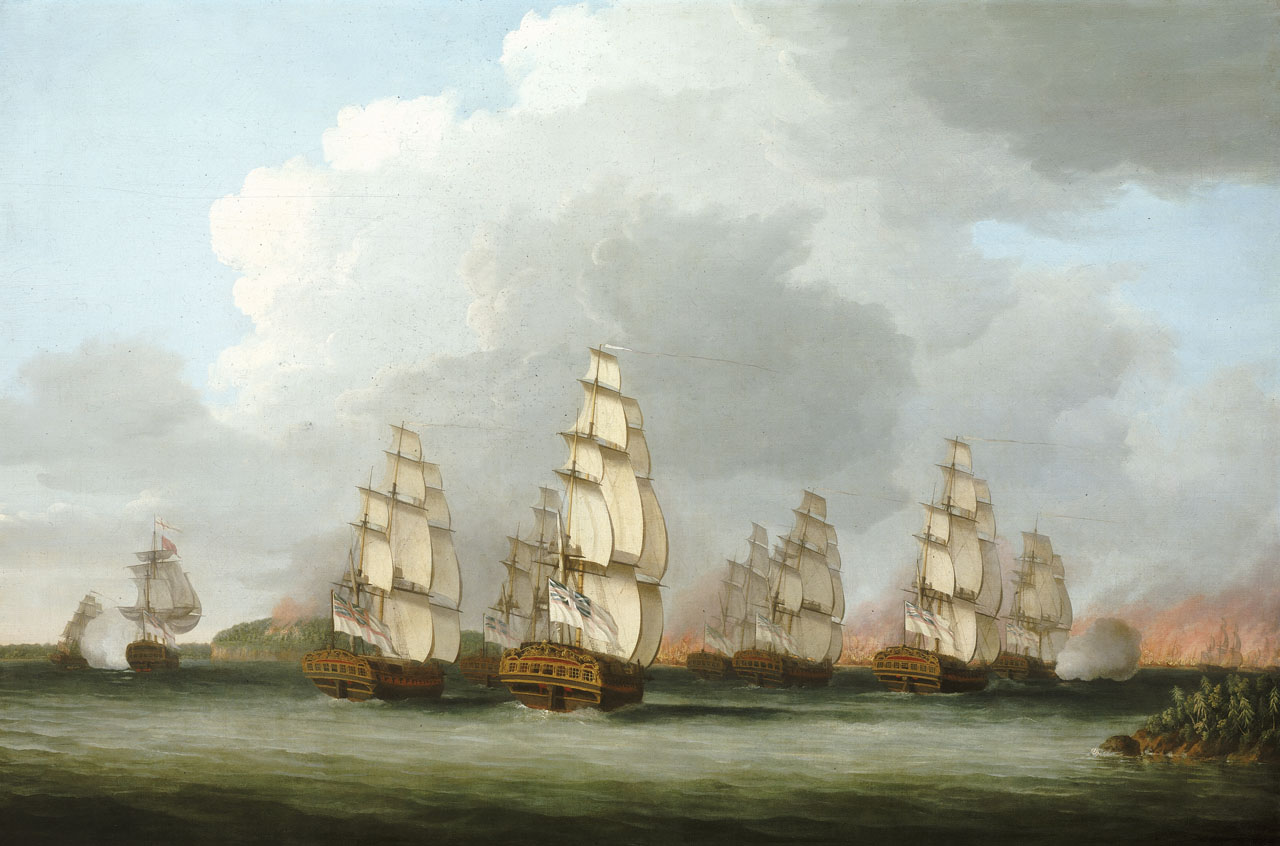
Penobscot Expedition by Dominic Serres, circa 1779. (Wikimedia Commons). Warren met her end in this American defeat.
On May 15, 1776, the Continental Navy frigate Warren-32 slid down the ways into the Providence River, the first purpose-built American frigate to taste water. The local committee came up with fifty dollars to pay musicians and throw a party for the men who had worked on her. Eight more followed her in the next few weeks: Providence-28 (Providence) on May 18, Raleigh-32 (Portsmouth) on May 21, Boston-24 (Newburyport) on June 3, Hancock-32 (Newburyport) in July, Delaware-24 and Randolph-32 (Philadelphia) a few weeks later, Virginia-28 (Baltimore) in August, and Trumbull-28 (Chatham) in September.[i] They were far from finished. Rigging, masts, equipment, guns, and crews were all still necessary to complete them.
The colonies already had a navy, just back from a successful, if ill-considered, raid on the Bahamas, where it had seized cannon, shot, and other war materiel already making its way into the armed forces of the rebelling colonies. But, the ships were all converted civilian vessels turned into ad hoc navy ships. Some performed well; others were ill-suited to combat. But, these new ships were designed for war, making May 15 a seminal moment in the history of the Continental Navy. Thirteen colonies, which hadn’t declared their independence, were creating capabilities designed to take the fight to the mother country on the sea, where she was strongest.
The Continental Congress approved the creation of this second generation of naval vessels on December 13, 1775 after reviewing the report of a committee created specifically for the purpose. It intended to build 13 ships: five of 32 guns, five of 28, and three of 24. Congress was precise in the amount to be paid for these ships: 866,666 and 2/3 dollars for all of them, roughly 66,666 and 2/3 dollars each. Due to the limitations of the American shipbuilding industry—no yard was large or capable enough to handle the entire order in a timely fashion—the Congress spread construction across seven colonies. It also helped firm up political support for financing the fleet, a practice still evident today. Each colony was to provide the materials for the hull and masts assigned to it, but Congress undertook to provide the canvas and gunpowder.[i]
Captain Esek Hopkins, Commander in Chief of the Continental Navy, transferred his flag to Warren in December 1776, an indicator that he was ready to go to sea. Still, he struggled with recruitment and the Royal Navy blockading Narraganset Bay. Hopkins might be ready, but Warren wasn’t. It was more than a year before she finally reached open water in March 1778. Warren took two prizes, but entered Boston harbor on March 23 after only two weeks at sea. She sortied briefly again in the fall, and, a third time in company with two other vessels. On this cruise, in the spring of 1779, she took seven of nine ships in a British convoy. She put to sea a fourth time in July 1779 under the command of Captain Dudley Saltonstall, who was also leading an impressive American battle fleet to Penobscot Bay to eject a new British lodgment on the Bagaduce Peninsula. The Penobscot expedition was the largest American amphibious operation of the war. Unfortunately, the campaign against the British unraveled within days of reacing the peninsula. It wasn’t long before a superior British squadron arrived. The American ships fled deeper into the bay. Trapped eventually, their crews set them afire to keep them from falling into British hands. It was the worst American naval defeat of the war and a sad ending for a frigate that had begun life with such promise in May, 1776.[1]
[i] “Journal of the Continental Congress, December 13, 1775,” William Bell Clark, ed., Naval Documents of the American Revolution, Volume 3 (Washington, DC: Government Printing Office, 1967), 90.
[i] Nathan Miller, Sea of Glory: A Naval History of the American Revolution (Annapolis, MD: Naval Institute Press, 1974), 209-210. The celebration in Providence was held on May 18 after the Providence’s hull joined the Warren in the river.
The American Revolution lasted eight years, 1775-1783. Why then do we celebrate 1776 and not the end of the war? Continental Congress presented the Declaration of Independence to the world on July 4, 1776. That’s the big deal.
There was something different about this revolution against British authority. The colonies were better organized. The people, policymakers, and military worked in harmony, though imperfect, toward freeing themselves from the bonds of the British Empire. Lexington and Concord had loudly proclaimed the shots heard round the world in April 1775.
By the second year, the colonial armies already had two significant military achievements in the winter and early spring. The militia turned back the invading southern British army at the battle of Moore’s Creek Bridge, North Carolina, in February. This victory contained the Redcoats in the southern theater to South Carolina. Up north, the British army withdrew from Boston in March, giving the colonists a physical and moral achievement. The leaders of the Glorious Cause, however, knew violence and blood wouldn’t be enough to win the war as failed Scottish and Irish uprisings had demonstrated all too well.
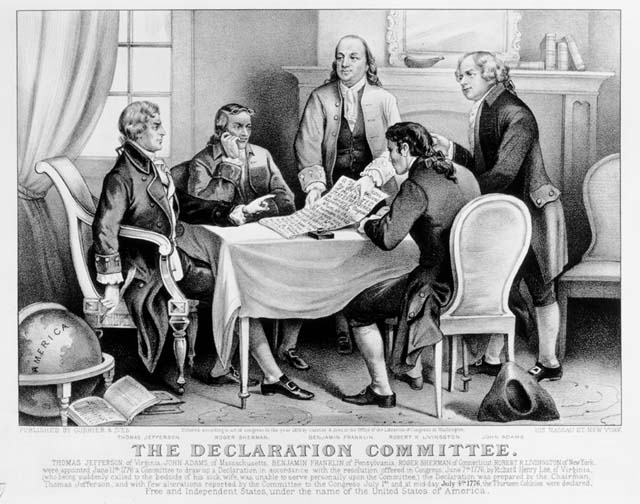
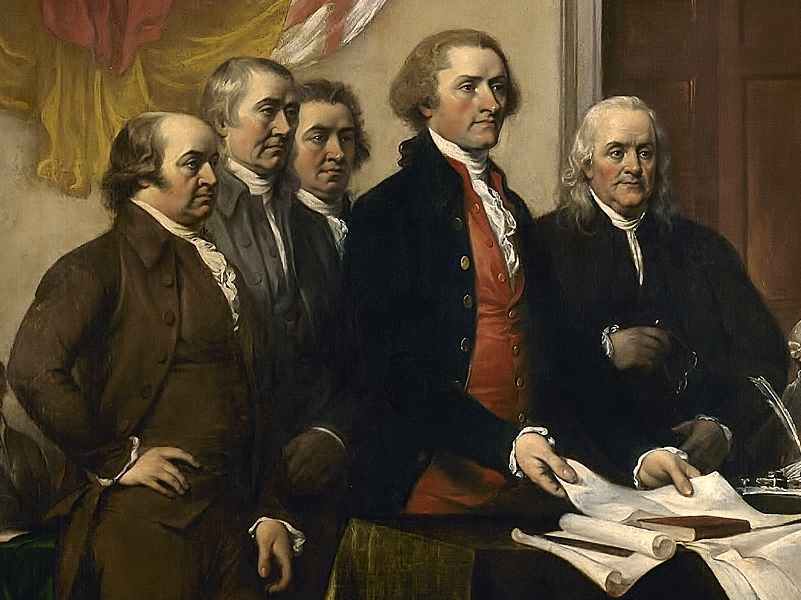
It was now up to the Continental Congress to fire a political shot. Congress tasked a committee of five to draft a declaration in June 1776. The members included Thomas Jefferson, John Adams, Benjamin Franklin, Roger Sherman, and Robert R. Livingston. Jefferson was the principal author. By July 1776, a final version was signed and submitted. It was only two paragraphs, but its words were, and still are, heard round the world.
The Declaration of Independence succinctly describes two of the five “Ws” of the war. Why we were fighting, or the main political goal, was first to be put forth. The colonists demanded a political divorce from British rule. As the committee wrote, at times “…it becomes necessary for one people to dissolve the political bands which have connected them with another …” Instead, the colonies wanted to form their own government based on a constitutional republic. It would be equal in standing to all other sovereign nations. That was the Why.
Then our founding fathers pulled the trigger and laid out the What, the reasons or “unalienable rights” we were fighting for against the crown. “We hold these truths to be self-evident, that all men are created equal, that they are endowed by their creator with certain unalienable rights, that among these are life, liberty, and the pursuit of happiness.” The King and Parliament hadn’t given these rights to any of their colonies or even their own citizens.
In fact, quite the reverse, British rule had subjugated the American colonies in “a long train of abuses and usurpations.” Redcoats threw colonists in jail without due process. Colonists were hung without a trial or after an unfair trial. Parliament levied taxes on colonial goods at a whim. We were subjects. We were here to serve the crown. Facing such despotism, the colonies had every right to abolish political ties with the British Empire and pursue life, liberty, and happiness.
It’s these three rights that we will soon be celebrating by commemorating the 250th Anniversary of the document that declared those rights, the Declaration of Independence.
Emerging Revolutionary War welcomes back guest historian Bjorn Bruckshaw
By the spring of 1776, the people of Rhode Island no longer needed to speculate about their relationship with Great Britain—they were already living in open resistance to it. War had begun the previous year, British naval power remained a constant threat along the coast, and the colony’s long history of defiance toward imperial authority had already brought confrontation to its shores. The destruction of His Majesty’s schooner Gaspee in 1772 had marked a decisive escalation, transforming protest into direct action against the Crown.¹ Now, as members of the Rhode Island General Assembly made their way to Providence in early May 1776, they did so with the reality of war firmly in mind. The question before them was no longer whether they opposed British authority, but whether that authority could continue to exist at all within their government.
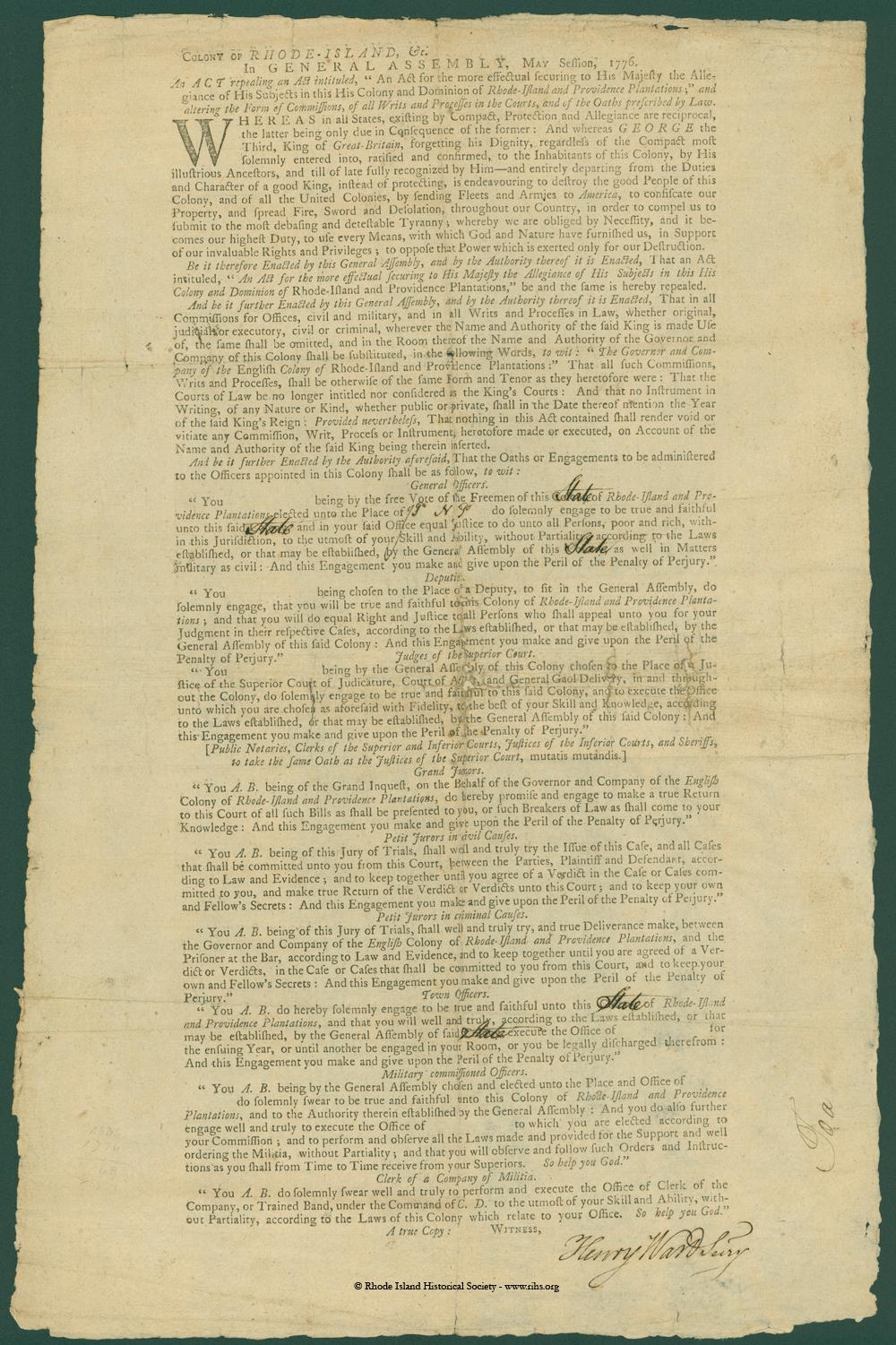
Rhode Island Independence Document
Inside the Assembly chamber on May 4, 1776, that question was answered with clarity and finality. Without issuing a sweeping declaration or engaging in extended philosophical argument, the legislature passed an act that removed King George III from every function of governance within the colony. The law ordered that “in all commissions, writs, and other proceedings in the courts of law,” the name and authority of the king be omitted.² In their place stood the authority of the colony itself. The act further directed that royal authority was to be “totally suppressed.”³ Courts would continue to function, but under a new source of legitimacy. Officials would take new oaths. The government would proceed without reference to the Crown. Rhode Island did not simply declare independence—it enacted it.
This action did not emerge suddenly. For years, Rhode Island had been among the most resistant of the colonies to British imperial control, particularly in matters of trade and enforcement. British officials repeatedly complained of the colony’s defiance, noting the difficulty of imposing authority in a place where regulations were often ignored.⁴ That resistance became unmistakable with the Gaspee affair, and the Crown’s response—threatening to transport suspects to England for trial—provoked widespread alarm. Colonial critics warned that such measures would undermine “that great bulwark of English liberty,” the right to trial by a local jury.⁵ By the time hostilities began in 1775, many Rhode Islanders had already concluded that reconciliation with Britain was increasingly unlikely.
That understanding was reflected not only in legislative action, but in the colonial press. The Providence Gazette soon reported the Assembly’s proceedings, noting that the legislature had taken measures removing the authority of the Crown from government functions, a step consistent with the colony’s wartime posture and political condition.⁶ While not framed in celebratory or rhetorical language, the report treated the change as a matter of governance already in motion. Similarly, the Newport Mercury, writing amid growing military uncertainty, reflected a broader shift in tone, reporting colonial affairs in a way that assumed the imperial relationship was breaking down beyond repair.⁷
These accounts are significant not because they proclaim Rhode Island’s primacy, but because they demonstrate how independence was understood in real time—not as a single dramatic declaration, but as a series of actions already unfolding.


 Emerging Revolutionary War Era