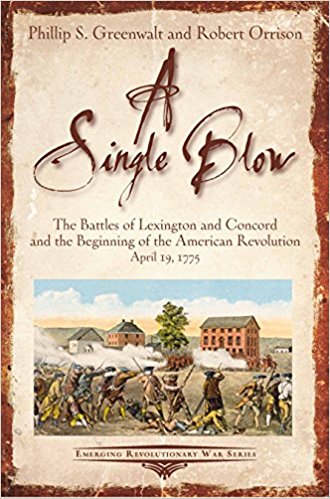
In honor of April being National Poetry Month, we share the connection of the literary icons of Concord (MA) and its American Revolution heritage. Concord historian Jayne Gordon wrote about these connections in an appendix in our recent release “A Single Blow.” Below is part of that text.
None of the eighteenth-century Concord authors lived through the American Revolution, yet reminders of that eighteenth-century war abounded in Concord in their lifetimes. Their neighbors were the grandchildren of the minutemen; veterans of the war were still among the townsfolk. Buildings, gravestones, old roads, and other landmarks evoked that part of the past, and they were surrounded by the stories of the fateful day of April 19, 1775. They each drew on their interpretations of the Revolution’s symbolic meaning, and incorporated those ideas into both their private and public writings.
The “Old Manse” next to the North Bridge in Concord
In the case of RALPH WALDO EMERSON (1803-1882), there was a direct historical link to a grandfather who had played a significant role in the beginnings of the Revolution. Sixty years after colonial militiamen confronted the British troops at the North Bridge within sight of the Old Manse, the grandson of patriot minister Reverend William Emerson would come to his ancestral home to stay, writing in his journal, “Hail to the quiet fields of my fathers! . . . Henceforth I design not to utter any speech, poem, or book that is not entirely & peculiarly my work.”Continue reading “THE AUTHORS AND THE AMERICAN REVOLUTION IN CONCORD”→
Modern Replica of Fort Randolph in Point Pleasant, WV (Wikimedia Commons)
At Fort Randolph, erected on the old Point Pleasant battlefield, Captain Matthew Arbuckle decided to take matters with the Shawnee into his own hands. He was already suspicious of the Shawnee in general, and Cornstalk in particular. In 1776, he reported that Cornstalk had traveled to Detroit and was “Treating with the English.”[i] Of course, this was William Wilson’s attempt to preserve the neutrality of tribes nearer Detroit by inviting them to a pace conference. Cornstalk had gone on the mission to lend weight to Wilson’s voice with those tribes. Arbuckle did not know that. Continue reading “Chief Cornstalk’s American Revolution (part two)”→
When writing a book, one of the most important initial aspects is picking a title. The author needs one that is expressive, attracts attention, but has some overall tie-in that provides a fitting capture of the essence of the book.
One of the advantages of writing history is the use of quotes. Let the participants, combatants, or witnesses of the event provide the context for a title. When one resonates, go with it!
With the recent publication, the co-author, Robert Orrison and myself bounced various potential titles off each other. Then we had a list of our favorites included in the initial information sheet sent to Ted Savas, of Savas Beatie, LLC, the publisher. Yet, one continued to stand out, as it was written in a diary by a British junior officer slightly more than a month before the Battles of Lexington and Concord.
The entire inscription is below:
“It is certain both sides were ripe for it, and a single blow would have occasioned the commencement of hostilities.” —Lieutenant Frederick Mackenzie, Royal Welch Fusiliers, March 6, 1775.
Mackenzie’s uncanny foresight predicted the exact outcome of the fighting that erupted on April 19, 1775. With casualties suffered by both sides, the war of words and near-misses became a war of shot and shell.
Hostilities had commenced and we had a title. A Single Blow: The Battles of Lexington and Concord and the The Beginning of the American Revolution.
Love brought Dr. Samuel Prescott, a practicing physician, to the town of Lexington on the night of April 18, 1775. The young doctor was courting Ms. Lydia Mulliken, when the alarm of the British soldiers marching from Boston went out to the local militia. Lydia’s brother was one of those called to gather.
Love. That emotion also drew Dr. Prescott back toward his hometown of Concord—this time to alert friends, neighbors, and family members of the urgent news of the evening. En route, Dr. Prescott along with Paul Revere and William Dawes, alerted the countryside of the moving British troops. After being vetted and vouchsafed as a true friend of liberty, Dr. Prescott rode posthaste to his hometown, where his word carried greater weight.
A artist’s interpretation of Paul Revere’s (or maybe William Dawes or Dr. Samuel Prescott)’s ride to warn the Massachusetts countryside. (courtesy of VFW)
When one studies British General Thomas Gage and his performance leading up to Lexington and Concord you must step back and put yourself in Gage’s position. A man that believed not only in Royal authority over the American colonies, but also in the basic rules of law. Gage was not anti-American by any means.
In November 1763, Gage was placed in overall command of British forces in the American colonies and settles in New York. At this time Gage was well respected by most American colonists. Of course, this all changed in 1774 when Gage was sent north to Boston to become the Royal-appointed Governor of Massachusetts and enforce the highly unpopular Port Bill that closed the port of Boston among other harsh actions. He was walking into a situation that most historians today argue was a no-win situation. Continue reading ““Acts of a Rude Rabble…” General Gage, Lord Dartmouth and Ignorant Orders”→
As British General Thomas Gage and his American Whig (or Patriot) antagonists squared off in Boston and the surrounding towns, information gathering became the key to success. Both sides had created networks of spies, but the advantage was clearly in favor of the Whigs. During the winter 1774-1775, groups such as the Sons of Liberty had established a complex spy network within Boston comprised of a system of riders that spread information and “alarms’ quickly. The Committee of Safety and the Massachusetts Provincial Congress relied on this network to stay informed of what was going on in Boston and the British intentions. Continue reading “Two Riders….Gage Gathers Information”→
While reading background on the siege and victory at Yorktown, Virginia in October 1781, I came across the following passage written by historian Jerome Greene.
“The officer was then quickly escorted to Washington’s headquarters in a nearby house, where he delivered Cornwallis’s message: “I propose a Cessation of Hostilities for 24 hours, & that two Officers may be appointed by each side, to meet at Mr. Moore’s house to settle terms for the Surrender of the Posts of York & Gloucester.” One can only imagine the emotions coursing through Washington’s body as he read these words.”
That last line is what really struck me.
Every image we have of George Washington depicts a stoic expression staring back out of us. Historians have a few instances from a long life of the Washington behind the marble, behind the self-imposed restraint, that he crafted for posterity.
However, he was human, he did have a fiery temper and he was a passionate person. One of the reasons he strove so hard to mask those emotions, to keep them in check, to keep perspective, and to persevere.
Those competing inclinations would have been bubbling at the surface on October 17, 1781, when that written communication was handed to him outside Yorktown, Virginia. What that moment must have been like, for Washington, for the French and American forces, and for all those fighting in favor of American independence.
Jerome Greene wondered about it. I am curious about it. Are you?
From a Pennsylvania State Historical Commission marker, one quickly can find out the importance of Osborne Hill to the Battle of Brandywine, fought on September 11, 1777.
Osborne Hill Marker (courtesy of Keith Smith, hmdb.org)
The hillside was the site of British General William Howe’s post in which he coordinated and commanded the different components of the British and Hessian forces that day. The battle opened the way for the British conquest of Philadelphia and was the largest, in terms of manpower fighting, of any American Revolutionary War battle.
19th century print of the Battle of Harlem Heights. The image shows the Americans attacking the British right flank.
After the Battle of Long Island, American forces evacuated to Manhattan Island. But with the British in command of the waters around New York, they easily could land their forces anywhere along Manhattan Island. On September 15th, the British crossed the East River north of New York City and landed at Kip’s Bay, easily pushing aside the American forces there. American forces in New York City were nearly cut off, but quickly retreated up Manhattan Island to Harlem Heights and began to dig in. On the morning of the next day, British troops arrived in front of the American lines at Harlem Heights. Washington expected an attack and decided to take the initiative.
Washington ordered a small party of 150 men called “The Knowlton Rangers” under the command of Lt. Col. Thomas Knowlton to move out and reconnoiter the British position. Knowlton quickly recognized the British were not planning a major assault but his force had brought about the attention of the British light infantry, soon the Knowlton Rangers were outnumbered and quickly retreated back to the American lines. When Knowlton reached safety, the British light infantry paused, placing them out in front of their main lines. Washington seized the opportunity and ordered an assault on their rear by Knowlton’s men and a reinforcement of 200 Virginia riflemen from the Third Virginia under Major Leitch.
Though the American attack was supposed to be in the rear of the British light infantry, but because of confusing terrain and attacking too soon, the flanking column instead hit the British in their flank. The effect still had an adverse effect on the British light infantry as they began to fall back. The Americans fought with determination and bravery. Knowlton went down mortally wounded. Colonel Griffith wrote of Leitch “He conducted himself on this occasion in a manner that does him the greatest honor, and so did all of his party.” Washington wrote the next day that “The General most heartily thanks the troop commanded yesterday by Major Leitch, who first advanced upon the enemy, and the officer who so resolutely supported them.”
At the head of the attacking column both Knowlton and Leitch led their men forward to attach the British flank. Early in the attack both men went down wounded. Knowlton died on the battlefield, Leitch took three musket balls to the abdomen and was carried off the field. At first most reported his condition as improving and he was thought to survive his ordeal. Washington wrote “Majr Leitch of Weedons Regiment (Third Virginia) had three balls through his side, and behaved exceedingly well – he is in fair way of recovery.”
Soon the British began to retreat back to their main line. Washington then ordered an attack along his line and the British light infantry fell back to the main line in confusion. Soon the entire British line began to give way. After about a 90 minute fight, Washington learned that more British forces were arriving on the field and ordered his men back to the main line. Though not a major victory, the American army had finally stood up to the British and even for a moment, pushed them off the field in combat. The British suffered 14 killed and an estimated 154 wounded, with the Americans suffering 30 killed and 100 wounded.
Though most believed that Leitch was recovering from his wounds, by September 20th Gen. Horatio Gates wrote “Major Leitch of Maryland was wounded and despaired of.” As his condition worsened, there was little for regimental surgeon David Griffith could do but to try to ease Leitch’s pain. Griffith wrote to Leitch family friend Richard Henderson on October 3rd that “[I] disagreeable duty of informing Mrs. Leitch through you, of the death of her husband is imposed upon me. He expired yesterday morning at Hackinsack Bridge where he had been removed for his better accommodation…But on the 28th Sept he was seized by lock’d jaw – with spasms about his neck and throat so violent as to baffle every effort to minister to him by medicine.” It seems the death of Leitch was a tough and unexpected blow to his fellow officers in the Third Virginia Regiment.
Where Major Leitch’s remains are today is a mystery. Captain John Chilton wrote on
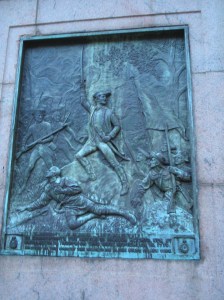
Commemorative Plaque showing the wounding of Knowlton and Leitch
October 4, 1776 that “the brave Major Leitch who died of his wounds received the 16th was interred yesterday by the side of Major Henly.” We know the general area of the American camps in the fall of 1776, but this burial location is long lost to history. In 1897, historian Henry Johnston wrote in his account of the Battle of Harlem Heights that Knowlton and Leitch are probably buried somewhere “on St. Nicholas Avenue, between 135th St and 145th St.” in New York City. Of course the land has changed a lot since then and whatever remains were left were destroyed by modern development.
Today the area of the Harlem Heights battlefield is now under the campus of Columbia University in New York City. Today there is a simple plaque on the wall on the eastside of Broadway north of 117th Street. This plaque commemorates the Battle of Harlem Heights and depicts Major Andrew Leitch as well as Lt. Col. Thomas Knowlton (who was mortally wounded in the same attack as Leitch). Near here is where Leitch was mortally wounded turning the flank of the British line.
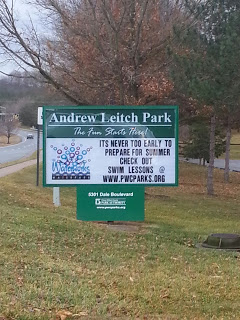
The search for Andrew Leitch continues. His contribution to the American Revolution is well documented through the letters of George Washington and others. When he moved to Dumfries, VA and where he lived is still unknown. We do know that he was influential enough to be elected to Prince William County’s Committee of Correspondence in 1774 and involved in the efforts to raise men and funds for local companies of troops. Continued research in his widow’s pension cases as well as researching contemporary archives may turn up new information. For now, he is honored with a plaque in New York City and a small park here in Virginia. My hope is that this story will end with an appropriate understanding and remembrance of a man who gave his life for our nation’s independence.
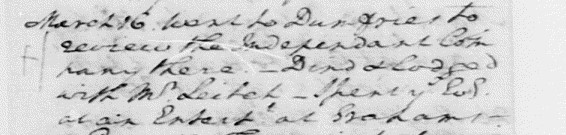
Entry in George Washington’s Papers for March 16, 1775: “Went to Dumfries to review the Independent Company there, Dined and Lodged with Mr. Leitch…”
For Further Reading:
Johnson, Henry. The Battle of Harlem Heights. New York: Macmillan Company, 1897.
Peters, Joan. The Third Virginia Regiment of Foot, 1776-1778, Volumes 1-2. Westminster (MD): Heritage Books, 2008.
After his first battlefield victory at the Battle of Harlem Heights on September 16, 1776, General George Washington wrote “The General most heartily thanks the troop commanded yesterday by Major Andrew Leitch, who first advanced upon the enemy, and the others who resolutely supported them.” The battle was a small victory for the American army, but instilled some confidence in the men who had suffered many defeats since August on Long Island and lost New York City to the British. One of the main players in this action was Major Andrew Leitch. A little known Continental officer who at the time was considered a rising star, but today is mostly forgotten.
But my connection with Andrew Leitch goes beyond my love and interest of the American Revolution, it is more personal than that. In 2008 I met the woman that became my wife. At the time, she ran a park locally named Andrew Leitch Park. Having worked here locally for a few years, I was not aware of who the park was named after. I did a quick search of the name Andrew Leitch and realized we had a Revolutionary War hero. In my ignorance thinking everyone was as interested in history as I was, I assumed my future wife knew this fact. Of course…she didn’t. But now I had an “in” to keep talking to this young lady. And of course…she saw through it and had little interest in Andrew Leitch but it worked out and now we are married and have two great young kids. So, I partly owe all of this to Mr. Andrew Leitch.
Who was this little known hero and why did have a park named after him in Prince William County, VA? In 1774 Andrew Leitch moved to Virginia from Maryland and began a new life in Northumberland County. He and his wife Margaret had three children and Leitch must have had influence because he was able to secure a commission as Captain in the 3rd Virginia Regiment on February 6, 1776. In this capacity he recruited men from Prince William County and led the Prince William Battalion (which also included men from Loudoun County). The Prince William Battalion joined the rest of the 3rd Virginia in Williamsburg in late February. Soon though Leitch received a promotion on June of the same year to Major in the 1st Virginia Regiment (though there is one source that places his promotion to Major on March 18th). As Washington moved his Continental Army from Boston to New York City in March 1776, he called for reinforcements. Men of the 1st Virginia and 3rd Virginia were called to join Washington in New York. For reasons unknown, the 1st Virginia was slow to get to New York. Leitch seemed to be a man of action as he joined his former men in the 3rd Virginia on their march to New York as they were a few weeks ahead of the 1st Virginia.
The 3rd Virginia did not arrive in New York in time for the disastrous Battle of Long
The Third Virginia flag captured at the Battle of Waxhaws on May 29, 1780. The flag is in a private collection.
Island, arriving in early September to join the American army on Harlem Heights. Washington was happy to see his fellow Virginians and he needed the reinforcements. The Americans had lost New York City and were pushed off of Long Island, all the way up to the northern tip of Manhattan Island. The Americans needed something to encourage them, a battlefield victory. Major Andrew Leitch played a crucial role in delivering that victory, though at a horrible cost.
Part 2 will cover Andrew Leitch’s role in the Battle of Harlem Heights and his once forgotten legacy.






 But my connection with Andrew Leitch goes beyond my love and interest of the American Revolution, it is more personal than that. In 2008 I met the woman that became my wife. At the time, she ran a park locally named Andrew Leitch Park. Having worked here locally for a few years, I was not aware of who the park was named after. I did a quick search of the name Andrew Leitch and realized we had a Revolutionary War hero. In my ignorance thinking everyone was as interested in history as I was, I assumed my future wife knew this fact. Of course…she didn’t. But now I had an “in” to keep talking to this young lady. And of course…she saw through it and had little interest in Andrew Leitch but it worked out and now we are married and have two great young kids. So, I partly owe all of this to Mr. Andrew Leitch.
 Emerging Revolutionary War Era