ERW Weekender: In the Footsteps of James Madison

Emerging Revolutionary War welcomes guest historian Kate Bitely 

In the Foot Steps of James Madison.

A view of the front yard of Montpelier
A view from the front yard of Montpelier (author collection)

Spring is finally here in Virginia and if you are looking for a place to explore that offers a great outdoor experience, get in the car and head to Montpelier, in Orange Virginia. James Madison’s plantation home offers visitors a glimpse of what life was like in colonial America.   Be sure to start your trip with the feature film in the welcome center that provides highlights of Montpelier’s lengthy history dating back to the mid 1700’s.  The preserved property has something to offer everyone including hikes, gardens, and a breath-taking view of the blue ridge mountains. The grounds are filled with opportunities to learn about our nation’s early history and the impact it still has on our country today. Continue reading “ERW Weekender: In the Footsteps of James Madison”

Alexander Hamilton’s “First” Duel

glc07167engweb_
Lt. Col. Alexander Hamilton at Yorktown, VA by Alonzo Chapel

Alexander Hamilton has reappeared as a modern pop star with the wide success of the Broadway musical “Hamilton.” Due to this success, most people today know that Alexander Hamilton met his end in a duel with Aaron Burr on the banks of the Hudson River. But this was not Hamilton’s first involvement in a duel, nearly 26 years earlier Hamilton found himself embroiled in a feud with one of highest ranking Continental officers, Maj. Gen. Charles Lee.

It all started on June 28, 1778 at the Battle of Monmouth. The beginning of the battle had gone against the Americans and Lee, who was in command of the vanguard was ordering a retreat in front of the British. Washington, seeing the retreat rode ahead and encountered Lee. What was said between the men has been debated since that day, but what is not indisputable is that Lee took offense. Continue reading “Alexander Hamilton’s “First” Duel”

Thanksgiving with the Continental Army, 1777

Abraham Lincoln usually gets the credit for establishing Thanksgiving as a national holiday in 1863.  He deserves much of it for making it an annual event.  But, Lincoln was harkening back to an earlier practice of giving thanks amidst the trials and tribulations of war, whether it was going well or not.  The tradition predated the Revolutionary War generation, but they were as apt to a hold national day of giving thanks as any of their predecessors or successors in American history.  Continue reading “Thanksgiving with the Continental Army, 1777”

George Washington’s Greatest Speech?

On the morning of March 15, 1783, George Washington strode into the “New Building” or “Temple” as the structure was referred as, to address the assembled officers of the Continental Army. He asked General Horatio Gates if he could have the floor to say a few words and when he unfolded his pieces of paper on the podium, the words lost their importance.

Why? Continue reading “George Washington’s Greatest Speech?”

Another American in Paris

IMG_0931So, vacation time rolls around again and this year my family and I had an opportunity to travel to Paris, France for a few days.  Riding into the city from Charles de Gaulle Airport, our taxi driver, by chance, took us past an old, green-corroded bronze statue, set in the middle of a little flowered square.  From my vantage, I could only see the bottom portion of the statue; what appeared to be the lower portion of a man in buckled shoes, seated in a wooden chair, atop a marble pedestal.  My wife happened to be in the right spot in the vehicle as we quickly drove by.  “Looks like Benjamin Franklin, I think.” she said, and with those words, she sent me on a journey to find that statue again and, hopefully, other sites in Paris associated with Mr. Franklin.

Unlike his colleague from New England, John Adams, who was from good, plain Puritan stock, the pulse of a city like Paris, with its decadence, opulence and social intrigue, fit Benjamin Franklin like a glove.  As ambassador to France after the signing of the Declaration of Independence, Franklin was instrumental in helping to obtain for our fledging nation the financial and military support necessary for bringing our war for independence to a happy conclusion.  To the people of Paris, he was somewhat of a celebrity, due to his experiments with electricity. He spoke French and endeared himself to the people by displaying, in his dress and speech, what they considered his “rustic” demeanor.  In a word, they were charmed by Benjamin Franklin.  The fur cap he was fond of wearing only added to his disguise of “homespun rusticity”.  So, finding a monument to him in this city was not much of a surprise.  Continue reading “Another American in Paris”

The Brush of John Trumbull

Emerging Revolutionary War welcomes back guest historian Michael Aubrecht

Trumbull
John Trumbull

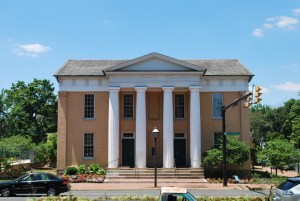
John Trumbull’s paintings represent some of the most familiar depictions from the time of the American Revolution. Trumbull was a graduate of Harvard University and the gifted son of the Governor of Connecticut. As a child, Trumbull showed a remarkable talent for an attention to detail. This aptitude set his drawings apart from his contemporaries. Trumbull traveled to London in 1784 to study painting under the master Benjamin West. It was then that he started painting some of his most notable pieces. There he honed his expertise for realistic painting. A year later later Trumbull traveled to the City of Paris to do commissioned artworks. He later did portraits of George Washington, John Adams, Alexander Hamilton and Thomas Jefferson. In 1816, he was selected as the president of the American Academy of the Fine Arts where he would serve for 20 years. Emphasizing classic traditions Trumbull attempted to teach the skills he had acquired while overseas. Following his death in 1843 at the age of 87, Trumbull was buried beneath the Art Gallery at Yale University which he had designed. In 1867, his collection of artworks were displayed at the Street Hall building on the same grounds. He and his wife’s remains were later re-interred and buried on the grounds of that building. Trumbull’s approach to painting has been studied by art students around the world. Today Trumbull’s paintings remain some of the most cherished ever to be painted by an American artist.  Continue reading “The Brush of John Trumbull”

Review: First Founding Father: Richard Henry Lee and the Call for American Independence by Harlow Giles Unger

ERW Book Reviews (1)

A member of one of Virginia’s first families, Richard Henry Lee was a critical voice in America’s struggle against Great Britain. Born at the family home, Stratford Hall, in Westmoreland County, Lee was educated in England. In 1758, he entered Virginia’s House of Burgesses. Seven years later, Lee’s efforts on the road to independence began.

In response to the recent passage of the Stamp Act, Lee co-authored what became known as the Westmoreland Resolves. The document condemned fellow colonists who paid the related tax as well as the British Parliament. As tensions rose with Britain, Lee proposed a means for the individual colonies to communicate with one another. This idea birthed the Committees of Correspondence. In 1774, Lee was elected to the Continental Congress which met in Philadelphia. It was here in the early summer of 1776 that Lee suggested a bill for the colonies to break all allegiance with England and form a United States. The proposal was the basis of the Declaration of Independence. Continue reading “Review: First Founding Father: Richard Henry Lee and the Call for American Independence by Harlow Giles Unger”

Lachlan McIntosh

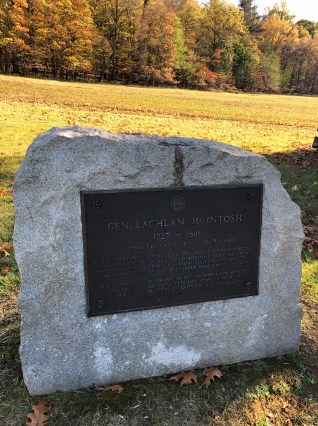
On a recent trip to Valley Forge National Historical Park I came across the monument to featured below, of a general that did not initially ring a bell in my memory. So I did a little investigating. The first name was intriguing. His story even more so. Especially how he came to spend the winter at Valley Forge.

Lachlan McIntosh
Lachlan McIntosh Monument, Valley Forge National Historical Park (author collection)

Born near Raits, Badenoch, Scotland on March 17, 1725 and at the age 11, Lachlan, along with his family and approximately 100 other Scottish immigrants, landed in Georgia where they founded the town of New Iverness. Out of all the cruelties that could visit a family eking out a future on the frontier, the calamity that claimed Lacklan’s younger brother would have been far down the list. While swimming in the Altamaha River in 1737, Lewis McIntosh was killed by an American alligator.  Continue reading “Lachlan McIntosh”

Standing in the Room Where American Was Born

Indep Hall WindowAs I stood in Independence Hall, in the room where the Founders debated the Declaration of Independence, I suddenly started thinking of the opening scene from the musical 1776, when John Adams cries for independence while everyone else complains about either the heat or the flies. “Won’t somebody open up a window?” one of the delegates pleads. “Too many flies!” others respond, shouting him down. Adams is advocating the most lofty of ideas but everyone else is mired in their own personal discomfort. What a great metaphor.

To stand in that room where Adams and the other delegates worked was a privilege. The tour group consisted of 50 people or so, so there was no opportunity for quiet reflection. There was no sublime, transcendent moment of awe or epiphany. The tour guide could not even tell me which table Adams sat at except “toward the back over here somewhere.”  Continue reading “Standing in the Room Where American Was Born”

“Adams and Jefferson: A Revolutionary Friendship”

On February 1, 2017 at 7:00 p.m. join Emerging Revolutionary War’s Derek Maxfield for the launch of the “Historical Horizons Lecture Series” sponsored by the Genesee Community College History Club.

Two of the most important men in American History are John Adams and Thomas Jefferson.  From the time they met in Philadelphia in 1775 until their deaths in 1826, these two men had a most fascinating relationship; much of the time it was one of admiration and love, but it was interrupted by a period of intense partisan strife that nearly ended the friendship.  Come hear the intriguing story of how the friendship was restored.

The lecture is part of the Historical Horizons Lecture Series sponsored by the GCC History Club.  Get the complete spring semester line-up here: https://gcchistoricalhorizons.wordpress.com/

All events are FREE and open to the public at the Genesee Community College Batavia campus, room T102 of the Conable Technology Building.