Visiting the Scene of Action: Battle of Camden

A reflection on the previous month’s exploration in South Carolina.

IMG_1905 (1)August 16, 1780 would prove to be a devastating day for the American Army in the south, known as the “Grand Army” by its commander, Maj. Gen. Horatio Gates, the Hero of Saratoga. The battle between this army and that of Lt. Gen. Charles, Earl Cornwallis, in the Pine Barrens near the South Carolina town of Camden, would end in the total rout of the Americans and the destruction of the reputation of its commander. It would also temporarily leave the southern colonies without a central army to oppose the British.

On November 1, members of the Emerging Revolutionary War Era staff took a road trip to Camden, SC to research the battle, walk the battlefield and meet with local historians in preparation for an upcoming addition to our book series, on the Battle of Camden.  On the way down, we took the opportunity of visiting other sites of combat, actions that occurred prior to and after the fight at Camden. Continue reading “Visiting the Scene of Action: Battle of Camden”

Disaster on the Eastern Frontier

Emerging Revolutionary War welcomes back guest historian Travis Shaw.

Part One

I’d be willing to bet that Maine isn’t the first place to come to mind when you hear the word “frontier”. For many Americans I imagine they immediately think of the wild west. Wagon trains of pioneers crossing the prairies, and Native nations like the Sioux and Apache ranging the plains on horseback. A century before the age of Manifest Destiny, however, the region that is now the state of Maine marked the eastern frontier of the English colonies. It was a wild and sparsely settled place, caught between New England and the French colonies to the north. The few European settlers eked out a living from the thin, rocky soil or turned to lumbering and to the sea. They lived alongside and often fought against the region’s original inhabitants – the Wabanaki or “People of the Dawn.” For two centuries the Eastern Frontier was torn apart by war between various European powers and their respective Native allies. Nowhere is this more clearly evident today than in the small coastal town of Castine, Maine.

Castine is located near the mouth of the Penobscot River, more or less in the middle of the Maine coast (Google Maps)

Continue reading “Disaster on the Eastern Frontier”

Book Review: A Battlefield Atlas of the American Revolution by Craig L. Symonds

ERW Book Reviews (1)

As a young history buff, I remember well wearing out the pages of the original A Battlefield Atlas of American Revolution by Craig Symonds. Though I have no idea where that well worn out book is today, I am happy to see that Symonds has revised and re-released his encompassing atlas, published by Savas Beatie Publishing.917TV+p0UsL.jpg

Symonds, using his experience as a lifelong teacher, approaches the war from the viewpoint of an educator. Breaking the war into four parts chronologically, Symonds provides a short narrative at the beginning of each section giving an overview of the action in each region and year. The battle descriptions for each map are thorough and give a great account of the action and the impact each event had on the overall campaign or war effort.

Symonds should be commended for covering lesser known campaigns and battles of the American Revolution such as Valcour Island, Fort Stanwix, Oriskany, Newport, Penobscot Bay and others. This enhances the work as it shows where these battles took place and speaks to the depth that Symonds took to comb the entire continent to include these minor yet important engagements in the atlas. For many readers, this will be the first time these actions have been visualized through maps.

As in his previous work, cartographer William Clipson provides easy to read and clear maps. The maps provide a good mix of detail and broadness to appeal to the casual history buff and dedicated researcher. As in his other atlases, the text flows well with the map as Symonds has numbers in the text that relate to specific parts of the map.

Though I enjoyed this book, there are two critiques of this volume. First, the size of the text which is very small and condensed. The font style and size selected could prove to be hard for some people to read. Secondly, a few of the maps have been cropped to the point where parts of the maps and text have been cut off, making them incomplete.

This book is a great addition to any library or better yet, in the glove box of your car as you visit these battlefields. It is a perfect companion in the field that allows one to understand the action and provides just enough of an overview to fill in for those battlefields that do not have any signage or interpretation. The information is detailed enough to give you a clear understanding of the battle and campaigns and the maps provide a great visualization of the action.


George Washington Passed By Here

One of my favorite places to visit are the Laurel Highlands of southwestern Pennsylvania. The area abounds in history, and its scenery is, in my view, unparalleled. Rugged mountains overlook beautiful valleys of hardwoods, streams and waterfalls. Rocky outcroppings emerge from the forest. Powerful rivers wind through the region

It is a center of industrial history: railroading and mining, transportation like canals, the National Road, and other scenic highways. There is even a bit of Civil War history in the region. But my favorite topic to explore is its French and Indian War history. Which brings me to the person who started it all, George Washington.

Continue reading “George Washington Passed By Here”

Press Release: Victory at Yorktown

ABT

Breaking on Friday, the 237th anniversary of the surrender of British Lord Charles Cornwallis’ surrender at Yorktown, there was another victory.

The American Battlefield Trust announced the successful acquisition of 49 acres of “hallowed ground associated with the 1781 battle.”

The full press release is at the link below!

Victory at Yorktown!

“Elbow Room” for “Uncle Johnny”

On this date in 1777, British General John Burgoyne surrendered to American General Horatio Gates around Saratoga, New York. This victory solidified French support for the fledgling American nation and became one of the turning points in the road to independence.

800px-BurgoyneByReynolds
General John Burgoyne

Out of this momentous occasion came an anecdote about the British general officer. The short story has some truth in it, yet, whether the entire tale is accurate, well, I’ll leave that for you to decide!

Two years prior to the Battles of Saratoga and upon arriving in Boston, Massachusetts, General Burgoyne remarked “Well, let us get in, and we’ll soon find elbow-room” when he was told the numbers of militia besieging British regulars around the town.

After his capitulation, Burgoyne and his forces were marched toward Albany, New York, and multitudes of people turned out to see the vanquished British and German soldiery along the route. One resident supposedly yelled from her homestead doorway;

“Make elbow room for General Burgoyne.” 

Not what he had envisioned in 1775 upon disembarking in North America. Yet, history does not relate what “Gentleman Johnny” Burgoyne thought exactly about the elbow room he received in the countryside of upstate New York!*


This slideshow requires JavaScript.


*“Gentleman Johnny” was a nickname acquired by Burgoyne was stationed in London with the Horse Guards, a fashionable cavalry regiment.” 

**Information gathered from A.J. Langguth’s “Patriots” and The Patriot Resource, which can be found here.

Summer Lecture on Summer of 1787

This past July I had the pleasure to attend and present at the American Battlefield Trust Teacher Institute. One of the keynote speakers was David O. Steward, the author of Summer of 1787: The Men Who Invented the Constitution. During his talk, there were a few points that stuck out to me and I share them with you.summer of 1787 stewart

  • 72 elected, 55 attended, and 35 delegates were probably there all summer.
  • Out of the 55 that attended, 39 affixed their signatures to the document

In reference to George Washington, Stewart candidly remarked he had “more influence by keeping his mouth shut” almost as if by his calm, quiet demeanor, he was displaying that “I trust in you and I’ll try and make it work” with whatever the delegates designed in that hot and stuffy room in Philadelphia.  Continue reading “Summer Lecture on Summer of 1787”

Captain John Asbhy

Part Two

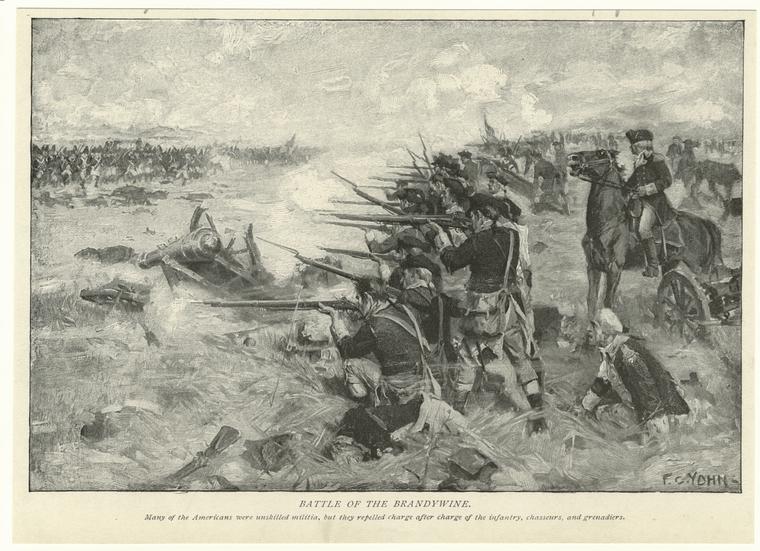
Captain John Ashby and his fellow Virginians would face their greatest test of the war on the afternoon of September 11th, 1777 at the Battle of Brandywine. Following a wide flank march the bulk of the Crown forces emerged on Washington’s right flank, ready to trap and smash the Continental Army. Washington reorganized his line, drawing men north in a desperate attempt to meet the new threat. The Third Virginia was ordered into position far in advance of the American lines – their objective was to hold a wooded hill near the Birmingham Friends Meeting House in order to buy time for the rest of the American troops to take up position. Ashby and his fellow officers arranged their men among the buildings and woodlot of the Samuel Jones farm and awaited the attack that was certain to come.

The Battle of Brandywine, September 11, 1777 (American Battlefield Trust)

Continue reading “Captain John Asbhy”

Missionary Extraordinaire: David Zeisberger

Over the summer, I took a family excursion to several Revolutionary War sites in Ohio, some of which I recently wrote about.  In particular, I wanted to trace the experience of several Moravian missionaries and their congregations in the no-man’s land of the frontier.  Traveling a back road along the Tuscarawas River between the villages of Gnadenhutten and New Schoenbrunn, we stumbled across the graves of David Zeisberger (1721-1808) and several notable missionaries at the crossroads of Goshen.

IMG_2559
Moravian Cemetery at Goshen, Ohio.  (Author Photo)

Continue reading “Missionary Extraordinaire: David Zeisberger”

Captain John Ashby

Emerging Revolutionary War welcomes guest historian Travis Shaw. 

Part One

As he looked northward across the open ground in front of his position, Captain John Ashby could see the advance guard of the British army moving steadily closer. They came on in a loose, open line, taking time to return the fire of Ashby’s men. Made up of red-coated light infantry and their German counterparts, the rifle-armed Jaegers, the advance guard were the cream of the Crown forces – men chosen for their fitness, marksmanship, and ability to endure hardship. Ashby and his men were veterans, so they must have known they’d be in for a fight. As the battle intensified around him, one wonders if Captain Ashby’s thoughts turned to home. The Brandywine Valley of Pennsylvania was a long way from his native Virginia Piedmont.

The Crooked Run Valley in northern Fauquier County looks much as it did when John Ashby lived there two centuries ago (Author_s photo)
The Crooked Run Valley in northern Fauquier County looks much as it did when John Ashby lived there two centuries ago (Author’s photo)

John Ashby was born in 1740 in northwestern Fauquier County, among the foothills of the Blue Ridge Mountains. The son of Robert Ashby and Rosanna Berry, he grew up at Yew Hill, the family estate that lay just a few miles from the Gap that bears the family’s name to this day[1]. John’s uncle and namesake, Captain “Jack” Ashby commanded a company of Virginia rangers during the French and Indian War, where he made the acquaintance (and drew the ire) of a young George Washington[2]. Continue reading “Captain John Ashby”