Fort Stanwix in Rome, New York, has plenty of history to offer, but it’s equally a success story of urban renewal. The fort’s original location was long swallowed up by the city’s expansion in the twentieth century, but it was then reclaimed in advance of the American Bicentennial. City blocks were razed, the fort reconstructed, and American history became a central tourist attraction in the heart of downtown Rome. It’s a “faithful reproduction,” the Park Service says, constructed using “many original plans and documents.”
The site of Fort Stanwix in 1969 and after its reclamation in 1976. (courtesy NPS)
A few random musings on the importance of this date in American Revolutionary history…
President’s chair, Independence Hall, Independence National Historical Park (author collection)
This day was the date that the assembled Second Continental Congress voted on the draft of a document that was Richard Henry Lee, a delegate from Virginia had put forth in a measure, in June, to be voted on declaring;
“That these United Colonies are, and of right out to be, free and independent States, that they are absolved from all allegiance to the British Crown, and that all political connection between them and the State of Great Britain is, and ought to be, totally dissolved.”
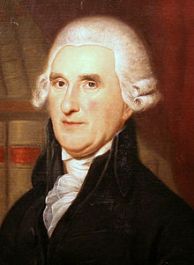
Thomas McKean by Charles Wilson Peale
On July 4, two days after this resolution passed, the final and formal version was approved by Congress. John Hancock, president of the Continental Congress affixed his signature boldly and largely at the bottom of the document. Eventually 55 other men would place their signature on the Declaration of Independence, with Thomas McKean, generally accepted, as the last to sign the document, possibly as late as January 1777.
Copies were made and four days later, on July 8, the first public reading occurred in Philadelphia. George Washington had the document read to the Continental Army in New York on the following day, July 9.
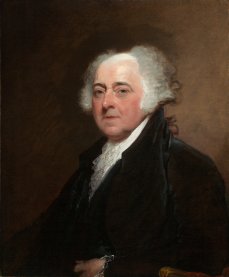
John Adams by Gilbert Stuart
For John Adams, future second president of the United States, the second day of July would and should be the day to remember American Independence, as he wrote;
“The most memorable Epocha, in the History of America. I am apt to believe that it will be celebrated, by succeeding Generations, as the great anniversary Festival…It ought to be solemnized with Pomp and Parade with shews, Games, Sports, Guns, Bells, Bonfires, and Illuminations from one End of this continent to the other from this Time forward forever more.”
And that is how many Americans choose to celebrate the anniversary of the Declaration of Independence, however, usually two days later on July 4th. Yet, it took another war; World War II, for July 4th to become a national paid holiday for workers of the Federal government when Congress approved it in 1941.
So, happy Independence Day!
*Feel free to add any interesting historical tidbits about the Second Continental Congress, the signers, or 1776 below!*
From our friends at American Battlefield Trust (ABT). To learn more about the ABT, click here.
At stake are 31 acres associated with two Southern Campaign Revolutionary War battlefields, Hanging Rock in South Carolina and Guilford Courthouse in North Carolina.
At Hanging Rock, generous battlefield preservationists like you have already secured 141 acres. These 30 acres in the part of the battlefield where the initial Patriot attack began will add significantly to the land we have saved there already.
At Guilford Courthouse, the half-acre tract at stake may be small, but it’s part of a larger strategy to deal with the modern development crowding in on this battlefield from all points of the compass. Our plan is to buy up plots of battlefield land – including small ones and those with non-historic structures on them like this one – remove all non-historic structures and restore the battlefield. The Guilford Courthouse National Military Park has generously agreed to take responsibility for demolishing and removing the house on this plot, a considerable cost that we would typically need to cover. Continue reading “Rise and Fight Again for Southern Revolutionary History”→
From our friends at American Battlefield Trust (ABT), for more information about the ABT click here.
Iraq, Afghanistan and Vietnam veterans have returned to the battlefield. But instead of the Middle East or Southeast Asia, they are mustering at Saratoga National Historical Park where they will be applying their military knowledge and newly learnt archaeological skills to conduct a field survey at the famous Revolutionary War battlefield.
Approximately 33 veterans will participate in the project created by the American Veterans Archaeological Recovery (AVAR) in cooperation with the American Battlefield Trust and the National Park Service (NPS). Working together, they will attempt to verify revolutionary-era troop locations during the 1777 battle while aiding participants’ transition back to civilian life. AVAR recruits veteran participants through social media, and specifically targets those who feel isolated and disconnected after leaving service; the organization predominantly recruits veterans from recent conflicts, such as Iraq and Afghanistan, with a young average participant age of 35. Continue reading “Press Release: Veterans Dig History in Groundbreaking Project at Saratoga Battlefield”→
From our friends at American Battlefield Trust (ABT) comes the following announcement and call for assistance.
The first line of the announcement sums up the importance of this new initiative of the American Battlefield Trust:
“They secured our liberty. It’s time for us to honor their legacy.”
In a collaboration between the ABT, the National Park Service, and the South Carolina Battleground Trust, the joint initiative is to highlight the “tremendous significance of these places to American independence.” Their combined goal is to preserve 2,500 acres of American Revolutionary War battle lands in the Palmetto State.
As of the middle of this month, 308 acres of hallowed ground has been saved. The land protected are part of the battlefields of Camden and Eutaw Springs, which “bookend a period of incredible consequence to the American Revolution.”
This is a great start, but as that means, it is a beginning and the ABT will need all our help to make it happen. This new direction will bring preservation, education, and technology together into one investment and keep the effort going, until this land is saved for the present and future generations.
For those readers of ours that are already members, thank you. For those that are interested in learning more, click here.
To check out the various sites and history associated with the Liberty Trail, click here.
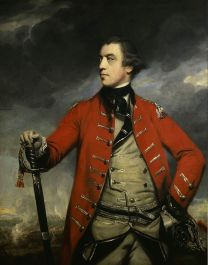
On this date in 1777, British General John Burgoyne surrendered to American General Horatio Gates around Saratoga, New York. This victory solidified French support for the fledgling American nation and became one of the turning points in the road to independence.
General John Burgoyne
Out of this momentous occasion came an anecdote about the British general officer. The short story has some truth in it, yet, whether the entire tale is accurate, well, I’ll leave that for you to decide!
Two years prior to the Battles of Saratoga and upon arriving in Boston, Massachusetts, General Burgoyne remarked “Well, let us get in, and we’ll soon find elbow-room” when he was told the numbers of militia besieging British regulars around the town.
After his capitulation, Burgoyne and his forces were marched toward Albany, New York, and multitudes of people turned out to see the vanquished British and German soldiery along the route. One resident supposedly yelled from her homestead doorway;
“Make elbow room for General Burgoyne.”
Not what he had envisioned in 1775 upon disembarking in North America. Yet, history does not relate what “Gentleman Johnny” Burgoyne thought exactly about the elbow room he received in the countryside of upstate New York!*
This slideshow requires JavaScript.
*“Gentleman Johnny” was a nickname acquired by Burgoyne was stationed in London with the Horse Guards, a fashionable cavalry regiment.”
**Information gathered from A.J. Langguth’s “Patriots” and The Patriot Resource, which can be found here.
Part of an ongoing series of about the Continental Army in Morristown, New Jersey. For the first post, click here.
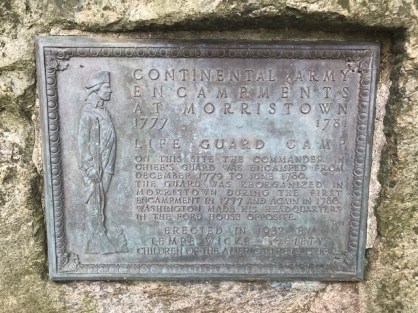
Across the street from the Ford Mansion, the elegant home of the Jacob Ford, Jr. and his family, and the headquarters for George Washington during the winter encampment of 1779-1780, sits a small boulder with a iron plaque plastered on the side.
Erected in 1932 by the Tempe Wicke Society Children of the American Revolution, the monument commemorates the Life Guards that served as Washington’s headquarters command during the American Revolution. Although the unit went by different names and reorganized at least twice, including once during the winter encampment at Morristown, the company, numbering approximately 150 men, would be around for the duration of the war. Continue reading “Uncovering the Continental Army in Morristown”→
Part of an ongoing series about the Continental Army in Morristown, New Jersey. To read previous posts, click here.
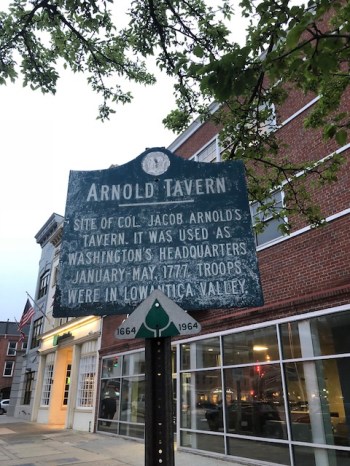
All that remains is a historical marker, on the side of North Park Place across the street from Morristown Green. For a few months, between January 1777 and May 1777, in this location, the headquarters of the Continental Army was located. Within that headquarters, obviously, was George Washington.
Although no specific date of construction exists, it is believed that Arnold’s Tavern was built by Samuel Arnold between 1735 and 1750. By the time of the American Revolution owned by the son, Colonel Jacob Arnold. The structure was three stories high, with a wide hallway that bisected the building, a front and back parlor, barroom, dining room, and kitchen. Continue reading “Uncovering the Continental Army in Morristown”→
Emerging Revolutionary War welcomes back guest historian Michael Aubrecht
John Trumbull
John Trumbull’s paintings represent some of the most familiar depictions from the time of the American Revolution. Trumbull was a graduate of Harvard University and the gifted son of the Governor of Connecticut. As a child, Trumbull showed a remarkable talent for an attention to detail. This aptitude set his drawings apart from his contemporaries. Trumbull traveled to London in 1784 to study painting under the master Benjamin West. It was then that he started painting some of his most notable pieces. There he honed his expertise for realistic painting. A year later later Trumbull traveled to the City of Paris to do commissioned artworks. He later did portraits of George Washington, John Adams, Alexander Hamilton and Thomas Jefferson. In 1816, he was selected as the president of the American Academy of the Fine Arts where he would serve for 20 years. Emphasizing classic traditions Trumbull attempted to teach the skills he had acquired while overseas. Following his death in 1843 at the age of 87, Trumbull was buried beneath the Art Gallery at Yale University which he had designed. In 1867, his collection of artworks were displayed at the Street Hall building on the same grounds. He and his wife’s remains were later re-interred and buried on the grounds of that building. Trumbull’s approach to painting has been studied by art students around the world. Today Trumbull’s paintings remain some of the most cherished ever to be painted by an American artist. Continue reading “The Brush of John Trumbull”→






 Emerging Revolutionary War Era