Visiting Carlyle House

IMG_2250
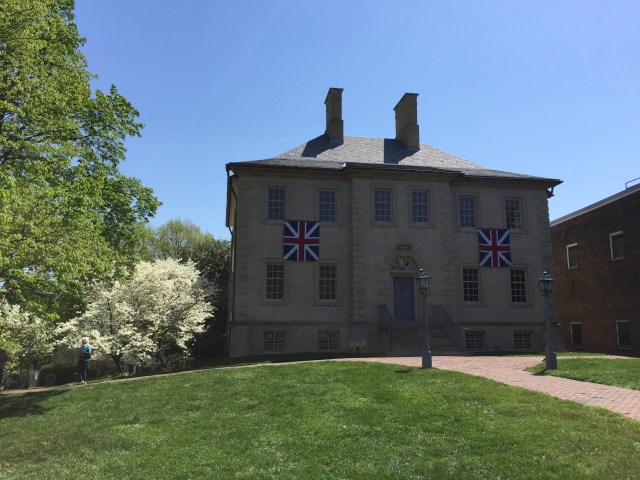
Carlyle House from the Front (Author Photo)

William Griffith’s examination of the Carlyle House Congress last month (The Carlyle House Congress and Britain’s Military Objectives for 1755) reminded me that I had been remiss in not visiting the site.   So, the family and I set off for Alexandria, VA and a visit to John Carlyle’s home.

Continue reading “Visiting Carlyle House”

A Very Special Message

A special announcement in the preservation world was made public today. The Civil War Trust, which the Campaign 1776 initiative spawned from, officially changed their name to the American Battlefield Trust. You can see their video announcement of the name change and what it means, here.

logoEmerging Revolutionary War sent an email inquiry to our friends at American Battlefield Trust to elaborate a little further on what this name change means and the impact to their current and future preservation efforts. Continue reading “A Very Special Message”

The Brush of John Trumbull

Emerging Revolutionary War welcomes back guest historian Michael Aubrecht

Trumbull
John Trumbull

John Trumbull’s paintings represent some of the most familiar depictions from the time of the American Revolution. Trumbull was a graduate of Harvard University and the gifted son of the Governor of Connecticut. As a child, Trumbull showed a remarkable talent for an attention to detail. This aptitude set his drawings apart from his contemporaries. Trumbull traveled to London in 1784 to study painting under the master Benjamin West. It was then that he started painting some of his most notable pieces. There he honed his expertise for realistic painting. A year later later Trumbull traveled to the City of Paris to do commissioned artworks. He later did portraits of George Washington, John Adams, Alexander Hamilton and Thomas Jefferson. In 1816, he was selected as the president of the American Academy of the Fine Arts where he would serve for 20 years. Emphasizing classic traditions Trumbull attempted to teach the skills he had acquired while overseas. Following his death in 1843 at the age of 87, Trumbull was buried beneath the Art Gallery at Yale University which he had designed. In 1867, his collection of artworks were displayed at the Street Hall building on the same grounds. He and his wife’s remains were later re-interred and buried on the grounds of that building. Trumbull’s approach to painting has been studied by art students around the world. Today Trumbull’s paintings remain some of the most cherished ever to be painted by an American artist.  Continue reading “The Brush of John Trumbull”

Fight for Osborne Hill

From a Pennsylvania State Historical Commission marker, one quickly can find out the importance of Osborne Hill to the Battle of Brandywine, fought on September 11, 1777.

Photo184914
Osborne Hill Marker (courtesy of Keith Smith, hmdb.org)

The hillside was the site of British General William Howe’s post in which he coordinated and commanded the different components of the British and Hessian forces that day. The battle opened the way for the British conquest of Philadelphia and was the largest, in terms of manpower fighting, of any American Revolutionary War battle.

Now, this important tract of land needs a few more people to fight for its control and preservation. Continue reading “Fight for Osborne Hill”

From Campaign 1776: Ten Crucial Days

Emerging Revolutionary War is pleased to share the following information from our friends at Campaign 1776 managed by the Civil War Trust. 

unnamed

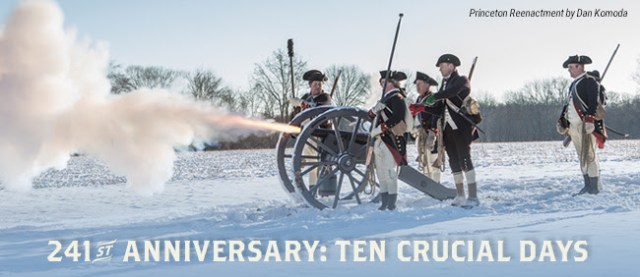
“As many of you may know, this winter marks the 241st anniversary of the American victories at the battles of Trenton and Princeton. The Continental Army’s triumphs in the Ten Crucial Days campaign proved instrumental to rekindling Patriot morale and keeping the cause for American independence alive in the wake of early defeats. Continue reading “From Campaign 1776: Ten Crucial Days”

Emerging Revolutionary War Weekender: The Boston Tea Party Ships & Museum

Emerging Revolutionary War welcomes guest historian Paige Gibbons Backus to the blog. This Weekend marks the 244th anniversary of the Boston Tea Party.

boston-museum-about-museum-experience

Boston Tea Party Ships and Museum

306 Congress St., Boston, MA 02210

http://www.bostonteapartyship.com

We all know the holidays are some of the heaviest travelled times of the year and over my Thanksgiving holiday, I had the opportunity visit Boston for a day. When in the city for only one day, what do we go and see? Do you go to the U.S.S. Constitution, Bunker Hill, Faneuil Hall, or the Paul Revere House? Do you go to the colonial meetinghouses, the historic cemeteries, or just walk around the historic sections of the city? One of the sites that I decided to visit was the Boston Tea Party Ships & Museum. I heard many good things about it from online reviews and professional colleagues about the interactive exhibits and experiences available there. Working at an immersive historic site myself, I was definitely curious to see what they had done to make their history exciting to audiences, and despite the museum’s shortcomings, make it interesting they did.

One of the highlights of the Boston Tea Party Ships is that they did a decent job creating an interactive experience for visitors. After purchasing tickets outside, visitors receive an identity card and a feather, and are then invited into a room meant to replicate the South Meetinghouse. From there, first-person actors serving as tour guides take visitors through the planning, implementation, and effects of the Boston Tea Party. For example, Sam Adams rallied the crowd weaving in the events leading to the Boston Tea Party, even teaching visitors how to show approval or displeasure in a public setting, (to which I was hissing before it was cool). He even called on visitors with various identity cards to voice their opinion, bringing in interesting, albeit reluctant, audience participation. After the visitors were riled up, we donned our feathers in our hair and were lead onto the ships to commence tossing the tea. Continue reading “Emerging Revolutionary War Weekender: The Boston Tea Party Ships & Museum”

AfterWARd, the new exhibit at the American Revolution Museum at Yorktown. A visit with Curator Kate Gruber

IMG_20170927_153356397
The stacks of books reflect Knox’s role as a bookseller before the war.

If you have not made a trip to the new American Revolution Museum at Yorktown (the former Yorktown Victory Center) then you are missing out. Not only does the museum great exhibits on the causes of the war and the events leading up to Yorktown (with great technology), there is a changing exhibit gallery that allows for short term exhibits. The first exhibit opened in June and features the lives of four prominent Revolutionaries after the American Revolution. Continue reading “AfterWARd, the new exhibit at the American Revolution Museum at Yorktown. A visit with Curator Kate Gruber”

The Battle of Groton Heights, September 6, 1781: The Fort Griswold Massacre

Part Three
Click here for parts one and two.

With British soldiers pouring into the fort, Colonel Ledyard ordered a ceasefire, and prepared to surrender Fort Griswold to the victorious British. However, the British disregarded the ceasefire and continuing pouring fire into the American garrison, killing or wounding nearly all of the fort’s defenders. “I believe there was not less than five or six hundred men of the enemy on the parade in the fort,” claimed American soldier Rufus Avery. “They killed and wounded nearly every man in the fort as quick as they could.”

battleofgrotonheights_giclee_p3y8

Maj. Stephen Bromfield, the ranking British officer after Montgomery fell, called out, “Who commands this fort?” Ledyard stepped forward and responded, “I did, sir, but you do now.” Another American, Jonathan Rathbun, watched Bromfield run Ledyard through the heart and lungs with Ledyard’s own sword:

     “…the wretch who murdered him [Ledyard], exclaimed, as he came near, “Who
    commands this fort?” Ledyard handsomely replied, “I did, but you do now,” at the same
moment handing him his sword, which the unfeeling villain buried in his breast! Oh, the
hellish spite and madness of a man that will murder a reasonable and noble-hearted
    officer, in the act of submitting and surrendering!”

Continue reading “The Battle of Groton Heights, September 6, 1781: The Fort Griswold Massacre”

Preserve Washington’s Legacy

If you follow Campaign 1776, the initiative by our friends at Civil War Trust, you are familiar with the saga over the Princeton Battlefield. Now you have a chance to help as well.

Battle of Princeton - Death of Mercer by Trumbull (Yale)
Battle of Princeton, Death of Mercer by Trumbull (courtesy of Yale University)

Continue reading “Preserve Washington’s Legacy”

Reporting Success on a Monday!

With the start of the work week, some folks loath logging onto the computer to check work email, news, and updates. If you are one of those folks, keep reading, as the news we are about to share is positive and exciting.
campaign-1776-logo-220This past Thursday, July 27, 2017, Campaign 1776, the initiative of the Civil War Trust, announced the preservation of 184 acres at two sites in New York state. One tract of land was pivotal to the United States success in the Saratoga Campaign in 1777 and where a U.S. fleet was saved during the War of 1812.

The Battle of Fort Ann, fought on July 8, 1777 was a four-hour affair and was influential in the course of the larger Saratoga Campaign as it affected the British’s attempt to secure the strategically important Hudson River Valley. The delay around Fort Ann and every delay on the route of General John Burgoyne’s push south aided the Patriot cause tremendously.

Fast-forward to the War of 1812 and Sackets Harbor, New York provided as safe-haven for the United States fleet operating on the Great Lakes. Horse Island and the harbor that gained prominence during the May 29, 1813 offensive by the British, is where 24 acres were saved by Campaign 1776. The battlefield, which was one of 19 sites that benefited from $7.2 million in grants announced earlier in July and the first War of 1812 site anywhere in the country to be awarded money since the National Park Service expanded the grant opportunities in 2014.

Not just one success, but two for this Monday morning! For the full report, courtesy of our friends at Civil War Trust, click here.