The Shot Heard in Youngstown?

Emerging Revolutionary War welcomes historian Dan Welch

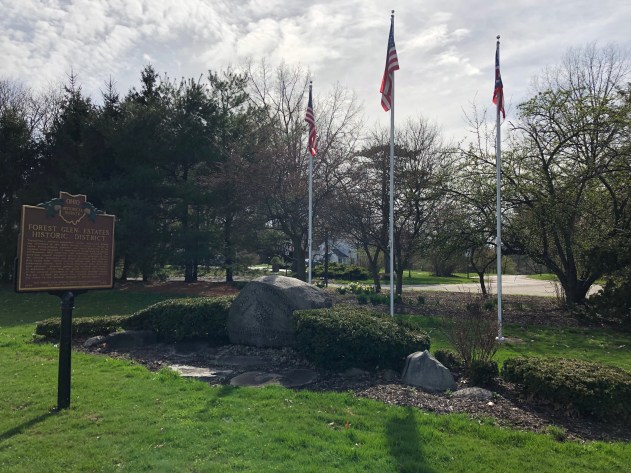
As we commemorate the 244th anniversary of the engagements at Lexington and Concord, it is an opportunity to reflect upon this moment’s importance in American history. The results of what happened in April 1775 were truly “heard around the world.” The importance of those events are commemorated and remembered in various forms across the fabric our country. This holds true, even in Youngstown, Ohio.

ERW 1
The Road to Remembrance Memorial on the southside of Youngstown, Ohio. (Image courtesy of the author)

As the country grappled with the effects of the Great Depression, numerous civic organizations in the state of Ohio sought to construct a “Road of Remembrance” in honor of the servicemen from the country’s previous conflict. On June 17, 1930, the state legislature designated a portion of Route 193 from Lake Erie to 422 in Youngstown as a memorial roadway in honor of those soldiers who gave their last full measure of devotion during the Great War. Many towns planted memorial trees along the route, some erected monuments, while other organizations held ceremonies marking the occasion. This special route was to be just a small portion of remembrance that was to span from Montreal, Canada to the Gulf of Mexico. Continue reading “The Shot Heard in Youngstown?”

From the Preservation Front: “Liberty Trailblazers – American Battlefield Trust”

ABTFrom our friends at American Battlefield Trust (ABT) comes the following announcement and call for assistance. 

The first line of the announcement sums up the importance of this new initiative of the American Battlefield Trust:

“They secured our liberty. It’s time for us to honor their legacy.” 

In a collaboration between the ABT, the National Park Service, and the South Carolina Battleground Trust, the joint initiative is to highlight the “tremendous significance of these places to American independence.” Their combined goal is to preserve 2,500 acres of American Revolutionary War battle lands in the Palmetto State.

As of the middle of this month, 308 acres of hallowed ground has been saved. The land protected are part of the battlefields of Camden and Eutaw Springs, which “bookend a period of incredible consequence to the American Revolution.”

This is a great start, but as that means, it is a beginning and the ABT will need all our help to make it happen. This new direction will bring preservation, education, and technology together into one investment and keep the effort going, until this land is saved for the present and future generations.

For those readers of ours that are already members, thank you. For those that are interested in learning  more, click here.

To check out the various sites and history associated with the Liberty Trail, click here.

First Shots

IMG_6846-min
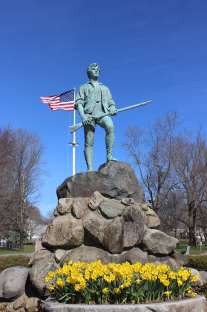
Lexington Minuteman Statue , facing the route of the British advance (author collection)

We all have bucket list items that we want to check off in our lifetime. Some revolve around traveling, some may revolve around learning a new hobby or skill. We may have different categories of items. The last is true for me.

One of those categories was to see the first shots of the wars of the United States (okay and the French and Indian War, since that started the march toward independence, when looked at through the lens of history and distance). Continue reading “First Shots”

Women in War

As February turns to March, our friends at American Battlefield Trust (ABT), in honor of Women’s History Month, are starting a series on “Women in War.”

ABT

The objective of the initiative is to highlight the important role women have played in America’s conflicts, especially the wars that the Trust is actively trying to preserve the hallowed ground from. From the home-front to the front-lines, women were crucial to all aspects of the winning or sustaining the fight during the respective conflicts.

That got one historian at Emerging Revolutionary War thinking.

If you had to list the most influential women during the American Revolutionary War time period, who would top the list?

Feel free to comment below!

For information about the ABT’s month-long series click here.

George Rogers Clark Recaptures Fort Sackville, Part II

Vincenes (Army Center of Military History)
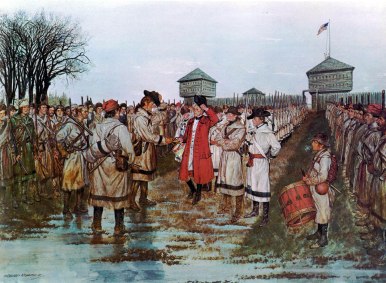
Hamilton Surrenders Fort Sackville (U.S. Army Center for Military History)

By February 23, 1779–two hundred and forty years ago—Virginia Lieutenant Colonel George Rogers Clark had marched his little army from the Mississippi across the flooded plains of what would become southern Illinois to the French town of Vincennes on the Wabash River, in modern Indiana.  His men were tired, hungry, and waterlogged, but they had made it safely across the Wabash and delivered themselves to the same shore as the town and Fort Sackville, then defended by the much-hated British Lieutenant Governor Henry Hamilton.  His river scouts had managed to find a small, dry hillock covered by a grove of trees and within sight of the town and Clark’s force, about 170 strong, lay in the grove drying their clothes by the sun, occasionally taking a wandering citizen from the town prisoner.   Clark later reported:

Continue reading “George Rogers Clark Recaptures Fort Sackville, Part II”

Alexander Hamilton’s “First” Duel

glc07167engweb_
Lt. Col. Alexander Hamilton at Yorktown, VA by Alonzo Chapel

Alexander Hamilton has reappeared as a modern pop star with the wide success of the Broadway musical “Hamilton.” Due to this success, most people today know that Alexander Hamilton met his end in a duel with Aaron Burr on the banks of the Hudson River. But this was not Hamilton’s first involvement in a duel, nearly 26 years earlier Hamilton found himself embroiled in a feud with one of highest ranking Continental officers, Maj. Gen. Charles Lee.

It all started on June 28, 1778 at the Battle of Monmouth. The beginning of the battle had gone against the Americans and Lee, who was in command of the vanguard was ordering a retreat in front of the British. Washington, seeing the retreat rode ahead and encountered Lee. What was said between the men has been debated since that day, but what is not indisputable is that Lee took offense. Continue reading “Alexander Hamilton’s “First” Duel”

Revolution on the Ohio Frontier: Fort Laurens

img_2465
The Museum at Fort Laurens, Ohio

For much of the American Revolution, the British waged war on their rebelling colonists in the Ohio River Valley via proxy, relying on western Indian nations (Shawnee, Wyandot, Mingo, Chippewa, Ottawa, and others) to attack isolated American settlements and villages across the Ohio River.  The Continental Congress, already unable to meet the needs of its own army along the coasts, could offer little in the way of assistance. So, frontier defense largely fell upon the local militia.  They adopted a two-pronged strategy: 1) build forts and blockhouses along the frontier, giving settlers a place of safe haven when Indian raiding parties were about, and 2) preemptive raids against Native American villages in an attempt to disrupt their preparations for raids against the settlers.

In 1777, however, Congress realized that more aggressive measures were required: the war would have to be carried against the heart of British power at Detroit, from where the British coordinated, supplied, and rewarded Native American raids. With that in mind, Congress and Continental authorities at Pittsburgh began planning an offensive to capture the British post between Lakes Huron and Erie.  First, they would need to secure the continued neutrality of the Delaware Indian nation in the Muskingum River Valley, which today is in Eastern Ohio. Second, they would need to build a substantial network of forts capable of sustaining an overland offensive. Building a new fort in Delaware territory would serve both goals.

Continue reading “Revolution on the Ohio Frontier: Fort Laurens”

“You shall be carried to the gaol of Fredericktown” (Part 2)

The first post in this series looked at the various prisons established in Frederick, Maryland to hold British, German, and Loyalist prisoners. We’ll wrap this up by examining a notorious trial that took place in 1781.

Perhaps the most well-known case involving Loyalist prisoners in Frederick occurred in the summer of 1781. By this point in the war, enthusiasm for the American cause was on the wane in many communities. Conscription and heavy taxation to support the war effort were unpopular, especially as there was little battlefield success to boost morale. British forces were campaigning deep in Virginia and the Carolinas, giving hope to local Loyalists. Some Loyalists chose to declare their allegiance publicly, leading to a number of short-lived “uprisings” against American rule.[i] The Council of Maryland got wind of one such conspiracy in June, 1781, when orders were given to the lieutenants of the Frederick and Washington County militias to arrest a number of “disaffected and Dangerous Persons whose going at Large may be detrimental to the State.”[ii] Among those singled out for arrest were “Henry Newcomer and Bleachy of Washington County and Fritchy, Kelly, and Tinckles of Frederick County.” All these men had been connected to a supposed plot to raise a group of armed Loyalists in western Maryland, free the prisoners of war in Frederick, and march to support Lord Cornwallis in Virginia.

The details of the plot were uncovered by Christian Orendorff, an enterprising militia captain from the vicinity of Sharpsburg, in Washington County. His neighbor, Henry Newcomber, had confided to him one night that “we have raised a body of men for the Service of the King” to be commanded by a “Dutch Man” from Frederick named Fritchey. Orendorff feigned sympathy with Newcomber’s cause and soon met with Caspar Fritchey, who revealed more of the plot to him – including names of some of his co-conspirators. Captain Orendorff sent word to the authorities, who acted quickly to break up the insurrection and round up the ringleaders. Although Orendorff claimed that the Loyalists had recruited 6,000 men, only seven were brought to trial.
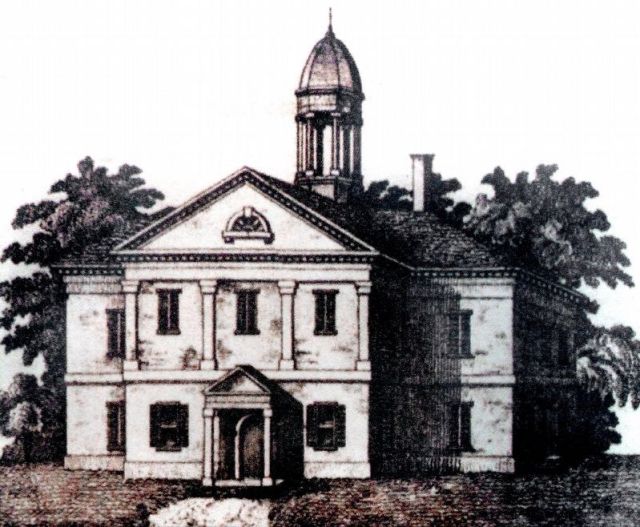
Photo431930.jpgFrederick’s 1752 Courthouse as depicted on the 1858 Isaac Bond Map. The Courthouse burned in 1861 and was replaced the following year. The former courthouse now serves as city hall. (Library of Congress)

The seven men condemned to stand trial – Peter Sueman, Nicholas Andrews, John Graves, Yost Plecker, Adam Graves, Henry Shell, and Caspar Fritchie[iii] – were singled out as the leaders of the plot. All were brought to Frederick under a heavy guard while a special court convened. Thomas Sprigg, serving as Lieutenant of Washington County, wrote to the Council that “[they Acknowledge themselves to be Captains that they have Misted and Admin’d the Oath of Allegeance to many persons, one of them to the Amot of 42 they Confess very freely they say they expect and deserve to be hang’d, and I pray God they may not be disappoint’d…”[iv]

On June 17th, 1781 a special court of oyer and terminer was called. Derived from old English law, these special courts were overseen by a panel of commissioners, and typically presided over serious crimes like treason. Among the judges were the local militia commander Col. James Johnson, Alexander Hanson (son of President of the Continental Congress, John Hanson), and Upton Sheredine. All were men with staunch patriot sympathies. It wasn’t a surprise, then, that the trial was a short one. Relying primarily on Orendorff’s testimony, the court found all seven men guilty of treason against the state of Maryland. For the crime of enlisting men for the service of the King, Judge Hanson handed down a grisly punishment:

“You, Peter Sueman, Nicholas Andrews, Yost Plecker, Adam

Graves, Henry Shell, John George Graves, and Casper Fritchie,

and each of you, attend to your sentence. You shall be carried

to the gaol of Fredericktown, and be hanged therein; you shall

be cut down to the earth alive, and your entrails shall be taken

out and burnt while you are yet alive, your heads shall be cut off,

your body shall be divided into four parts, and your heads and

quarters shall be placed where his excellency the Governor

shall appoint. So Lord have mercy upon your poor souls.”[v]

Four of the accused – Andrews, Shell, and the Graves brothers – were subsequently pardoned due to their “want of education and experience.” It appears that the court saw them as young men duped by the real leaders of the plot. The other three men were not so lucky.
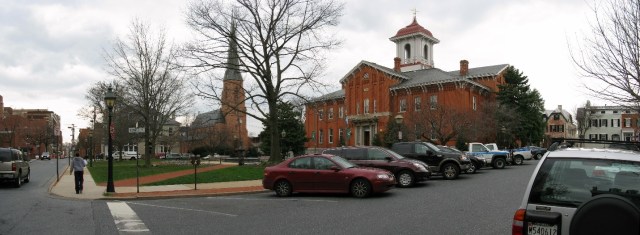
new courthouse.jpgThe former courthouse square in Frederick, near where the county jail once stood. It’s likely that the executions took place very near this location in August 1781. The large brick structure is the 1862 courthouse (now Frederick’s City Hall).

While the plot and trial are well documented, the aftermath is not. Later historians cannot agree on whether the entire sentence of hanging, drawing, and quartering was ever carried out, or if the three men were simply hung. On August 28, 1781 the Baltimore Advertiser simply reported that “On Friday the 17th instant, Caspar Fritichie, Peter Sueman, and Yost Plecker, suffered Death in Frederick Town for High Treason.” Many family stories that have been passed down in the area, however, firmly state that the full punishment was meted out on the unlucky Loyalists. Today the only physical reminder of this “First American Civil War” in Frederick is a simple bronze plaque and a small sign near the courthouse where the executions likely took place. The episode, however, still sheds light on the darker side of Maryland’s Revolutionary story.

[i] A perfect example was “Claypool’s Rebellion” on the Virginia frontier. In June 1781 John Claypool of Hampshire County, Virginia led a large body of men in resisting efforts to tax or raise troops for the State of Virginia. After dozens of men took up arms alongside Claypool a body of militia was sent to put down the “rebellion.” For more information visit https://secondvirginia.wordpress.com/2015/06/17/claypools-rebellion/

[ii] Journal and Correspondence of the Council of Maryland, 1780-1781. p 467

[iii] John Caspar Fritchie was the father-in-law of legendary Civil War heroine Barbara Fritchie

[iv] Journal and Correspondence of the Council of Maryland, 1781. p 298

[v] Scharf. P 143

Disaster on the Eastern Frontier

Part Two
For Part One, click here.

The British and loyalists would not have to wait long. Word of the landing reached the Massachusetts government within a matter of days, and preparations for a counterattack began almost immediately. There was such a hurry to respond that the General Assembly voted to carry out the operation with state forces rather than wait for Continental assistance.[1] Despite the initial rush it still took a month to assemble a force of over 1,000 militiamen, as well as the food, arms, and other supplies to sustain them. All of these troops and their supplies would be transported by a fleet of 21 transports, accompanied by nearly twenty state and Continental navy vessels and privateers. Among the warships the largest was the Frigate Warren of 32 guns which served as the flagship of Commodore Dudley Saltonstall. The Connecticut born officer was given overall command of the naval forces – no small task given the lack of experience with large scale fleet actions among his subordinates. Command of the land forces was given to Massachusetts Brigadier Solomon Lovell. Lovell has seen experience early in the war outside of Boston, but was also relatively untested in battle. The inexperience and poor communication between Saltonstall and Lovell was to have a decisive impact on the coming expedition. Notable among the other officers in the expedition was Paul Revere, who commanded the Massachusetts artillery. The expedition was also joined by a band of the local Penobscot Indians allied to the Continental Congress.

The New England fleet entered the Penobscot Bay on July 25th and immediately attempted a landing. Clearly outnumbered and with their works incomplete, General McLean and his men were determined to resist the Americans, but expected the worst. Saltonstall’s fleet sailed in close to the shore and exchanged cannon fire with both the British defences and the three remaining Royal warships, now under the command of Captain Henry Mowatt. In the confusion and smoke the Americans lowered seven launches full of marines and militiamen, but as they neared the shore they were met by a hail of musket fire[2]. At least one of the attackers – a Native American – was killed and the boats returned to the safety of the fleet. It was an inauspicious start to the battle for the New Englanders and already the relationship between the two commanding officers was becoming strained. General Lovell knew little about sailing or naval operations. He questioned the Commodore as to why he couldn’t just sail his fleet into the harbor and blast the British to pieces while his troops landed under their covering fire. The Connecticut seaman replied curtly, exclaiming “You seem to be damn knowing about the whole matter! I am not going to risk my shipping in that damned hole!”[3]

On the 26th a second militia landing on the peninsula was repulsed after the lead boat carrying militia Major Daniel Littlefield was swamped by British chain shot, drowning the Major and two privates.That same day, however, the Americans scored a small victory when a force of 200 Continental marines and artillerymen landed on Nautilus Island and captured the small British battery there[4]. More artillerymen were landed and soon the Americans had a battery from which they could harass the British shipping. With the Americans making some headway Captain Mowatt withdrew the remaining British ships deeper into the harbor, creating a defensive line across the Bagaduce River.

Castine harbor, looking out roughly where Captain Mowatt anchored the British transports and warships (Author_s photo)
Castine Harbor, looking out roughly where Captain Mowatt anchored the British transports and warships (Author’s photo)

Continue reading “Disaster on the Eastern Frontier”

Visiting the Scene of Action: Battle of Camden

A reflection on the previous month’s exploration in South Carolina.

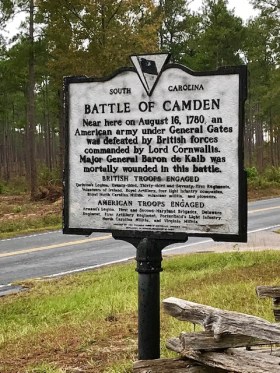
IMG_1905 (1)August 16, 1780 would prove to be a devastating day for the American Army in the south, known as the “Grand Army” by its commander, Maj. Gen. Horatio Gates, the Hero of Saratoga. The battle between this army and that of Lt. Gen. Charles, Earl Cornwallis, in the Pine Barrens near the South Carolina town of Camden, would end in the total rout of the Americans and the destruction of the reputation of its commander. It would also temporarily leave the southern colonies without a central army to oppose the British.

On November 1, members of the Emerging Revolutionary War Era staff took a road trip to Camden, SC to research the battle, walk the battlefield and meet with local historians in preparation for an upcoming addition to our book series, on the Battle of Camden.  On the way down, we took the opportunity of visiting other sites of combat, actions that occurred prior to and after the fight at Camden. Continue reading “Visiting the Scene of Action: Battle of Camden”