George Rogers Clark Recaptures Fort Sackville, Part I

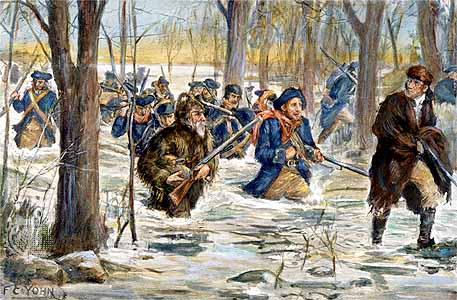
March to Vincennes (Wikimedia Commons)
March to Vincennes by Frederick Coffay Yohn, 1875-1933 (Wikimedia Commons–Most of Clark’s men would not have dressed in the blue uniforms visible here, but would have dressed in fur and buckskin like the individual in the middle of the picture.)

Last fall, I posted several pieces following British Lieutenant Governor Henry Hamilton’s campaign in the Illinois territory as seen through the eyes of Captain Norman MacLeod.  MacLeod led an advance party stuck with the logistical and diplomatic mission of moving 33,000 pounds of supplies and trade goods south from Detroit in order to mobilize the local Indian tribes as British allies.  Hamilton’s campaign culminated with the successful capture of Fort Sackville (Vincennes, IN) on December 17, 1778.  Since it’s the 240th anniversary of the campaign, I thought I’d continue the series by shifting to the American perspective, particularly that of Virginia Lieutenant Colonel George Rogers Clark and one of his Captains, Joseph Bowman.  This is not a campaign history by any stretch.  It’s meant more to be considered in combination with portions of MacLeod’s diary that appeared last fall.  Taken together, they might give rise to a few different ideas about the Americans and British fighting the Revolution on the frontier.

Although he planned to recapture the entire Illinois territory, Hamilton decided to winter at Fort Sackville and resume his campaign in the spring.  He dismissed the bulk of his force, settling in at the fort with just under 100 men.  Normally, this would have been a prudent choice.  Hamilton did not expect Clark to retake the field until spring brought about the customary campaign season and dispersing his army eased the logistical burden of maintaining so many men idle in the wilderness.  Hamilton had under-estimated the meddle of his adversary.

Continue reading “George Rogers Clark Recaptures Fort Sackville, Part I”

Alexander Hamilton’s “First” Duel

glc07167engweb_
Lt. Col. Alexander Hamilton at Yorktown, VA by Alonzo Chapel

Alexander Hamilton has reappeared as a modern pop star with the wide success of the Broadway musical “Hamilton.” Due to this success, most people today know that Alexander Hamilton met his end in a duel with Aaron Burr on the banks of the Hudson River. But this was not Hamilton’s first involvement in a duel, nearly 26 years earlier Hamilton found himself embroiled in a feud with one of highest ranking Continental officers, Maj. Gen. Charles Lee.

It all started on June 28, 1778 at the Battle of Monmouth. The beginning of the battle had gone against the Americans and Lee, who was in command of the vanguard was ordering a retreat in front of the British. Washington, seeing the retreat rode ahead and encountered Lee. What was said between the men has been debated since that day, but what is not indisputable is that Lee took offense. Continue reading “Alexander Hamilton’s “First” Duel”

Hamilton Recaptures Fort Sackville: Norman MacLeod’s Campaign Journal, December 17, 1778

(An occasional series highlighting British Lieutenant Governor Henry Hamilton’s march south from Detroit to recapture Vincennes (Indiana) on its 240th anniversary through the entries in Captain Norman MacLeod’s diary.)

Fort Sackville Map Inset, (Nova Scotia Archives and Record Management, Wikimedia Commons)
Fort Sackville Map Inset, Nova Scotia Archives and Records, (Wikimedia Commons)

As Lieutenant Governor Henry Hamilton’s army arrived on the lower Wabash, the river widened and deepened, enabling his much-fatigued army to spread out and make better progress to Vincennes and Fort Sackville.  All along the way, the governor’s efforts to grow his army through the addition of Indian allies had largely succeeded, not only increasing his numbers but improving his intelligence about the American forces awaiting him.  Those were paltry, indeed.

Continue reading “Hamilton Recaptures Fort Sackville: Norman MacLeod’s Campaign Journal, December 17, 1778”

Disaster on the Eastern Frontier

Part Two
For Part One, click here.

The British and loyalists would not have to wait long. Word of the landing reached the Massachusetts government within a matter of days, and preparations for a counterattack began almost immediately. There was such a hurry to respond that the General Assembly voted to carry out the operation with state forces rather than wait for Continental assistance.[1] Despite the initial rush it still took a month to assemble a force of over 1,000 militiamen, as well as the food, arms, and other supplies to sustain them. All of these troops and their supplies would be transported by a fleet of 21 transports, accompanied by nearly twenty state and Continental navy vessels and privateers. Among the warships the largest was the Frigate Warren of 32 guns which served as the flagship of Commodore Dudley Saltonstall. The Connecticut born officer was given overall command of the naval forces – no small task given the lack of experience with large scale fleet actions among his subordinates. Command of the land forces was given to Massachusetts Brigadier Solomon Lovell. Lovell has seen experience early in the war outside of Boston, but was also relatively untested in battle. The inexperience and poor communication between Saltonstall and Lovell was to have a decisive impact on the coming expedition. Notable among the other officers in the expedition was Paul Revere, who commanded the Massachusetts artillery. The expedition was also joined by a band of the local Penobscot Indians allied to the Continental Congress.

The New England fleet entered the Penobscot Bay on July 25th and immediately attempted a landing. Clearly outnumbered and with their works incomplete, General McLean and his men were determined to resist the Americans, but expected the worst. Saltonstall’s fleet sailed in close to the shore and exchanged cannon fire with both the British defences and the three remaining Royal warships, now under the command of Captain Henry Mowatt. In the confusion and smoke the Americans lowered seven launches full of marines and militiamen, but as they neared the shore they were met by a hail of musket fire[2]. At least one of the attackers – a Native American – was killed and the boats returned to the safety of the fleet. It was an inauspicious start to the battle for the New Englanders and already the relationship between the two commanding officers was becoming strained. General Lovell knew little about sailing or naval operations. He questioned the Commodore as to why he couldn’t just sail his fleet into the harbor and blast the British to pieces while his troops landed under their covering fire. The Connecticut seaman replied curtly, exclaiming “You seem to be damn knowing about the whole matter! I am not going to risk my shipping in that damned hole!”[3]

On the 26th a second militia landing on the peninsula was repulsed after the lead boat carrying militia Major Daniel Littlefield was swamped by British chain shot, drowning the Major and two privates.That same day, however, the Americans scored a small victory when a force of 200 Continental marines and artillerymen landed on Nautilus Island and captured the small British battery there[4]. More artillerymen were landed and soon the Americans had a battery from which they could harass the British shipping. With the Americans making some headway Captain Mowatt withdrew the remaining British ships deeper into the harbor, creating a defensive line across the Bagaduce River.

Castine harbor, looking out roughly where Captain Mowatt anchored the British transports and warships (Author_s photo)
Castine Harbor, looking out roughly where Captain Mowatt anchored the British transports and warships (Author’s photo)

Continue reading “Disaster on the Eastern Frontier”

Visiting the Scene of Action: Battle of Camden

A reflection on the previous month’s exploration in South Carolina.

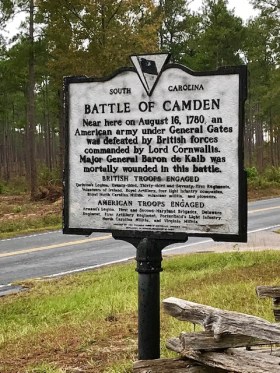
IMG_1905 (1)August 16, 1780 would prove to be a devastating day for the American Army in the south, known as the “Grand Army” by its commander, Maj. Gen. Horatio Gates, the Hero of Saratoga. The battle between this army and that of Lt. Gen. Charles, Earl Cornwallis, in the Pine Barrens near the South Carolina town of Camden, would end in the total rout of the Americans and the destruction of the reputation of its commander. It would also temporarily leave the southern colonies without a central army to oppose the British.
On November 1, members of the Emerging Revolutionary War Era staff took a road trip to Camden, SC to research the battle, walk the battlefield and meet with local historians in preparation for an upcoming addition to our book series, on the Battle of Camden.  On the way down, we took the opportunity of visiting other sites of combat, actions that occurred prior to and after the fight at Camden. Continue reading “Visiting the Scene of Action: Battle of Camden”

“Elbow Room” for “Uncle Johnny”

On this date in 1777, British General John Burgoyne surrendered to American General Horatio Gates around Saratoga, New York. This victory solidified French support for the fledgling American nation and became one of the turning points in the road to independence.

800px-BurgoyneByReynolds
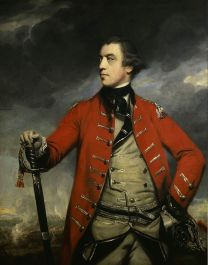
General John Burgoyne

Out of this momentous occasion came an anecdote about the British general officer. The short story has some truth in it, yet, whether the entire tale is accurate, well, I’ll leave that for you to decide!

Two years prior to the Battles of Saratoga and upon arriving in Boston, Massachusetts, General Burgoyne remarked “Well, let us get in, and we’ll soon find elbow-room” when he was told the numbers of militia besieging British regulars around the town.

After his capitulation, Burgoyne and his forces were marched toward Albany, New York, and multitudes of people turned out to see the vanquished British and German soldiery along the route. One resident supposedly yelled from her homestead doorway;

“Make elbow room for General Burgoyne.” 

Not what he had envisioned in 1775 upon disembarking in North America. Yet, history does not relate what “Gentleman Johnny” Burgoyne thought exactly about the elbow room he received in the countryside of upstate New York!*


This slideshow requires JavaScript.


*“Gentleman Johnny” was a nickname acquired by Burgoyne was stationed in London with the Horse Guards, a fashionable cavalry regiment.” 

**Information gathered from A.J. Langguth’s “Patriots” and The Patriot Resource, which can be found here.

The Battle of the Clintons

This past spring I was able to visit a fascinating historic site, one that is largely overlooked in the larger story of the Revolution. Many of us know that in 1777 the British planned to use the Hudson River to cut off New England from the other states.

With General William Howe in New York City, and General John Burgoyne moving south from Canada, the plan seemed destined for success. Yet Howe decided to move his army by water to the Chesapeake and advance on Philadelphia.

It is commonly assumed that his lack of cooperation with Burgoyne was one major reason for the latter’s failure, and surrender, at Saratoga. In fact, a force of British troops did ascend the Hudson, hoping to cooperate with Burgoyne. I was able to follow and retrace the little known expedition.

Continue reading “The Battle of the Clintons”

Captain John Asbhy

Part Two

Captain John Ashby and his fellow Virginians would face their greatest test of the war on the afternoon of September 11th, 1777 at the Battle of Brandywine. Following a wide flank march the bulk of the Crown forces emerged on Washington’s right flank, ready to trap and smash the Continental Army. Washington reorganized his line, drawing men north in a desperate attempt to meet the new threat. The Third Virginia was ordered into position far in advance of the American lines – their objective was to hold a wooded hill near the Birmingham Friends Meeting House in order to buy time for the rest of the American troops to take up position. Ashby and his fellow officers arranged their men among the buildings and woodlot of the Samuel Jones farm and awaited the attack that was certain to come.

The Battle of Brandywine, September 11, 1777 (American Battlefield Trust)

Continue reading “Captain John Asbhy”

The Crawford Campaign, 1782: Captivity, Torture, and Execution

IMG_2443
One of the few historical markers denoting the campaign.  The other side of the security fence at the left is home to the county landfill.  Tymochtee Creek is to the right.  (Author Photo)

(part five of five)

For those men separated from the retreating main body in the pell-mell retreat, Crawford’s expedition had become a nightmare, beginning with the panic on the night of June 5.  James Paul remembered being shaken awake with word that the men were leaving and attempting to retrieve his horse in the dark before finding it had already slipped its bridle and wandered away.

“I groped about in the dark and discovered two other horses tied to the same sapling and my horse standing at their tails.  This revived my drooping spirits.  On finding my horse standing quiet, I bridled him and mounted, and about the same time a number of other horses were mounted by their owners, and all put out from the camp ground together, amounting in all to nine in number, and we made as much haste to get away as we could, considering the darkness of the road, and no roads but open woods to ride through, and no one to guide us.”  Paul and his fellows realized Colonel Williamson, now leading the main body, was retreating on a longer route home, “leaving us nine and many other stragglers behind to take care of themselves as best they could, and to steer their own course homeward, and, as it turned out afterward, but few of these stragglers ever got home.”[1]

Paul and his group eventually became mired in a swamp and had to abandon their horses, making their way on foot, pursed by Native American warriors who forced them to scatter.  After sleeping in hollow logs and under rocks, going without food other than a blackbird and occasional handful of berries, Paul eventually made his way back across the Ohio alone near Wheeling, arriving at a small fort where settlers had taken refuge against renewed Indian raids.[2]

Continue reading “The Crawford Campaign, 1782: Captivity, Torture, and Execution”

The Crawford Campaign, 1782: Rout, Retreat, and Recovery

(part four of five)

As the night of June 5 gave way to a dark retreat on June 6, the militia struggled eastward, attempting to reimpose some order on their main body.  According to Rose, Crawford set out after one wayward company that had decided on a more circuitous route of retreat that separated it from the main body.  While he was gone, the Indians began firing into the militia camp in the dark.  At “that instant, every Body was pushing as if it had been a signal agreed for that purpose.”[i]

Rose fell in with a group of about fifty men, who pushed south back toward the abandoned Wyandot town on the Sandusky they had passed through just a few days earlier, seeking to avoid the Shawnee, and then rejoined Williamson with the main body of men as it returned the way the expedition had come.[ii]  In the rush, they lost track of Colonel Crawford.  They moved directly to the route east without much order, placing speed over the coherence of a fighting unit.  Williamson did manage to separate his best horsemen into a smaller group to contest any light horsemen they encountered on the Sandusky plain, but expected to find relative safety when they reached more heavily timbered areas.  On June 6, Rose had a close call.  Riding ahead while trying to keep the group from breaking up into smaller parties, mounted Indians charged him and his companions from a wooded area on the left.  Rose managed to make it back to the main body, which promptly counter-charged with the light horse Williamson had created.[iii] In the process, he lost contact with his two companions, Colonel William Harrison (Colonel Crawford’s son-in-law) and Mr. William Crawford, (Colonel Crawford’s nephew).[iv]

IMG_2448
The monument to the “Battle of the Olentangy.”  The battle was more of a skirmish, but marked the end of British pursuit of Williamson’s retreating force.  Native Americans continued to chase and harass the Americans.  (Author Photo)

Later that day, about 24 miles into their march, the militia paused to rest along Olentangy creek.  Their mounted pursuers promptly fired into the main body from behind and the militiamen detected a light screen moving into place ahead of them, the beginning of an encirclement.[v]  The militia started skirmishing while Rose rode to the rear, nearly through the Native Americans behind them, retrieved the rear body, which contained a substantial portion of the light horse, and sent them to clear the woods of enemy skirmishers in front.  The maneuver succeeded and the militia were able to enter the woods, losing three dead and eight wounded in the hour-long fight.  Despite anticipating a degree of relative safety there, pursuers continued to harass the flanks and the rear.  Simultaneously, the poorly organized militia lost still more cohesion as a fighting unit as the woods broke up formations and isolated men in small groups. To make matters worse, the skies opened up and a heavy downpour soaked everyone to the bone.[vi]

Continue reading “The Crawford Campaign, 1782: Rout, Retreat, and Recovery”