The Road to Waxhaws: British Moves after the Capture of Charleston

Lieutenant General Henry Clinton, New York Public Library

With the Charleston in British hands, Clinton believed that all he had to do was establish outposts in South Carolina stationed with British regulars. This be believed would put down what was left of the rebellion in the state. These posts assisted the recruitment and training of the thousands of Loyalist troops he believed would now rally around the King’s Colors. To take the best advantage of his Regular troops, Clinton determined to establish three major outposts in the South Carolina backcountry. Clinton established these posts at Augusta (Georgia), Ninety-Six, and Camden. While these posts were to be centers for the British army, the local Loyalist militias were to serve as the pacification forces in South Carolina while the main British force was freed up for larger strategic goals. 

To recruit, enlist, and train the large, expected influx of Loyalist militia, Clinton named Maj. Patrick Ferguson as Inspector of Militia. Ferguson was ordered to enlist younger men, preferably unmarried, into companies that would form battalions. He was instructed to recruit from Georgia to North Carolina and offer short enlistments if necessary. Clinton believed that having the colonists maintain their own law and order (via Great Britain’s authority) would cause less apprehension with those that were mostly undecided about to whom they should throw their support, the Patriots or the British. 

By mid-May, the British army set out for their destinations in the back country. Clinton’s second in command, Lieut. Gen. Charles Lord Cornwallis, marched to Camden while Ferguson moved to Ninety-Six. Without much resistance, Clinton’s plan to conquer South Carolina was working perfectly. Patriot leaders scrambled to find ways to organize their resistance. The only organized Continental force remaining in South Carolina was a small force of Virginians under Col. Abraham Buford that was on its way to Charleston when the city surrendered. Ordered by Brig. Gen Isaac Huger to reverse course and make his way north toward Hillsborough, North Carolina. There along with the North Carolina militia, he could be the core of American defense in North Carolina.  

On May 27, Cornwallis ordered Lieut. Col. Banastre Tarleton with 300 of his dragoons and mounted infantry in pursuit of Buford. Tarleton’s British Legion was mostly composed of Loyalist recruits, so many in his force were from America. Tarleton pushed him men and horses hard, many horses falling out along the way. Buford was aware of a possible British pursuit but underestimated the speed in which Tarleton closed the gap. On May 29, Tarleton caught up with Buford in a region near the South and North Carolina border called the “Waxhaws.”  

Lieutenant Colonel Banastre Tarleton, New York Public Library

The events that took place next are still debated today. Tarleton under a flag of truce tried to get Buford to surrender. Writing to Buford, Tarleton wrote “Resistance being vain, to prevent the effusion of human blood, I make offers which can never be repeated.” Tarleton was already creating an image of himself as an aggressive and brutal fighter. Buford, however, refused, replying, “I reject your proposals, and shall defend myself to the last extremity.” With that, Buford continued his march north towards North Carolina as did Tarleton’s pursuit. Around 3:00 p.m. the lead elements of Tarleton’s force wiped out Buford’s small rearguard, forcing Buford to stop and deal with Tarleton.  

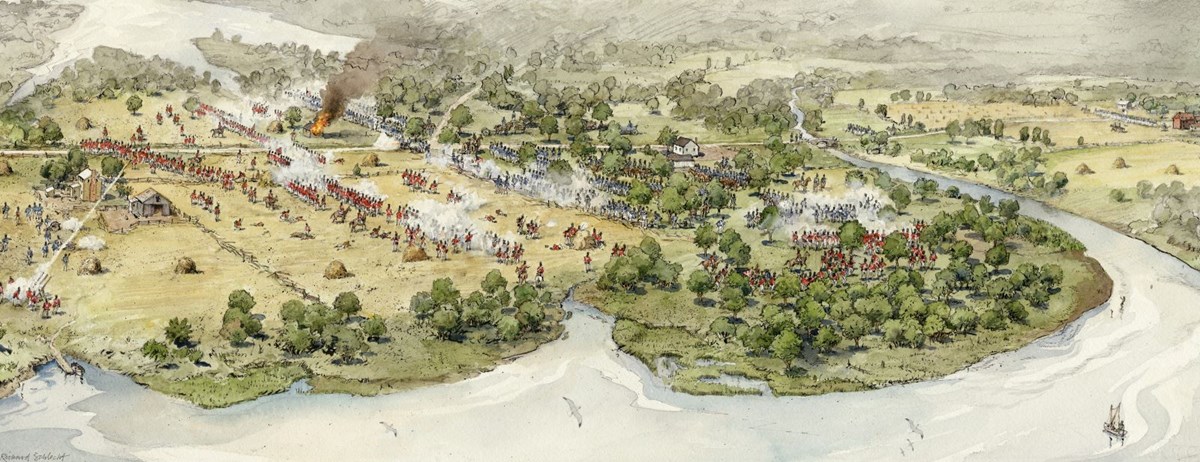
Buford decided to create a single battle line east of the Rocky River Road. Tarleton, ever the aggressive commander, ordered his horsemen to charge the Virginians. Here, Buford made what would be a devastating blunder. He ordered his men to not fire until the British cavalry was within ten yards of the American line. This would not allow the Americans a chance to fire another volley before the British charge was upon them. The Virginians fired, taking out some of the British dragoons and horses (Tarleton himself became briefly trapped under his horse), but most charged through Buford’s line, wielding their sabers and cutting down the Virginians. Total chaos ensued, and many of Buford’s men attempted to flee. Some tried to surrender by throwing their arms to the ground, but American accounts state that the British were offering “no quarter” and killing everyone that tried to surrender. Other accounts report that Buford sent a white flag to Tarleton, but probably because he was injured, it was never received, and the fighting continued. Accounts differ widely between the Americans and British on the fighting, but the fact cannot be argued that Buford’s command was destroyed. 

Waxhaws Grave and Monument, photo and flags courtesy of the author

American casualties were estimated at 350, 113 men killed, 147 wounded, 50 captured, and 2 six-pound artillery pieces and 26 wagons captured. Buford himself was able to escape the field. Tarleton only suffered 5 killed and 12 wounded, a complete victory. What has become known as “Buford’s Massacre” was not referred to as a massacre at all in many period accounts. Tarleton himself blamed the “slaughter” on the fact that his men thought he was killed in the battle and sought revenge. The disparity in numbers and the reports of indiscriminate British slaughter of Americans led to the creation of “Tarleton’s Quarter.” Patriot leaders quickly pounced on this and began to spread stories about Tarleton’s brutal tactics. This proved to be a public relations coup for the Patriot cause, as it energized their side and led to a more robust recruitment of militia and partisan forces to take on the British who now faced no organized opposition in South Carolina or Georgia.

Stay Tuned for the Emerging Revolutionary War Series newest book releases “To the Last Extremity: The Battles for Charleston, 1776-1782” by Mark Maloy and “All That Can Be Expected: The Battle of Camden and the British High Tide in the South, August 16, 1780” by Rob Orrison and Mark Wilcox to learn more abou the 1780 Southern Campaign. Both releases are published by Savas Beatie Publshing: https://www.savasbeatie.com/american-revolution/

Evacuation Day

Emerging Revolutionary War welcomes guest historian Christopher of The British-American Historian blog.

Almost two years after debating a joint French-American assailment of Lord Cornwallis’ precarious position in Yorktown, Virginia over Washington’s grand plan to recapture New York long after being swept from the city and its environs as independence was officially declared in 1776, the implacable Washington prepared to reenter New York in triumph.

Eight years after making New York the center of the British war effort in the American Revolution, the massive garrison was greatly reduced and preparing for its final retirement from the new nation. The new commander in chief of North America, Sir Guy Carleton, arrived in New York on May 5, 1782[1] to relieve Sir Henry Clinton. Carleton won accolades for holding Quebec City when the Continental Army struck during a late night blizzard, an accomplishment that was all the more vaunted now that the British were losing territory that did not include Canada. Carleton lost no time in notifying Washington of his arrival in an affable letter sent on May 7th, 1782 in which Carleton wrote “if the like pacific disposition should prevail in this country, both my inclination and duty will lead me to meet it with the most zealous concurrence”[2].

A notable disruption in the growing amity was the unresolved Asgill Affair. Exasperated with wanton assailments of loyalists in New Jersey, a prominent rebel militia commander named Joshua Huddy was plucked from the provost in New York by an American member of the Associated Loyalists[3]. The Associated Loyalists were presided over by William Franklin, the loyalist son of Benjamin who had endured arduous captivity before being exchanged[4]. In response to the wanton execution of Joshua Huddy, Washington ordered a British officer to await reprise. Charles Asgill was selected, but pleas from the French along with Washington’s honorable disposition prevailed and the captain was spared[5].

 The city and Long Island were swarming with thousands of loyal “Refugees” who had fled from every rebellious colony to seek the king’s protection. Ranging from itinerant tenant farmers to some of the largest landlords in America such as Beverly Robinson and Frederick Philipse, Carleton’s task of evacuating the troops could not be fulfilled until such persons were safely resettled in the empire. While many of the men joined provincial regiments that saw combat in the south (playing a pivotal role defending Savannah and being routed at Kings Mountain) and performed prodigious woodcutting on Lloyd Neck for the insatiable demand for firewood[6]flocks of women and children crowded the city. A subset of the refugees were former slaves who had flocked to the British cause for the promise of freedom under Dunmore’s Proclamation and the Philipsburg Proclamation, a promise Washington would vigorously contest in negotiations.

Continue reading “Evacuation Day”

Rev War Revelry Discusses NEW Emerging Rev War Book!

Charleston, South Carolina is one of the most beautiful and historic cities in the United States. Numerous sites, battlefields, and buildings from the period of the Revolution still exist.

Join us this Sunday at 7pm as we discuss ERW’s newest release “To The Last Extremity: The Battles for Charleston” by Mark Maloy. In To the Last Extremity: The Battles for Charleston, historian Mark Maloy not only recounts the Revolutionary War history of Charleston, he takes you to the places where the history actually happened. He shows you where the outnumbered patriots beat back the most powerful navy in the world, where soldiers bravely defended the city in 1779 and 1780, and where thousands suffered under occupation. Through it all, brave patriots were willing to defend the city and their liberty “to the last extremity.”

We will talk to Mark about his research, his favorite and most compelling stories and why this book is a “must have” for any history buff. Join us this Sunday, April 16 at 7pm on our Facebook page to join in on the conversation. As always, if you can not join us live you can catch the talk at any time on our You Tube or podcast channel.

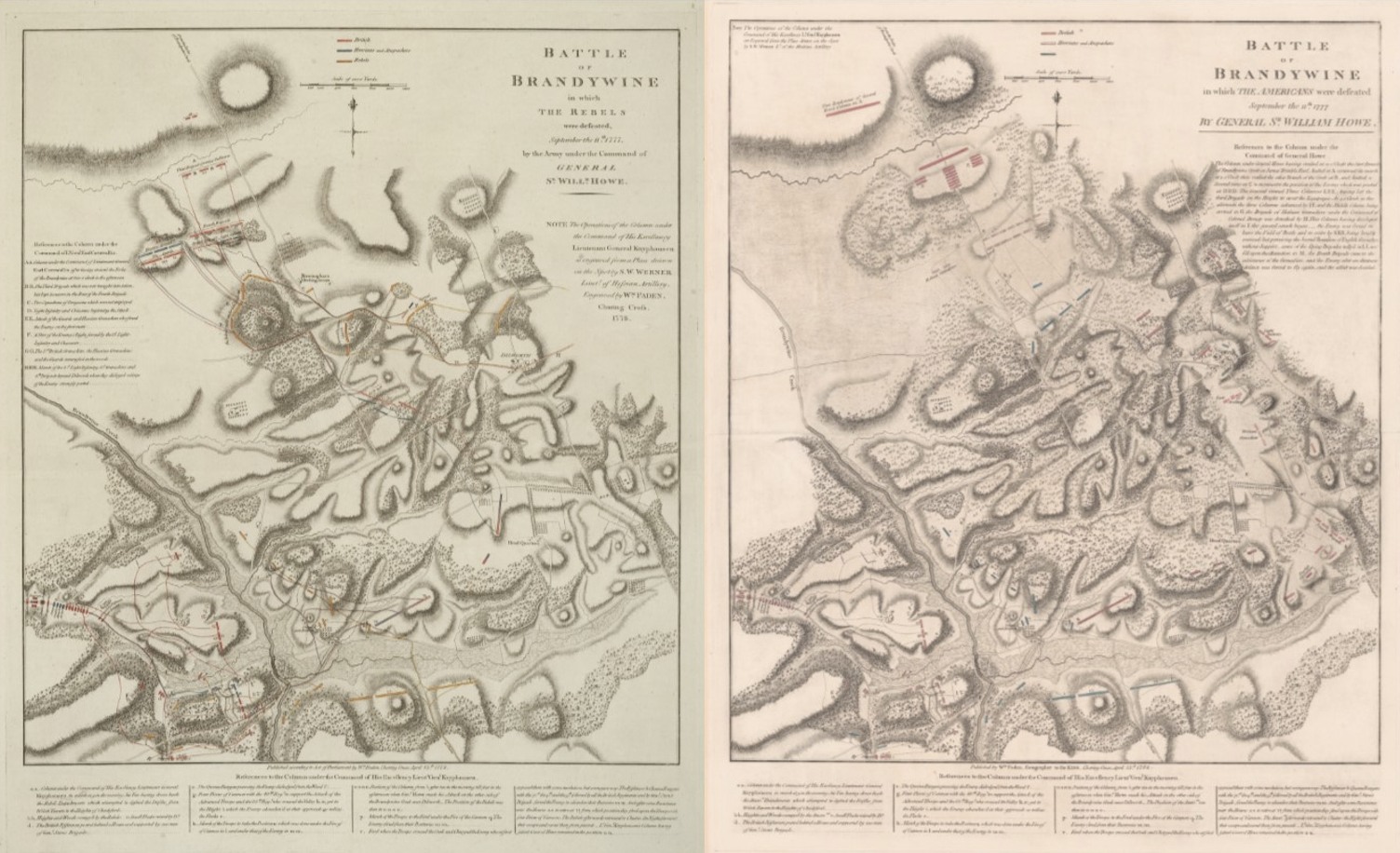
Rev War Revelry This Sunday: William Faden’s 1778 & 1784 Maps of the Battle of Brandywine with Andrew Outten

British cartographer William Faden is well known for his maps depicting major battles of the Revolutionary War. Unusually, he produced two maps of the Battle of Brandywine, one in 1778 and the other in 1784. Each map shows troop movements and positions along with other aspects of the overall battlefield landscape, but each conveys significantly different information.

Join us this Sunday night at 7p.m. on our Facebook page as we chat with Andrew Outten, historical programs manager for the American Revolution Institute of the Society of the Cincinnati. Andrew will discuss the Battle of Brandywine, key differences between the two maps, and recent discoveries pertaining to those differences. Should be a great night sharing new research so grab a drink and join us for our January 8th Rev War Revelry!

“Rev War Revelry” Battle of North Point

On September 12, 1814, approximately 4,700 soldiers, a mix of British infantry and marines, were landed on the North Point peninsula, a jut of land between the Back and Patapsco River and on a direct line of march toward Baltimore. While the infantry and marines advanced toward the city, the British Navy’s task was to subdue the American fortifications in Baltimore harbor. The latter was foiled by the stout defense of Fort McHenry which served as the backdrop for the future national anthem, the Star-Spangled Banner.

Less is known about the accompanying land engagement, fought at North Point between the British and American militia. That battle, which cost the life of Major General Robert Ross, the British commander, saw the American militia retreat, but in order, and stymied the initial approach of the British toward Baltimore. Furthermore, the battle gave the Americans more time to add to their defenses.

To shed light on this aspect of the Battle of Baltimore, Emerging Revolutionary War will be joined by two historians, both of who have worked on volunteered at Fort McHenry National Monument and Historic Shrine.

Jim Bailey is now the Chief of Visitor Services and Education at Manassas National Battlefield Park but is a former park ranger at Fort McHenry. The other guest historian is Chris Boyle who has been a National Park Service volunteer at Fort McHenry National Monument & Historical Shrine since 2005 in both the Fort McHenry Guard living history program and as an historical interpreter focusing on the Fort’s history from the War of 1812 through the Civil War. While not a native Baltimorean, he has called the city home for the last 20 years.

We hope you can join us on Sunday at 7 p.m EDT on our Facebook page for this historian happy hour.

2022 Symposium Speaker Spotlight: Norman Desmarais

We are happy to welcome Norman Desmarais to our Third Annual Symposium on the American Revolution, co-hosted with Gadsby’s Tavern Museum, The Lyceum and Emerging Revolutionary War. This year’s theme is “The World Turned Upside: The American Revolution’s Impact on a Global Scale. We asked Norm to answer a few questions about their talk and their passion for history.

Mr. Desmarais is the author of The Guide to the American Revolutionary War series (six volumes about the war on land and seven volumes about the war at sea and overseas), as well as America’s First Ally: France in the American Revolutionary War and Washington’s Engineer: Louis Duportail and the Creation of an Army Corps. He is the former editor-in-chief of The Brigade Dispatch, the Journal of the Brigade of the American Revolution.

Norm translated the Gazette Françoise, the French newspaper published in Newport, Rhode Island by the French fleet that brought the Comte de Rochambeau and 5,800 French troops to America in July 1780. He also translated and annotated Louis-François-Bertrand du Pont d’Aubevoye, comte de Lauberdière’s journal, published as The Road to Yorktown: The French Campaigns in the American Revolution, 1780-1783 (Savas Beatie 2021). He has also completed the translation and annotation of Journal of a French Quartermaster on the March to Yorktown June 16—October 6, 1781 which hopefully will find a publisher before the conference.

Norm was inducted into the American French Genealogical Society French-Canadian Hall of Fame in 2015 and received the Albert Nelson Marquis Lifetime Achievement Award in 2019 and 2020.

What first attracted you to the study of early American history?

Watching the Walt Disney television miniseries The Swamp Fox and Davy Crockett with Fess Parker and Buddy Ebsen as a youngster captured my interest. Later, during the nation’s bicentennial, I attended some reenactments and my interest blossomed in a different direction.

When I was going through a period of writer’s block and looking for a project for my first sabbatical, I was speaking with one of my friends who suggested I consider following one of my interests and that brought me into the Revolutionary Era.

What keeps you involved in the study of this history?

Continually learning about our nation’s history. The best way to learn is by doing, so I’m involved with reenacting which feeds my research and gives me opportunities to share my knowledge with the public and other historians. It’s an educational experience like no other.

Do you find these things are the same or different?  

I think they’re different, but they are related.  They use the same sources in different ways for different objectives—sort of a repurposing of information.

Why do you think it is important for us to study the Revolutionary Era? 

People today go to great effort to do their family genealogy to discover their roots.  Going back to the Revolutionary Era is sort of like doing our national genealogy and going back to our national roots. If we don’t know where we come from, we can’t understand where we’re going as family members or as a nation.

What do you think was the most significant foreign impact on the American Revolution? 

The entry of France in the war. France began providing covert aid to support the war effort right from the beginning. However, once she officially entered the war, she could provide military assistance along with a lot of materiel the Continental Army needed so badly.  French artillery helped win the battle of Saratoga which was key to France joining the war.  Without French involvement, we could not have won at Yorktown. Three quarters of the allied force at Yorktown was French (army and navy).

What are some of the important lessons of the American Revolution do you think are still relevant today?

Logistics: Supplying and maintaining an army across an ocean is extremely difficult. Consider our experience in Vietnam, Syria and Afghanistan among others.

Morale: An army that has a will to fight for its independence, homeland or whatever can sometimes defeat a better supplied and trained army that has a lesser will to fight.

National support: Think of this as morale on the home front.  If the populace of a nation doesn’t support the war effort, it’s going to be very difficult to win.  Consider our experience in Vietnam and what Russia is experiencing in the Ukraine.

What was it about the American Revolution that elicited such global interest? 

First of all, it was inspired by the ideological principles of the Enlightenment which introduced some novel ideas and ways of thinking that inspired Europeans.

Second, there was great resentment about the increasing expansion of the British empire and its dominance in world politics and economy.

Third, Britain pretty much controlled the trade routes between Europe and the West and East Indies, in other words, the lucrative sugar trade and the tea and spice trade. The rest of Europe wanted to minimize Britain’s power and to obtain a share of that trade. Then there were the lucrative fishing rights off the coast of North America.

Fourth, People began to realize that the power of the monarchy resided in the willingness of the people to be governed by the monarchy. As they realized this and acted upon it, there arose a series of revolutions for independence and changes of government.

Join us for our Third annual Emerging Revolutionary War Symposium on September 24, 2022. Emerging Revolutionary War is excited to continue our partnership with Gadsby’s Tavern Museum and The Lyceum of Alexandria, VA to bring to you a day-long Symposium focusing on the American Revolution.

Registration fee is now only $60 per person and $50 for OHA members and students. If you feel more comfortable attending virtually, the fee is $30. To register visit: https://shop.alexandriava.gov/EventPurchase.aspx

2022 Symposium Speaker Spotlight: Kate Egner Gruber

We are happy to welcome Kate Egner Gruber to our Third Annual Symposium on the American Revolution, co-hosted with Gadsby’s Tavern Museum, The Lyceum and Emerging Revolutionary War. This year’s theme is “The World Turned Upside: The American Revolution’s Impact on a Global Scale. We asked Kate to answer a few questions about their talk and their passion for history.

Kate Egner Gruber is the acting director of curatorial services for the Jamestown-Yorktown Foundation, where she works with a team to grow the collection and broaden the interpretation of early American history at Jamestown Settlement and the American Revolution Museum at Yorktown. Kate is a graduate of the University of Mary Washington’s Historic Preservation program, where she focused on archaeology and material culture, and holds her masters degree in early American history from the College of William and Mary.

What first attracted you to the study of early American history? What keeps you involved in the study of this history? Do you find these things are the same or different?   

I never know how to answer this question. The past has always been a presence in my life—whether I was digging up holes in my mom’s backyard looking for buried treasure (sorry, Mom), enthralled with the stories behind the old things in my grandmother’s upstairs room, or lost in my imagination about the landscape I called home.

I like to say that history doesn’t change—but our relationship to it does. This is what keeps me involved in the study of history of today. There’s always something new to learn, new perspectives to consider, new lenses through which to view the past. This is what keeps me motivated and eager to keep diving in.

Why do you think it is important for us to study the Revolutionary Era?  

What we learn about the past helps us better understand our present and create a more perfect union for the future.

What do you think was the most significant foreign impact on the American Revolution? 

As someone who studies both 17th and 18th century history, my perspective on this question is flipped—I think the most significant impact on the American Revolution was the colonies’ shared 17th history in the growing English and (later) British empire.

What are some of the important lessons of the American Revolution do you think are still relevant today?

From England’s Glorious Revolution to America’s Glorious Cause, we’re still negotiating our rights to life, liberty, and the pursuit of happiness—or in the words of John Locke, life, liberty, and property!

What was it about the American Revolution that elicited such global interest

Some of the founders saw their American Revolution through the lens of the English Civil Wars and Glorious Revolution, all of which had global consequences. The American Revolution isn’t just American history—it’s world history! 

Join us for our Third annual Emerging Revolutionary War Symposium on September 24, 2022. Emerging Revolutionary War is excited to continue our partnership with Gadsby’s Tavern Museum and The Lyceum of Alexandria, VA to bring to you a day-long Symposium focusing on the American Revolution.

Registration fee is now only $60 per person and $50 for OHA members and students. If you feel more comfortable attending virtually, the fee is $30. To register visit: https://shop.alexandriava.gov/EventPurchase.aspx

“If General Howe attempts…”

On December 19, 1777 a bedraggled, underfed, undersupplied, and hemorrhaging manpower, the Continental army trudged into their permanent winter encampment at Valley Forge. Located approximately 20 miles from Philadelphia, General George Washington’s army would recuperate, revitalize, re-train, and march out six months later a different military force.

Meanwhile, the British army, victors of Brandywine and survivors of Germantown ensconced themselves in the colonial capital of the rebellious colonies after its peaceful fall on September 26, 1777. Commanded by Sir General William Howe the British were better fed, better equipped, and in theory better suited to continue conducting military operations to quell the rebellion.

Which begs the question, why did Howe not attack Valley Forge?

Sir William Howe

Although historians have grappled with this, there are a number of reasons why Howe did not press the issue during the winter months, some range from personal to logistical to how warfare was conducted in the 18th century.

Was Howe frustrated at Washington for not taking the bait at White Marsh in early December 1777 to fight outside defensive works and envisioned the same reticence would be shown by the Virginian if the British attempted an offensive action toward Valley Forge?

Or was Howe simply a man of his time and war was not practiced in winter when there were so many variables one could not control, chiefly the unpredictability of Mother Nature?

Was Howe already worried about his reception and defense when he arrived back in England? Only willing to take a low risk-high reward gambit, which he attempted in May 1778 at Barren Hill?

One of his own soldiers, Captain Richard Fitzpatrick in a letter to Charles Fox penned the following;

               “If General Howe attempts anything but securing his army for the winter I shall
consider him, after what has happened in the north, a very rash man. But if he
lets himself be governed by General Grant I shall not be surprised if we get
into some cursed scrape.”[1]

Or does this one paragraph explain the main reason behind no winter campaigning, “what has happened in the north.” A clear implication to the disaster of the other field army operating in the northern American colonies, Burgoyne’s that capitulated at Saratoga in October 1777.

Although we will never know for certain, this is a question that has come up in conversations, at book talks, and around the national park at Valley Forge. This is a question Emerging Revolutionary War will grapple with on our second annual bus tour, which will include Valley Forge, this November. Check the link “Bus Tour 2022” on the black banner above to secure your ticket and partake in the ongoing debate on why Howe did not attack. Limited tickets remain.

[1] Urban, Mark. “Fusiliers: The Saga of a British Redcoat Regiment in the American Revolution (Walker & Company: Manhattan, 2007).

A Handsome Flogging: 244th Anniversary of the Battle of Monmouth Revelry

Join ERW historians on our Facebook page this Sunday night at 7 p.m. as we discuss the Battle of Monmouth, which took place on June 28, 1778. In preparation for our trip to Monmouth Battlefield State Park next week, and our annual bus tour in November, we will focus on the journeys of both armies from Valley Forge and Philadelphia, the transformations each had experienced during the winter and spring, and the decisions made by the commanders on the road to Monmouth and on the battlefield that hot summer day in June. We hope you can join us as we begin our commemoration events of what most historians declare the “battle that made the American Army.”

“Rev War Revelry” Battle of Cowpens

On January 17, 1781, General Daniel Morgan and his mixed force of Continental soldiers and militia defeated the British under the command of Lieutenant Colonel Banastre Tarleton. This victory for the patriots in northwestern South Carolina had major implications on the southern theater and the main British force under General Lord Charles Cornwallis. The battle, named after the use of the fields in which it was fought, Cowpens, also included one of the only instances in American history of a successful double envelopment.

On Sunday, at 7 p.m. EDT, Emerging Revolutionary War will be joined by American Battlefield Trust’s Kristopher White, Deputy Director of Education and Daniel Davis, Education Manager, in a discussion about the history and preservation of the Battle of Cowpens.

Round out your January weekend by joining us on our Facebook page for this live historian happy hour.