St. Louis, Missouri is considered the gateway to the west for the United States beginning in the 19th century. In the 18th century, St. Louis was not on the radar of many in the burgeoning United States.
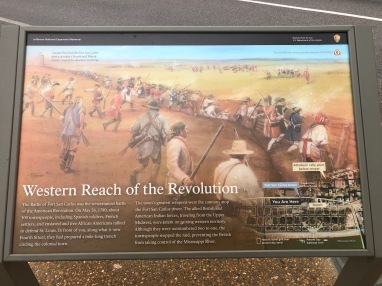
Western Reach of the Revolution, wayside informational tablet at Gateway Arch National Park (author collection)
However, the westernmost engagement of the American Revolution unfolded in the town of St. Louis, crushing British designs to conquer the territory from the Spanish, who were allied with the French and thus the United States.
Mark your calendars for September 28, 2019! Emerging Revolutionary War is excited to announce that we are partnering with Gadsby’s Tavern Museum and The Lyceum of Alexandria, VA to bring to you a day long Symposium focusing on the American Revolution.
Gadsby’s Tavern Museum
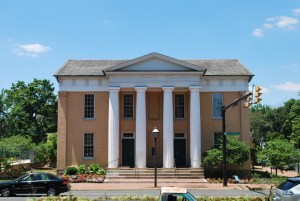
Alexandria is George Washington’s hometown and we feel is a great place for us to start this new endeavor. Historic “Old Town” Alexandria is home to dozens of museums and historic sites as well as great pubs, restaurants and shops. Gadsby’s Tavern Museum is the premier 18th century tavern museum in the country and is host to the famous annual George Washington Birthnight Ball. The Lyceum: Alexandria’s History Museum will be our host location. Today The Lyceum serves as the City’s history museum and is a center of learning through lectures, demonstrations and exhibits.
This year’s theme is “Before They Were Americans” and will highlight several topics
The Lyceum
about the years leading up to the American Revolution. Our speakers include: Phillip Greenwalt, Katherine Gruber, William Griffith, Stephanie Seal Walters and Dr. Peter Henriques as the keynote. Registration will open on July 1, 2019 through AlexandriaVA.gov/Shop or by calling 703-746-4242. Stay tuned as we highlight each of our speakers and their topics.
While Charleston, South Carolina, absolutely overflows with history dating all the way back to colonial times, I had the chance to explore a particularly historic churchyard recently. St. Michael’s Episcopal Church sits on the corner of Meeting Street and Broad Street, and tucked into its small graveyard are not one but two signers of the U.S. Constitution: Charles Cotesworth Pinckney and John Rutledge.
Emerging Revolutionary War welcomes historian Daniel T. Davis.
1777.
An elder Daniel Boone (courtesy of the LoC)
The conflict ignited at Lexington and Concord finally reached beyond the Allegheny Mountains as the British stepped up their raids on American settlements in Kentucky. With so many troops dedicated to the colonies, Henry Hamilton, the Lieutenant Governor at Detroit, relied on Native tribes allied with the Crown to carry on the war effort. In March, Shawnees began to harass Harrodsburg, Logan’s Station and Boonesborough. Founded as part of the Col. Richard Henderson’s proprietary colony of Transylvania along the banks of the Kentucky River, Boonesborough derived its name from one of the most famous long hunters of the day and resident, Daniel Boone. Continue reading ““You are a fine fellow”: The April 24, 1777 Attack on Boonesborough”→
Emerging Revolutionary War welcomes guest historian Paige Backus.
Aron, Paul. “Fighting as a Common Soldier”. Colonial Williamsburg: Trends and Traditions (Spring 2017). Accessed March 12, 2019. Click here for URL.
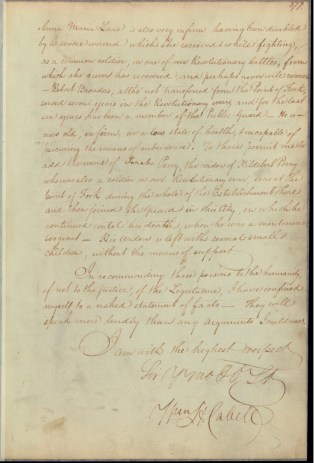
Women’s History Month is dedicated to celebrating extraordinary women and encouraging the women of today to be the same. Throughout American history, there are multitudes of women who certainly were put into extraordinary situations and rose to the challenge to make their place in history. Throughout the American Revolution, women were generally not allowed to serve in the armies so they accompanied their husbands to war as camp followers assisting with the cooking, cleaning, nursing and other domestic tasks needed by the army. This is no small feat considering that women were exposed to the hardships and challenges of war, working without the modern technology we take for granted today, and doing it all in skirts. However, one woman named Anna Maria Lane not only followed her husband into war, but she joined him in battle becoming the only known woman in Virginia to serve as a soldier during the American Revolution. Continue reading “Women’s History Month: The Story of Anna Maria Lane”→
For much of the American Revolution, the British waged war on their rebelling colonists in the Ohio River Valley via proxy, relying on western Indian nations (Shawnee, Wyandot, Mingo, Chippewa, Ottawa, and others) to attack isolated American settlements and villages across the Ohio River. The Continental Congress, already unable to meet the needs of its own army along the coasts, could offer little in the way of assistance. So, frontier defense largely fell upon the local militia. They adopted a two-pronged strategy: 1) build forts and blockhouses along the frontier, giving settlers a place of safe haven when Indian raiding parties were about, and 2) preemptive raids against Native American villages in an attempt to disrupt their preparations for raids against the settlers.
In 1777, however, Congress realized that more aggressive measures were required: the war would have to be carried against the heart of British power at Detroit, from where the British coordinated, supplied, and rewarded Native American raids. With that in mind, Congress and Continental authorities at Pittsburgh began planning an offensive to capture the British post between Lakes Huron and Erie. First, they would need to secure the continued neutrality of the Delaware Indian nation in the Muskingum River Valley, which today is in Eastern Ohio. Second, they would need to build a substantial network of forts capable of sustaining an overland offensive. Building a new fort in Delaware territory would serve both goals.
The British and loyalists would not have to wait long. Word of the landing reached the Massachusetts government within a matter of days, and preparations for a counterattack began almost immediately. There was such a hurry to respond that the General Assembly voted to carry out the operation with state forces rather than wait for Continental assistance.[1] Despite the initial rush it still took a month to assemble a force of over 1,000 militiamen, as well as the food, arms, and other supplies to sustain them. All of these troops and their supplies would be transported by a fleet of 21 transports, accompanied by nearly twenty state and Continental navy vessels and privateers. Among the warships the largest was the Frigate Warren of 32 guns which served as the flagship of Commodore Dudley Saltonstall. The Connecticut born officer was given overall command of the naval forces – no small task given the lack of experience with large scale fleet actions among his subordinates. Command of the land forces was given to Massachusetts Brigadier Solomon Lovell. Lovell has seen experience early in the war outside of Boston, but was also relatively untested in battle. The inexperience and poor communication between Saltonstall and Lovell was to have a decisive impact on the coming expedition. Notable among the other officers in the expedition was Paul Revere, who commanded the Massachusetts artillery. The expedition was also joined by a band of the local Penobscot Indians allied to the Continental Congress.
The New England fleet entered the Penobscot Bay on July 25th and immediately attempted a landing. Clearly outnumbered and with their works incomplete, General McLean and his men were determined to resist the Americans, but expected the worst. Saltonstall’s fleet sailed in close to the shore and exchanged cannon fire with both the British defences and the three remaining Royal warships, now under the command of Captain Henry Mowatt. In the confusion and smoke the Americans lowered seven launches full of marines and militiamen, but as they neared the shore they were met by a hail of musket fire[2]. At least one of the attackers – a Native American – was killed and the boats returned to the safety of the fleet. It was an inauspicious start to the battle for the New Englanders and already the relationship between the two commanding officers was becoming strained. General Lovell knew little about sailing or naval operations. He questioned the Commodore as to why he couldn’t just sail his fleet into the harbor and blast the British to pieces while his troops landed under their covering fire. The Connecticut seaman replied curtly, exclaiming “You seem to be damn knowing about the whole matter! I am not going to risk my shipping in that damned hole!”[3]
On the 26th a second militia landing on the peninsula was repulsed after the lead boat carrying militia Major Daniel Littlefield was swamped by British chain shot, drowning the Major and two privates.That same day, however, the Americans scored a small victory when a force of 200 Continental marines and artillerymen landed on Nautilus Island and captured the small British battery there[4]. More artillerymen were landed and soon the Americans had a battery from which they could harass the British shipping. With the Americans making some headway Captain Mowatt withdrew the remaining British ships deeper into the harbor, creating a defensive line across the Bagaduce River.
Castine Harbor, looking out roughly where Captain Mowatt anchored the British transports and warships (Author’s photo)
Abraham Lincoln usually gets the credit for establishing Thanksgiving as a national holiday in 1863. He deserves much of it for making it an annual event. But, Lincoln was harkening back to an earlier practice of giving thanks amidst the trials and tribulations of war, whether it was going well or not. The tradition predated the Revolutionary War generation, but they were as apt to a hold national day of giving thanks as any of their predecessors or successors in American history. Continue reading “Thanksgiving with the Continental Army, 1777”→
Emerging Revolutionary War welcomes back guest historian Travis Shaw.
Part One
I’d be willing to bet that Maine isn’t the first place to come to mind when you hear the word “frontier”. For many Americans I imagine they immediately think of the wild west. Wagon trains of pioneers crossing the prairies, and Native nations like the Sioux and Apache ranging the plains on horseback. A century before the age of Manifest Destiny, however, the region that is now the state of Maine marked the eastern frontier of the English colonies. It was a wild and sparsely settled place, caught between New England and the French colonies to the north. The few European settlers eked out a living from the thin, rocky soil or turned to lumbering and to the sea. They lived alongside and often fought against the region’s original inhabitants – the Wabanaki or “People of the Dawn.” For two centuries the Eastern Frontier was torn apart by war between various European powers and their respective Native allies. Nowhere is this more clearly evident today than in the small coastal town of Castine, Maine.
Castine is located near the mouth of the Penobscot River, more or less in the middle of the Maine coast (Google Maps)
Captain John Ashby and his fellow Virginians would face their greatest test of the war on the afternoon of September 11th, 1777 at the Battle of Brandywine. Following a wide flank march the bulk of the Crown forces emerged on Washington’s right flank, ready to trap and smash the Continental Army. Washington reorganized his line, drawing men north in a desperate attempt to meet the new threat. The Third Virginia was ordered into position far in advance of the American lines – their objective was to hold a wooded hill near the Birmingham Friends Meeting House in order to buy time for the rest of the American troops to take up position. Ashby and his fellow officers arranged their men among the buildings and woodlot of the Samuel Jones farm and awaited the attack that was certain to come.
The Battle of Brandywine, September 11, 1777 (American Battlefield Trust)


 announce that we are partnering with Gadsby’s Tavern Museum and The Lyceum of Alexandria, VA to bring to you a day long Symposium focusing on the American Revolution.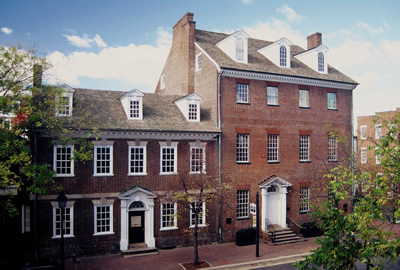
 While Charleston, South Carolina, absolutely overflows with history dating all the way back to colonial times, I had the chance to explore a particularly historic churchyard recently.


 Emerging Revolutionary War Era