Join us Sunday, October 4th at 7pm as we continue our series on the 250th of the New York Campaign. We welcome back ERW authors Mark Maloy and Dan Welch as they cover the events from the Battle of Harlem Heights to the Battle of White Plains. In the fall of 1776, George Washington struggled to keep his army together and keep the British Army at bay. From the strategic to the tactical, and what to see there today, this will be a revelry you will not want to miss.
This Revelry will be LIVE on our Facebook page, so join in on the conversation via the chat!
Admiral Lord Richard Howe, 50 years old, found himself in an awkward position.
Admiral Lord Richard Howe, 1789, painted by John Singleton Copley
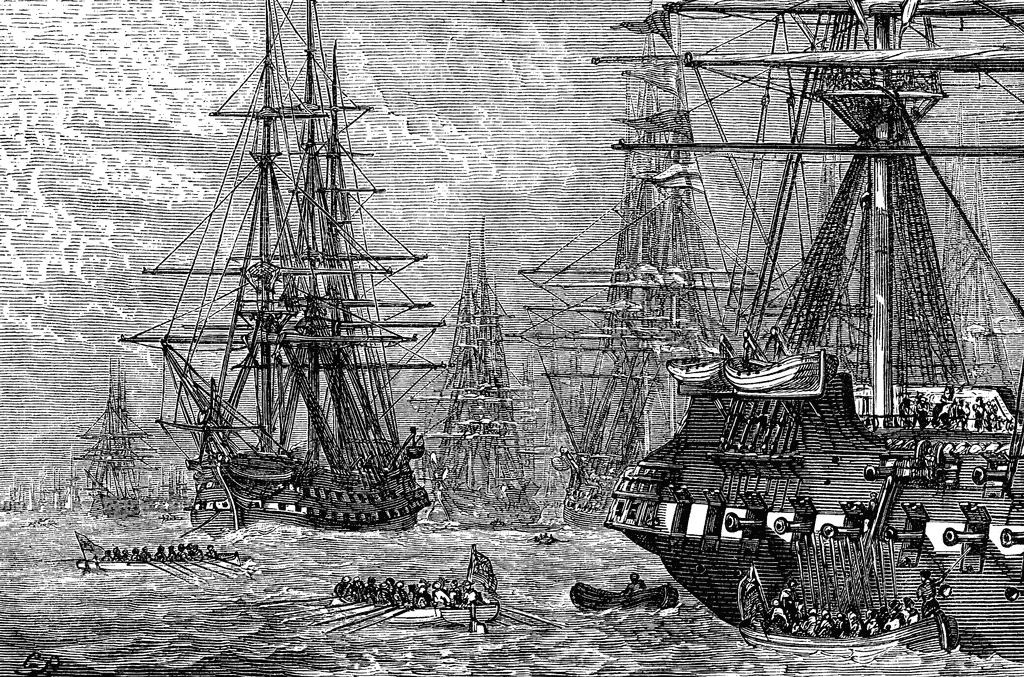
Howe commanded the Royal fleet even then investing Manhattan Island following the defeat of the Continental Army at Brooklyn Heights earlier in September. Nearly 400 ships of various sizes sailed under his command—the largest fleet England had thus far assembled.
Yet despite that military might, Howe had an additional role to fulfill. His Majesty, King George III, had appointed him as one of two “peace commissioners” charged with negotiating terms with the Americans. The other peace commissioner was Howe’s brother, General William Howe, commander of the Royal army. The makers of war were tasked with negotiating a peace.
Complicating matters even more, the brothers were not empowered to do much actual negotiating. Colonists first had to renounce their independence before any terms for a restored peace could be discussed. Pardons could then be liberally granted, although Howe did have a blacklist, a list of “Rebell[s] expressly excepted from Pardon.”
Lord Howe generally felt sympathetic toward the former colonies, and when he dispatched the paroled American general John Sullivan to Philadelphia with an overture for peace, Howe genuinely hoped for reconciliation.
Join us this Sunday at 7pm as we ERW authors and historians Dan Welch and Mark Maloy continue their 250th anniversary coverage of the New York Campaign. They’ll chat with us about the events following the Continentals retreat from Long Island, Nathan Hale, the Turtle, the Peace Conference, and of course the fighting at Kip’s Bay and Harlem Heights. Welch and Maloy’s new book, “Conquer or Die” will be available this fall. This Revelry will be LIVE on our Facebook and You Tube pages at 7pm.
The New York Campaign had been building for over year by August 1776. In July 1775, previous British commander of forces in America, Thomas Gage, had sent a request to his superiors to be allowed to leave Boston and begin a new campaign in New York. Following Lexington, Concord, and Bunker Hill, Gage’s force remained bottled up and besieged in and around Boston and Charleston. When word of approval of Gage’s plan reached Boston, so too did orders relieving him of command. Before he departed for England in October 1775, he met with his successor, William Howe, and greatly stressed the importance of moving the theater of war to New York. Howe would follow Gage’s preplanning and approval to the letter, including waiting until the spring to began the shift in the army’s base of operations. Howe’s timetable, however, was moved up after the arrival of Henry Knox’s artillery train and the placement of guns on Dorchester Heights. On March 17, 1776, Howe and 11,000 troops and Loyalist citizens sailed for Nova Scotia. Foreshadowing the British departure and the location of the next campaign in a letter written two days before they set sail, Col. Joseph Reed, later George Washington’s adjutant-general, correctly asserted, “If Howe should leave Boston, we expect he will make for New York; and, at all events, we look upon that as one of the scenes of the summer business.”
Meanwhile, George Washington also looked to New York as the next seat of this growing conflict. In January he sent Charles Lee to begin laying out a position for the Continental Army to take once it shifted southward from Boston. Not long after Lee arrived in February 1776 he assured the Committee of Safety that even though he could see no way to make New York into a “tenable fortification” he could make a position strong enough to be “a most advantageous field of battle” that would “cost the enemy many thousands of men to get possession of it.” Just two months later, on April 13, Washington and the Continental Army arrived.
The Continental Army commander had no other choice than to do what he could in New York. There was immense political pressure on Washington not to abandon it, the Congress believing it had high political and psychological value. Many in Congress believed abandoning it would demoralize the Patriot cause and swell the morale of the Loyalist population in the city and colony thereof. Furthermore, it was a central location along the Atlantic coast and a conduit of communication and supplies between New England and the southern colonies via the Hudson River. Furthermore, the Hudson River/Lake Champlain corridor remained a vital passage to Canada and the Great Lakes. New York was also a bustling economic hub, the second largest urban center in the colonies, with a port, shipbuilding, and deep-water harbor had immense naval and trade value. Widely considered as the “key to the continent,” Washington would have a difficult task defend the city, it’s deep water port, and the numerous navigable waterways; all reasons the British wanted to seize the city in their effort cutoff New England from the middle and southern colonies. Writing to his brother, John Augustine Washington, between May 31 and June 4, 1776, he confessed, “We expect a very bloody Summer of it at New York . . . & I am sorry to say that we are not, either in Men, or Arms, prepared for it.”
Finally, after several months of resupplying and refitting his army in Nova Scotia, William Howe and his command arrived on Staten Island, unopposed, in June 1776. Pvt. Daniel McCurtin, 1st Company of Maryland Rifles, recorded the British arrival, noting he saw, “the whole Bay was full of shipping as ever it could be. I declare that I thought all London was afloat.”Over the coming weeks he would be joined by his brother, Richard, with large numbers of reinforcements, ships, transports, supplies, and Hessians. Although the two brothers leaned into their role of peace commissioners, attempting to end this growing rebellion through pardons and not bloodshed in July, by August, with no peaceful resolution insight, military preparations moved forward.
On August 20, 1776, British troops began loading onto ships and transports from their Staten Island camps, and 250 years ago today, August 22, 1776, the first British troops landed on Long Island at Denyse’s Ferry. Howe had chosen this site for its richness and crops and plentiful livestock in which to supply his army. Still unsure of Howe’s intentions, and constantly worried about his flank and rear being turned by the British Navy, Washington had spread his army dangerously thin across several islands with waterways separating reinforcements should the need for them arise. Thus, on August 22, Washington only had 3,000 men, John Nixon and Nathaniel Heard’s brigades, and some Long Island militia in which to contest the landing. All they could really do was raise the alarm. By the end of the day 20,000 British troops were on Long Island. Only time would tell, at least for Washington, whether or not this would be Howe’s main push or simply a diversion to another beachhead and main strike.
Learn more about the 1776 New York Campaign with ERW’s forthcoming release, Conquer or Die: The 1776 New York Campaign, by Dan Welch and Mark Maloy. Pre-order here!