Emerging Revolutionary War would like to thank Drew Gruber, for bringing this connection to our attention.
During the May 5th, 1862 Battle of Williamsburg as Confederate soldiers ran down into what would be called the bloody ravine they ran headlong into men from New Jersey, New York, and Massachusetts. In an effort to push the Union soldiers out of the ravine and sweep them from the field brigade after brigade was sent into the fight. Among those was four Virginia regiments under AP Hill. After leaving the relative safely of the City they deployed in some form of a line and pitched down into the ravine too.
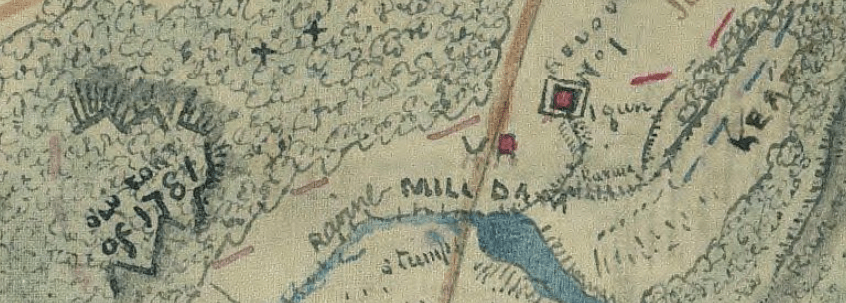
Portion of the map of the Battle of Williamsburg, showing the land the American Battlefield Trust is currently working to purchase (map courtesy of LOC)
In the ravine hand-to-hand combat, fallen trees, driving rain, and the thick smoke made communication almost impossible and command fell on company commanders to keep the battle moving in their favor. Among the men in Hill’s brigade fighting down in the bloody ravine was Tipton Davis Jennings of the 11th Virginia Infantry. His account of the fighting here at Williamsburg will be of particular interest to your readers of the ERW blog.
Writing in 1897 his “Incidents in the Battle of Williamsburg” appeared in the Confederate Veteran Magazine. In fact Kate and I covered this in an earlier ERW post titled, Revolutionary Memory. (click here to read that post).
“Just then,” he wrote, “we happened upon what was apparently an ancient line of grass-grown earthworks. We learned afterward that portions of Washington’s line of entrenchment were yet discernible thereabouts. And so it is possible that we ragged ‘Rebs’ were actually defending the same works were [sic] once stood the ragged continental ‘Rebs’ fighting, the hessian of Europe, as we were now, some eighty years later. So doth history repeat itself.”
At first glance is this a cool anecdote and yet rather odd. However, when you consult french maps from the Williamsburg region created during the Yorktown Campaign you’ll find references to Mulhenburg’s “lights” camped in this very area. Moreover, almost hidden in plain sight on one of Sneden’s 1862 maps is and “Old Fort of 1781.” Civil War soldiers seemed wholly cognizant of the Revolutionary landscape around them and like Jennings used it to spur on their cause(s).
Yesterday, on the 158th anniversary of the May 5th, 1862 battle the American Battlefield Trust launched a campaign to save the 29 acres over which Jennings charged. Perhaps it is this very same ground where the original cast of “ragged continental ‘Rebs'” also campaigned. Click here to read about that initiative and for further information on how to donate.
Emerging Revolutionary War (ERW) would like to highlight from time to time some of the lectures, presentations, talks, and events that our historians are apart of.
This month, ERW historians are giving the following presentations:
Bert Dunkerly
March 27th: “The Brown’s Island Explosion Victims” at the Virginia Forum, Richmond, Virginia
Kate Gruber
March 13th: “Tenacity: Women in Jamestown and Early Virginia” Shenandoah Lyceum Lecture Series, Harrisonburg, Virginia. For more information click here.
Along the wooded ridges of central Pennsylvania, a brutal war raged that was far removed from the orderly movements of large armies in the east. The attack on Phillip’s Rangers is a good example of this warfare.
Native Americans, supplied and encouraged by the British, raided far and wide on the frontier. These included Seneca, Shawnee, Delaware, and Mingo peoples. By the 1780s, many of these groups had been pushed out of their traditional homes to the east, and many viewed war with the Americans as the only way to protect what land they had left.
Billy Griffith, Kevin Pawlak, Rob Orrison and Mark Maloy at George Washington’s HQ in Newburgh, NY
Just over two weeks ago, ERW historians Billy Griffith, Phillip Greenwalt, Mark Maloy, Rob Orrison and Kevin Pawlak took a long weekend trip up to upstate New York. This was the fourth year that ERW authors have gotten together to take a “field trip” to see sites related to the French and Indian War and the American Revolution.
The trips not only serve as chances for research, but also to make new connections with public historians working in the American Revolution era. Along the way, we posted several videos from locations to give our followers an idea of some of the great places to visit out there. Again, our goal is to not just share this history, but to get people to visit these great sites.
Sites visited on the first day included the Stony Point Battlefield, where Americans under Gen. Anthony Wayne over ran a surprised British outpost. Reading about this action almost rings empty until you stand on the ground. Looking at the steep terrain that Wayne’s men climbed after traversing through a wetland, it is hard to imagine how the Continentals were able to take the British fort with so few casualties. Later that day we made a quick stop at George Washington’s headquarters in Newburgh. Here Washington lived from April 1782 to August 1783 and where he learned of the cease fire with the British, wrote his now famous circular letter to the colonial governors on his vision for the new government. Most importantly, here Washington responded to the Newburgh Conspiracy of his officers looking to possibly over throw the civil government. This site is also important in the history of the museum field as it is the first publicly owned historic site in the United States, opened in 1850 as a museum. A worthwhile nearby site, the New Windsor Cantonment site, preserves the camp site of the Continental Army during the 1782-1783 time period. Several of the buildings are rebuilt, including the Temple of Virtue, where Washington made his impassioned speech to his officers (with the assistance of his glasses) to diffuse their discontent with Congress.
The morning of the second day of the trip was spent visiting sites around Lake George, NY, including some much over looked French and Indian War sites. That afternoon sites along the upper Hudson including the site of the murder of Jane McCrea, Fort Edward and sites in Albany.
Park Interpreter Bob Hoar explains the terrain of the battlefield
Early Sunday morning, a quick trip to the Bennington Battlefield State Park was highlighted with a great personal tour by Bob Hoar. The battlefield is well preserved and interpreted. Bob also shared some of his research into reinterpreting the battlefield using first person accounts and the landscape. Again, understanding the landscape of these places creates such a better understanding.
The majority of the day on Sunday was spent at Saratoga National Historical Park, posting several Facebook Live videos from various points across the battlefield. Also a special visit to the surrender site in Schuylerville which was recently preserved and opened as a memorial by the Friends of Saratoga Battlefield. A great preservation victory that adds to the overall story of Saratoga.
One of the highlights of the trip took place on Monday, where we received a behind the
Curator Matthew Keagle gave a behind the scenes tour of Fort Ticonderoga’s amazing collection storage.
scenes tour by Fort Ticonderoga staff. We started by learning about the military interpretive program by Ron Vido, Military Programs Supervisor. Anyone who has visited Fort Ticonderoga knows about their quality interpretive staff and programs. Ron also shared with us their plans to slowly restore the Carillon Battlefield (1758), which will be a great addition to the understanding of North America’s bloodiest battle before the Civil War. That afternoon we were treated to a behind the scenes tour of Fort Ticonderoga’s collections storage by Curator Matthew Keagle. The Fort has been collecting 18th century items for nearly 100 years. Their collection is one of the largest collection of 18th century military artifacts in the United States. From a Continental knapsack to an original copy of Baron von Steuben’s drill manual, the collection on display is only a small portion of what the museum owns. Matt also shared the museum’s ongoing work to digitize their collection for the purpose of research. The day was capped off by a visit to one of the best preserved battlefields in the United States, Hubbardton. Fought as part of the Saratoga Campaign, this is Vermont’s only battlefield. The landscape at the foot of the Green Mountains is amazing and the viewsheds are near pristine. A nice state park and visitor center are there to help explain the events of July 7, 1777.
Thank you to all the people that assisted us in this trip and all the sites that were nice enough to host us. We will be posting more on the blog in the future focusing on some of the stories around these amazing sites. Again, we encourage you to take the time to visit all these places. History books are great, but there is no substitute for being in the footsteps of history
A few weeks ago, heading to the airport after the first Emerging Revolutionary War symposium, fellow ERW historian Rob Orrison made a pit stop in a residential neighborhood in Prince William County, Virginia.
To the average traveler to the Ronald Reagan International Washington National Airport this slight detour would not be normal. Yet, for two historians of early American history, these detours are rarely common.
This particular detour took us to a portion of the King’s Highway that has been preserved by the Prince William County Historic Preservation Division. Along this stretch soldiers in the French Army under Comte de Rocambeau and Continentals under General George Washington traversed on their way to Yorktown to entrap the British under General Lord Charles Cornwallis.
Thus, one king’s soldiers, King Louis XVI took a route named for monarch to assist rebels in trapping the ground forces of another king, that of Great Britain by using a road named for the British monarch. Interesting to think about the naming of the road in those terms.
Portions of this route are still preserved today, other sections have been modernized and blacktopped to be Route 1.
Below are a few photos I snapped, including the size 14 Nike shoe belonging to yours truly, re-enacting marching down the thoroughfare like the patriots of 1781.
From our friends at the American Revolution Round Table of Richmond
Tour Leader – Dr. Patrick H. (Pat) Hannum, Professor, Joint Forces Staff College, National Defense University, Lt Col USMC (Ret)
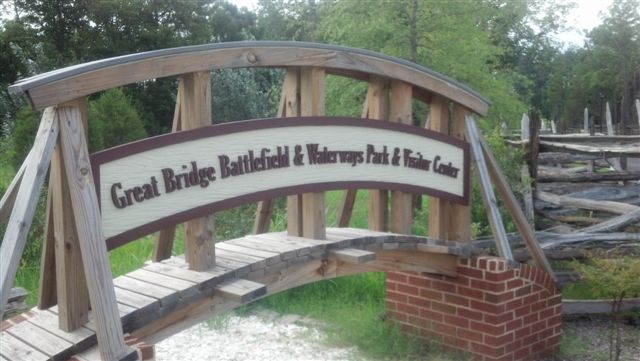
Great Bridge Battlefield (courtesy of Great Bridge Battlefield & Waterways History Foundation)
This tour will visit three critically important Revolutionary War sites, in the modern Cities of Norfolk, Virginia Beach and Chesapeake, in order to help inform the important events and explain how the Whig Government ousted the Royal Governor, Lord Dunmore, and British military forces from the State of Virginia. These events largely unfolded in the fall of 1775 and culminated with the destruction of the City of Norfolk in early 1776. Strategically important, these events led to near uncontested Whig control of the State of Virginia for three and one-half years. The British defeat at Yorktown in October 1781 traces its roots to the critical decisions and decisive actions of the Whig Governments of Virginia and North Carolina in the fall of 1775. We will visit: Continue reading “Southside Revolutionary Virginia 1775 Tour – October 12, 2019”→
Fort Stanwix in Rome, New York, has plenty of history to offer, but it’s equally a success story of urban renewal. The fort’s original location was long swallowed up by the city’s expansion in the twentieth century, but it was then reclaimed in advance of the American Bicentennial. City blocks were razed, the fort reconstructed, and American history became a central tourist attraction in the heart of downtown Rome. It’s a “faithful reproduction,” the Park Service says, constructed using “many original plans and documents.”
The site of Fort Stanwix in 1969 and after its reclamation in 1976. (courtesy NPS)
A few random musings on the importance of this date in American Revolutionary history…
President’s chair, Independence Hall, Independence National Historical Park (author collection)
This day was the date that the assembled Second Continental Congress voted on the draft of a document that was Richard Henry Lee, a delegate from Virginia had put forth in a measure, in June, to be voted on declaring;
“That these United Colonies are, and of right out to be, free and independent States, that they are absolved from all allegiance to the British Crown, and that all political connection between them and the State of Great Britain is, and ought to be, totally dissolved.”
Thomas McKean by Charles Wilson Peale
On July 4, two days after this resolution passed, the final and formal version was approved by Congress. John Hancock, president of the Continental Congress affixed his signature boldly and largely at the bottom of the document. Eventually 55 other men would place their signature on the Declaration of Independence, with Thomas McKean, generally accepted, as the last to sign the document, possibly as late as January 1777.
Copies were made and four days later, on July 8, the first public reading occurred in Philadelphia. George Washington had the document read to the Continental Army in New York on the following day, July 9.
John Adams by Gilbert Stuart
For John Adams, future second president of the United States, the second day of July would and should be the day to remember American Independence, as he wrote;
“The most memorable Epocha, in the History of America. I am apt to believe that it will be celebrated, by succeeding Generations, as the great anniversary Festival…It ought to be solemnized with Pomp and Parade with shews, Games, Sports, Guns, Bells, Bonfires, and Illuminations from one End of this continent to the other from this Time forward forever more.”
And that is how many Americans choose to celebrate the anniversary of the Declaration of Independence, however, usually two days later on July 4th. Yet, it took another war; World War II, for July 4th to become a national paid holiday for workers of the Federal government when Congress approved it in 1941.
So, happy Independence Day!
*Feel free to add any interesting historical tidbits about the Second Continental Congress, the signers, or 1776 below!*
Benjamin Franklin, one of the Founding Fathers of the United States, could have contributed to a forgotten shipwreck narrative, according to new research.
Benjamin Franklin
Based on studies of Franklin’s early life as a printer, Dr Hazel Wilkinson claims there are clues which provide information about Benjamin Franklin’s activities during his first visit to London as an 18-year-old printer.
From our friends at American Battlefield Trust (ABT). To learn more about the ABT, click here.
At stake are 31 acres associated with two Southern Campaign Revolutionary War battlefields, Hanging Rock in South Carolina and Guilford Courthouse in North Carolina.
At Hanging Rock, generous battlefield preservationists like you have already secured 141 acres. These 30 acres in the part of the battlefield where the initial Patriot attack began will add significantly to the land we have saved there already.
At Guilford Courthouse, the half-acre tract at stake may be small, but it’s part of a larger strategy to deal with the modern development crowding in on this battlefield from all points of the compass. Our plan is to buy up plots of battlefield land – including small ones and those with non-historic structures on them like this one – remove all non-historic structures and restore the battlefield. The Guilford Courthouse National Military Park has generously agreed to take responsibility for demolishing and removing the house on this plot, a considerable cost that we would typically need to cover. Continue reading “Rise and Fight Again for Southern Revolutionary History”→






 Emerging Revolutionary War Era