

Continuing to our build-up to the September 28, 2019 symposium Before They Were Americans, today we are highlighting Stephanie Seal Walters. Walters is a PhD Candidate at George Mason University. Her dissertation, “As I Glory in the Name of Tory”: Loyalism, Community, and Memory in Revolutionary Virginia, 1760-1794, focuses on loyalism within the different cultural and geographical regions of the colony of Virginia. For the symposium, she will be speaking about the impact of smallpox on the American Revolution during her talk “Smallpox to Revolution.”
Category: Uncategorized

George Washington’s “Favorite” Charles Lee
When you mention the name “Charles Lee” in many Revolutionary War circles, one immediately thinks of Maj. Gen. Charles Lee. Though there was another Charles Lee and it can be argued provided more contributions to the United States than the British born military general.

Charles Lee was born in 1758 on his father’s plantation Leesylvania in Prince William County, Virginia. The 2,000-acre farm that sat on the Potomac River and neighbored other Potomac River families such as the Fairfaxes, Washingtons and Masons. Charles’ father, Henry Lee II, a political colleague and friend of George Washington, Charles was one of eight siblings and five males that would solidify the Lee family’s role as leaders in politics and society. Continue reading “George Washington’s “Favorite” Charles Lee”
The Gerrymander: A Gift from the Founding Fathers
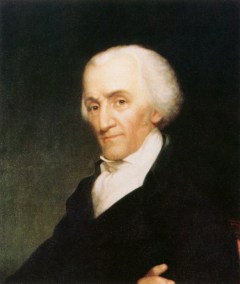
Lately, the term “gerrymandering” is getting thrown around as some sort of new illness that afflicts the republic. The process essentially involves drawing electoral district boundaries in ways that benefit one political party or the other and dates back to 1812 Massachusetts, when Governor Elbridge Gerry, a member in good standing of the founding generation, signed legislation radically redrawing electoral districts in the state to favor the Democratic-Republican Party.
Born in 1744, Gerry was a Massachusetts merchant and vocal opponent of British policy in the colonies who served in the Second Continental Congress, signed the Declaration of Independence, the Articles of Confederation, and attended the Constitutional Convention. Like a few of his contemporaries, notably George Mason and Patrick Henry of Virginia, he refused to sign the Constitution due to its lack of an explicit Bill of Rights. Nonetheless, he went on to serve as an envoy to France in the Adams administration, then was elected to the U.S. House of Representatives, as Governor of Massachusetts, and then was Vice President under James Madison. Only a few men had a better claim on the term “founding father.”
Continue reading “The Gerrymander: A Gift from the Founding Fathers”
Symposium Update
In the build-up to the September 28, 2019 symposium Before They Were Americans, today we are highlighting Liz Williams, Director of Gadsby’s Tavern Museum. The tavern consists of two buildings: a (circa) 1785 tavern and the 1792 City Tavern. Named after its tavern keeper from 1796 to 1808, Gadsby’s Tavern was an important center of economic, political, and social life in Alexandria after the American Revolution. Continue reading “Symposium Update”
“Shaking Leaves” and a “Damned Poltroon”?: Charles Lee, George Washington, and the 241st Anniversary of the Battle of Monmouth Court House
Two-hundred and forty one years ago, today, one of the most famous, yet controversial, exchanges between two commanding generals on a battlefield occurred in a field west of Monmouth Court House (present-day Freehold), New Jersey.
George Washington had arrived in Englishtown roughly an hour and a half ahead of the Continental Army’s main body and sat down for breakfast sometime around ten in the morning, June 28, 1778. Six miles away, Major General Charles Lee’s vanguard of roughly 5000 men was just about to throw itself at the British rearguard north of Monmouth Court House.

When those elements came into contact, what resulted was anything but a general engagement. Within an hour Lee’s men were retreating west with newly arrived British troops committed by Lieutenant General Henry Clinton right on their heels. Disaster loomed for the Americans as a result of miscommunication, misunderstanding, and poor generalship on the part of Lee’s subordinates. The American vanguard’s commander had specific orders from Washington to fall upon Clinton’s rear as it marched out of Monmouth, and now Lee was desperately attempting to stave off defeat. Continue reading ““Shaking Leaves” and a “Damned Poltroon”?: Charles Lee, George Washington, and the 241st Anniversary of the Battle of Monmouth Court House”
George Washington, Daniel Morgan, and Winchester, Virginia on Memorial Day
I’ve been intermittently visiting Winchester, VA for years, usually with an eye toward understanding its place in the Civil War. Tradition has it that no town changed hands more frequently. But, the town also has a prominent, if sometimes overlooked, role in America’s colonial and Revolutionary War history. In particular, it enjoyed a close relationship with George Washington and Daniel Morgan, helping shape both men.

Winchester, or Frederick Town, as it was then known, was the largest village in the lower Shenandoah Valley when Lord Thomas Fairfax decided to relocate from England to his land grant in northern Virginia and became a way-station of sorts for people traveling along the Great Wagon road that ran from Pennsylvania to North Carolina in the 18thcentury. So, when the Fairfax family hired a teenaged George Washington to help survey its grants in the Shenandoah, Winchester was a logical place for the surveying team to make its temporary home base. (In truth, surveying teams were constantly moving to maximize their efficient use of time: the saddle might be considered home.) While the teenager was less than impressed with most accommodations on the frontier, he was pleased with Fredericktown. He recorded in his diary: Continue reading “George Washington, Daniel Morgan, and Winchester, Virginia on Memorial Day”
Book Review: Revolutionary: George Washington at War by Robert L. O’Connell
Robert L. O’Connell, Revolutionary: Washington at War, e-book, (New York: Random House, 2019), $32 in hardback.

Robert L. O’Connell is best known for asking “big” questions. Armed with a PhD in history and a lengthy career in the intelligence community, his books Of Arms & Men: A History of War, Weapons, and Aggression (1989) and Ride of the Second Horseman: The Birth and Death of War (1995) tackled the origins, nature, and future of warfare. In the last decade, however, he has turned his sights on more specific targets: Hannibal at Cannae, William Tecumseh Sherman, and, most recently, George Washington. Released earlier this year, O’Connell’s Revolutionary: George Washington at War is just the latest work to tackle the martial aspects of George Washington’s life and career.
Continue reading “Book Review: Revolutionary: George Washington at War by Robert L. O’Connell”
Announcing the First Emerging Revolutionary War Symposium!
Mark your calendars for September 28, 2019! Emerging Revolutionary War is excited to announce that we are partnering with Gadsby’s Tavern Museum and The Lyceum of Alexandria, VA to bring to you a day long Symposium focusing on the American Revolution.
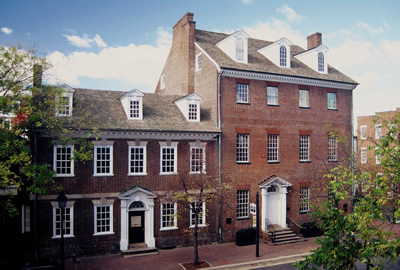
Alexandria is George Washington’s hometown and we feel is a great place for us to start this new endeavor. Historic “Old Town” Alexandria is home to dozens of museums and historic sites as well as great pubs, restaurants and shops. Gadsby’s Tavern Museum is the premier 18th century tavern museum in the country and is host to the famous annual George Washington Birthnight Ball. The Lyceum: Alexandria’s History Museum will be our host location. Today The Lyceum serves as the City’s history museum and is a center of learning through lectures, demonstrations and exhibits.
This year’s theme is “Before They Were Americans” and will highlight several topics
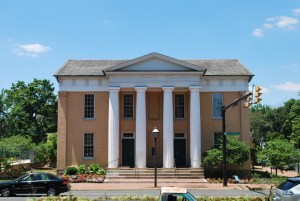
about the years leading up to the American Revolution. Our speakers include: Phillip Greenwalt, Katherine Gruber, William Griffith, Stephanie Seal Walters and Dr. Peter Henriques as the keynote. Registration will open on July 1, 2019 through AlexandriaVA.gov/Shop or by calling 703-746-4242. Stay tuned as we highlight each of our speakers and their topics.
John Wayne, Colonel James Smith, and the Black Boys Rebellion
 Allegheny Uprising, starring John Wayne and Claire Trevor, is an overlooked Revolutionary War movie. I first watched the 1939 film as a kid on a local UHF station, but never quite realized how closely it tracked with the memoir of a colonial and Revolutionary War soldier, Colonel James Smith. So, I decided to take a look.
For a significant portion of the last century, no actor signified “the American Century,” more than John Wayne. But, in the 1930s, he was a former-stuntman-turned-B-grade-actor churning out movies as a contract player for RKO Pictures. Born in Iowa as Marion Morrison, Wayne’s family made its way to California during World War I and he eventually attended the University of Southern California as a pre-law student. When an injury sidelined his football career, he did odd jobs in Hollywood for a friend-of-a-friend, eventually taking on bit parts and extra work before getting his first starring break in The Big Trail, a 1930 epic that flopped horrendously. Morrison needed a more impressive name for the movie—Marion Morrison apparently not being heroic enough for the character he would portray. So, Morrison, still in his 20s, suggested Anthony Wayne after the Revolutionary War general himself. The studio passed on “Anthony,” but settled on John Wayne. Newly named, Morrison went back to work, settling for the lead in a bunch of forgettable westerns.
Continue reading “John Wayne, Colonel James Smith, and the Black Boys Rebellion”
Book Review: Peckuwe 1780, by John F. Winkler

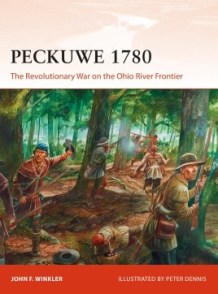
John F. Winkler, Peckuwe 1780: The Revolutionary War on the Ohio River Frontier, (Oxford: Osprey Publishing, 2018). $24.00
I once read a review comparing Osprey Publishing’s monographs on particular battles, weapons, uniforms, or campaigns to “flash cards,” which made me smile. As a kid, I somehow acquired stacks of flashcards laying out the technical specs of various military aircraft or ships and thought they were the greatest things since sliced bread. Those were the days before Amazon or Barnes & Noble, when a kid had to depend on the local library and Waldenbooks for books about history, which they didn’t have in large numbers. The Osprey monographs were a windfall of sorts when the local library started carrying them. They’re not intended for an academic audience by any stretch, but can play a useful role in interesting popular audiences in places, people, and events that might otherwise prove too obscure or too intimidating for a young or casual reader. So, when I came across John F. Winkler’s new monograph for Osprey, Peckuwe 1780, I snapped it up as much for sentimental reasons as for my interest in the American Revolution on the western frontier.
Continue reading “Book Review: Peckuwe 1780, by John F. Winkler”
 Emerging Revolutionary War Era