AfterWARd, the new exhibit at the American Revolution Museum at Yorktown. A visit with Curator Kate Gruber

IMG_20170927_153356397
The stacks of books reflect Knox’s role as a bookseller before the war.

If you have not made a trip to the new American Revolution Museum at Yorktown (the former Yorktown Victory Center) then you are missing out. Not only does the museum great exhibits on the causes of the war and the events leading up to Yorktown (with great technology), there is a changing exhibit gallery that allows for short term exhibits. The first exhibit opened in June and features the lives of four prominent Revolutionaries after the American Revolution. Continue reading “AfterWARd, the new exhibit at the American Revolution Museum at Yorktown. A visit with Curator Kate Gruber”

Three American Revolutionary War Luminaries

A few years ago I had the opportunity to visit Yorktown National Battlefield. This evening I was scrolling through my cache of American Revolution photos on an external hard drive, when I came across the picture below.

IMG_5993

A simple monument to three luminaries of the American Revolution. Three brilliant young men, one of which, John Laurens, would fall in one of the last small engagements of the war.

Could you imagine the conversation between the three that fateful October evening of 1781?

Upcoming Lectures, Talks, and/or Events

With autumn just around the corner, cooler weather on the horizon, and the holidays quickly approaching. Some stores in the local area have Halloween, Thanksgiving, and Christmas decorations all for sale currently, Emerging Revolutionary War wanted to bring your attention to a few different Revolutionary War Era happenings to mark on your calendars.  Continue reading “Upcoming Lectures, Talks, and/or Events”

Review: Dunmore’s War, The Last Conflict of America’s Colonial Era by Glenn F. Williams

ERW Book Reviews (1)
Reviewed by guest historian  Robert “Bert” Dunkerly.

Lord Dunmore’s War remains one of the murkier events of the Colonial era.  Historian Glenn F. Williams has produced a book that will set the standard for the study of this conflict.

9781594161667_p0_v2_s1200x630
Dunmore’s War, the Last Conflict of America’s Colonial Era by Glenn F. Williams

Dunmore’s War, The Last Conflict of America’s Colonial Era by Williams,  explains the complexity of the conflict and goes into detail analyzing the intertwined diplomatic and military events.  The late 1760s and early 1770s were a fascinating and complex time on the frontier.  Violence from the French and Indian War and Pontiac’s War had subsided, tribes were shifting alliances, settlers were moving into the region, and the colonies were still adjusting to the new realities following the Treaty of Paris.  The British regulations that would trigger colonial resistance were already coming, and tensions were slowly building.  Yet the issues which dominated the attention of most colonists were inter colonial rivalries, such as that between Virginia and Pennsylvania. 

Continue reading “Review: Dunmore’s War, The Last Conflict of America’s Colonial Era by Glenn F. Williams”

A Detour to Cowpens

Cowpens Cow Pasture
The sign at the first pull-off left me underwhelmed. Fortunately, my impression of the battlefield got better and better.

I know we’re getting close to the Cowpens battlefield when we pass Redcoat Drive and then Tory Trail. Unfortunately, my GPS takes us to the maintenance shed rather than the visitor center, but the park’s signage finally manages to get us where we need to go.

I know nothing about the battle of Cowpens, but my colleague Rob Orrison has strongly recommended I visit the battlefield. It involves some of the most colorful characters of the war, he tells me: Daniel Morgan and Banastre Tarleton. “The battle changed the course of the war in the Carolinas, in my humble opinion,” Rob adds.

That seems like a pretty ringing endorsement to me. My son and I, on our way back from Atlanta, decide to make the hop off I-85 for a visit. Continue reading “A Detour to Cowpens”

Inheriting the Preservation Efforts of the Past

Not long ago, I had the pleasure of accompanying our group of student interns from Richmond National Battlefield Park on a short field trip to the George Washington Birthplace National Monument (GWBNM), in Westmoreland County on Virginia’s famed Northern Neck.  First established near Pope’s Creek by John Washington, great-grandfather of our future first president, it was, as the name implies, the site of George Washington’s birth on February 22, 1732.  This much we know.

GW2
George Washington Birthplace National Monument

The grounds were designated a United States National Landmark in 1930 and deeded to the Federal government.  In honor of George Washington, the current Memorial House was constructed at the site in 1931.  Along with the house, visitors can find a colonial-style kitchen building and blacksmith’s shop.  Costumed interpreters also manage the Colonial Living Farm with barn, pastures and livestock.  The site depicts life on a middling-sized Virginia tobacco plantation during the mid-18th Century. Continue reading “Inheriting the Preservation Efforts of the Past”

The Maryland 400

On August 27, 1776, in Brooklyn, New York, a small contingent of Maryland soldiers showed the world what valor and patriotism looked like.  During one of the largest and bloodiest battles of the Revolutionary War, the actions of these brave soldiers would earn them the venerated name of the Maryland 400.

The Battle of Long Island
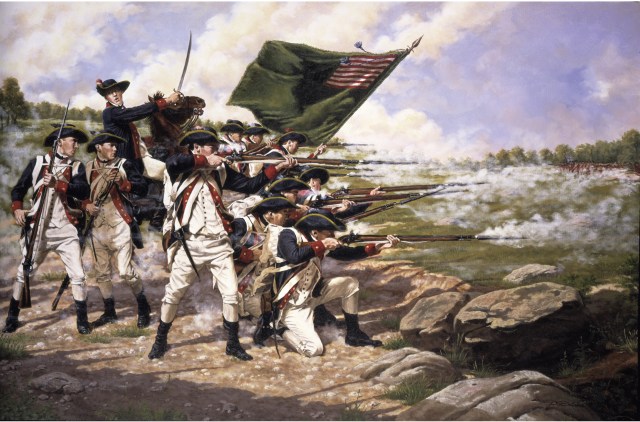
At Long Island, the 1st Delaware Regiment (pictured here) fought alongside the Marylanders on the American right flank. (Wikimedia)

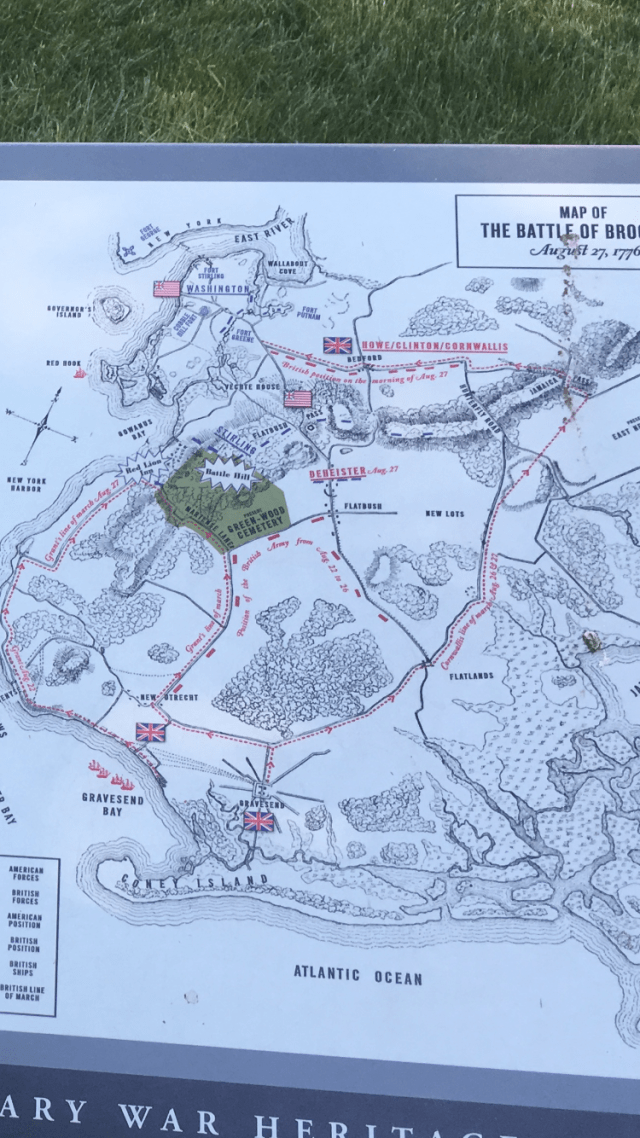
At the Battle of Long Island, the American Army was strung out in a long line across modern day Brooklyn facing south, with Washington and his headquarters located at Brooklyn Heights.  However, Washington and the Americans had failed to guard the extreme left flank of the American line.  As a result, British General William Howe divided his army in two, attacked the American main line head on to hold them in position, while British Generals Charles Cornwallis and Henry Clinton marched around the American flank and attacked from the east.

IMG_3869
Map of the Battle of Long Island. (Author’s photo)

Continue reading “The Maryland 400”

Review: The Ghost Ship of Brooklyn, An Untold Story of the American Revolution by Robert P. Watson

ERW Book Reviews (1)

Andersonville. Bataan. Auschwitz. All conjure up images of disillusion, devastation, and death.

All are infamously known as harsh prisoner-of-war camps. When those words are read, images flash through your mind and memory of hollow faces attached to gaunt bodies staring blankly in the direction of the cameraman.GhostShip_300x456

With Robert P. Watson’s new history, The Ghost Ship of Brookly, An Untold Story of the American Revolution, one can add another word to the lexicon of prison camp vernacular.

Jersey.

Or a few more words specifically, the HMS Jersey.  Continue reading “Review: The Ghost Ship of Brooklyn, An Untold Story of the American Revolution by Robert P. Watson”

“I hope my visit to Boston will do good…” Confederate Colonel John S. Mosby and American Revolution

A version of this post appeared in the Emerging Civil War blog on August 17, 2018.

396781_3669473495948_5063264_n
John S. Mosby, photographed here as a Federal civil servant

Those who know me know of my “interest” in famous Confederate partisan, John S. Mosby. Ok, some would say “love affair,” but either way, I grew up reading about Mosby and his exploits during the Civil War. It was not until later in my life that I started to read about the most interesting part of Mosby’s life—not his time in the war, but his time AFTER the war.

Mosby had a deep interest and passion in American history and you can see that on a trip that Mosby took north in April 1906 to one of the sacred sites of America’s founding: Boston, Massachusetts. In a 1906 letter to his friend Sam Chapman (a former member of Mosby’s Rangers), Mosby describes his visit and the many ironies (as a southerner) he experienced. Continue reading ““I hope my visit to Boston will do good…” Confederate Colonel John S. Mosby and American Revolution”

The Battle of Groton Heights, September 6, 1781: The Fort Griswold Massacre

Part Three
Click here for parts one and two.

With British soldiers pouring into the fort, Colonel Ledyard ordered a ceasefire, and prepared to surrender Fort Griswold to the victorious British. However, the British disregarded the ceasefire and continuing pouring fire into the American garrison, killing or wounding nearly all of the fort’s defenders. “I believe there was not less than five or six hundred men of the enemy on the parade in the fort,” claimed American soldier Rufus Avery. “They killed and wounded nearly every man in the fort as quick as they could.”

battleofgrotonheights_giclee_p3y8

Maj. Stephen Bromfield, the ranking British officer after Montgomery fell, called out, “Who commands this fort?” Ledyard stepped forward and responded, “I did, sir, but you do now.” Another American, Jonathan Rathbun, watched Bromfield run Ledyard through the heart and lungs with Ledyard’s own sword:

     “…the wretch who murdered him [Ledyard], exclaimed, as he came near, “Who
    commands this fort?” Ledyard handsomely replied, “I did, but you do now,” at the same
moment handing him his sword, which the unfeeling villain buried in his breast! Oh, the
hellish spite and madness of a man that will murder a reasonable and noble-hearted
    officer, in the act of submitting and surrendering!”

Continue reading “The Battle of Groton Heights, September 6, 1781: The Fort Griswold Massacre”