The 245th Anniversary of "Give Me Liberty or Give Me Death"

On this date, in 1775, Virginian Patrick Henry, a delegate to the Second Virginia Convention from Hanover County, Virginia sat in on the ongoing debate at St. John’s Episcopal Church in Richmond, Virginia.

Patrick Henry

The 28-year old then stood to give his defense of his proposed amendments to the petition then being debated. Below is the last few lines of his now famous statement, with the last sentence being the one most remembered;

If we were base enough to desire it, it is now too late to retire from the contest. There is no retreat but in submission and slavery! Our chains are forged! Their clanking may be heard on the plains of Boston! The war is inevitable and let it come! I repeat it, sir, let it come.

Continue reading “The 245th Anniversary of "Give Me Liberty or Give Me Death"”

The Journal of Nicholas Cresswell, Part 2

An Englishman on the Frontier

Part 1 click here.

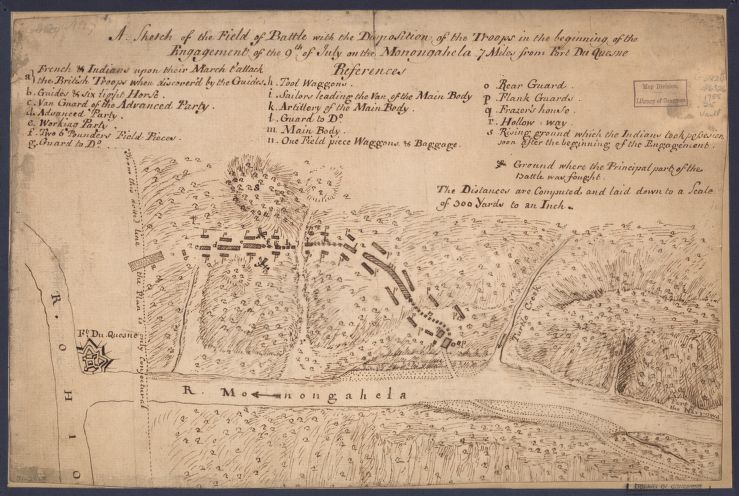
Nicholas Cresswell left Alexandria for the Illinois Country on March 16, 1775, his correspondence as yet unknown to the local Committee of Safety.  The Ohio River served as a highway to the west, so he headed for its origin at Pittsburgh.  Along the way, he stopped to visit the battlefield where French and Indian forces defeated Major General Edward Braddock in July, 1755.  Cresswell and his traveling companions found “great numbers of bones, both men and horses.  The trees are injured, I suppose by the Artillery…the greatest slaughter seems to have been made within 400 yards of the River…We could not find one whole skull, all of them broke to pieces in the upper part, some of them had holes broken in them about an inch diameter, suppose it to be done with a Pipe Tomahawk.”[i]

Monongaela Battle (Library of Congress)
Initial Dispositions of the Battle of the Monongahela.  Cresswell walked the battlefield on his way to Pittsburgh in 1775.  (Library of Congress)

Continue reading “The Journal of Nicholas Cresswell, Part 2”

The Journal of Nicholas Cresswell, Part 1


1BF5561D-F286-4DDD-BCEC-272C39979E49_1_201_a
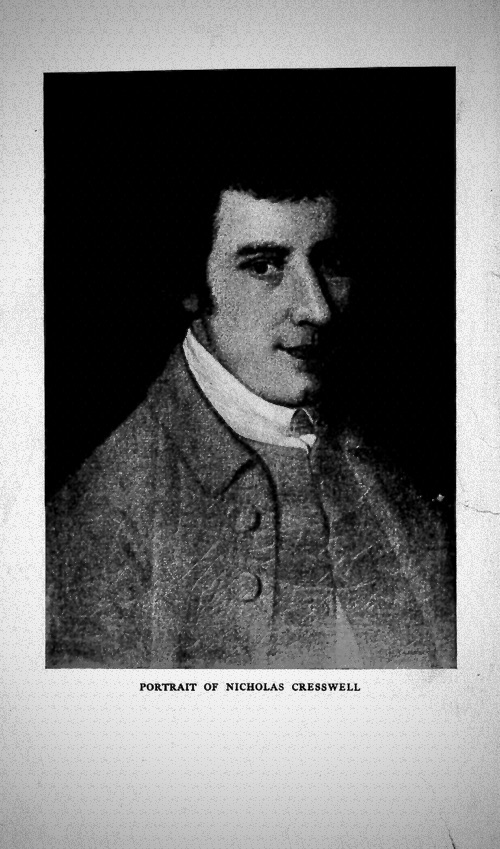
Nicholas Cresswell from the Frontispiece of his Memoir (Library of Congress)

For some Englishman, the political conflict between the United Kingdom and its American colonies was an afterthought that should not interfere with their plans to build a future based on American wealth.  Nicholas Cresswell was one such person.  He traveled to the colonies on the eve of the American Revolution and returned home in 1777, having kept an extensive diary of his travels, experiences, thoughts, and conditions in America during the war’s first years.  Along the way, he met some of the most colorful and interesting people who played prominent roles in the war: George Rogers Clark, Delaware Indian leaders White Eyes and Killbuck, Thomas Jefferson, Patrick Henry, William Howe, Robert Rogers, and Charles Lee to name a few.  Since its publication, Cresswell’s journal has become a touchstone for historians looking for insight into those people, how a loyal Englishman like Cresswell saw the world and the Americans around him interpreted events.  In particular, he recounts the feelings and treatment of loyalists trapped in America during the war.  With that in mind, reviewing Cresswell’s diary might help spread the word about a worthwhile primary resource.

Continue reading “The Journal of Nicholas Cresswell, Part 1”

Historians from the Past: Lyman Draper

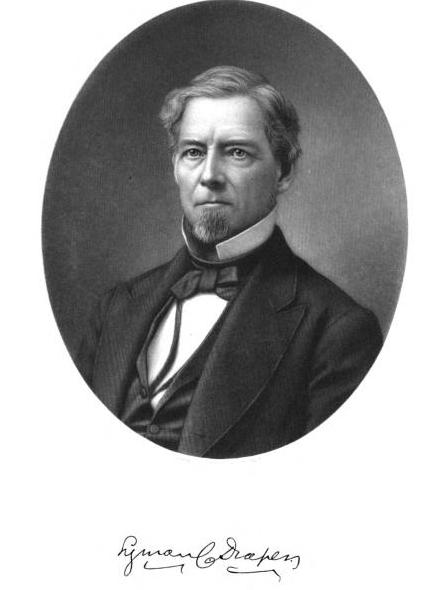
Lyman Copeland Draper (Wikimedia Commons)
Lyman Copeland Draper from the Fronts-pieceof his book, King’s Mountain and its Heroes, 1881 (Wikimedia Commons)

For the last century, everyone studying the frontier in the American Revolution has owed a debt to Lyman C. Draper.   Not many people are familiar with him, but he compiled one of the deepest and most extensive collections of original material related to the Trans-Appalachian Frontier, particularly during the American Revolution.  His hard work and extensive efforts represent a life dedicated to history that enabled his successors to continue his remarkable work .

Born in western New York in 1815, Draper’s grandfathers were both veterans of war with the British, either during the American Revolution or the War of 1812.  Given the number of veterans moving west to start farms after the war, a young and impressionable Draper heard their stories.  Draper’s family eventually settled in Lockport, NY on the Erie Canal and that is where he attended Continue reading “Historians from the Past: Lyman Draper”

Annis Boudinot Stockton, Mythmaking, and the American Revolution

Emerging Revolutionary War welcomes guest historian Blake McGready. A short bio is at the end of this post.

In December 1776, Richard Stockton of Princeton, New Jersey, a signer of the Declaration of Independence, disavowed the American Revolution and swore allegiance to King George III. After British forces imprisoned Stockton, he accepted his captor’s amnesty offer. Revolutionaries considered Stockton’s decision an act of cold betrayal and condemned his perfidy. And yet, following his death in 1781, most biographies avoided or ignored Stockton’s questionable political commitment; one tribute claimed his conviction inspired “the utmost confidence of his associates and the country at large.” Stockton owed much of this comeback to his wife, Annis Boudinot. As a prolific and published poet, she helped erase much of her husband’s political infidelity in her writings. At the time of his death she praised him in one tribute, “Can we forget how patiently he bore / The various conflicts of the trying hour / While meekness, faith, and piety refin’d.” She carefully forgot that her husband abandoned the revolutionaries during “the trying hour.”[i]

Annis Boudinot (Mrs. Richard) Stockton by James Sharples Senior, from life, 1796-1797. Courtesy, Independence National Historical Park.
Continue reading “Annis Boudinot Stockton, Mythmaking, and the American Revolution”

Thanksgiving with George Washington

St Paul's Chapel New York (Wikimedia Commons)
St. Paul’s Chapel, New York (Wikimedia Commons)

Setting aside one day to give national thanks to God for the blessings of the prior year and beseech him for future blessings had been frequently practiced in England, but it merged with several Puritan traditions in New England during the 17th century.  By the time of the American Revolution, Thanksgiving was a well-established custom.   The Second Continental Congress turned a regional tradition into a national one when offered its first Thanksgiving Proclamation on November 1, 1777, recommending that the individual states of the new United States set apart December 18th as a day of Thanksgiving and praise.  During the Revolution, Congress continued the practice, issuing its last proclamation in 1784.

Continue reading “Thanksgiving with George Washington”

The Ring Fight and the Emergence of Andrew Pickens

While the Second Continental Congress met in the early summer of 1776, colonists in the far away backcountry of South Carolina faced a threat from a perennial foe, the Cherokees. While delegates debated a declaration of independence, war parties struck settlements between the Broad and Saluda Rivers in the Ninety Six District. In response to these raids, militia Major Andrew Williamson mustered his Ninety Six regiment. Augmented by militia from the Carolinas and Virginia, he commenced a campaign against the Cherokee villages along the eastern face of the Blue Ridge.

General Andrew Pickens of South Carolina

Williamson struck at Esseneca on August 1. The colonials sustained twenty casualties but forced the warriors to abandon the village. Over the course of the next week, Williamson moved further into enemy territory. Rather than engage his force, the Cherokees retreated before the advance. Williamson burned a number of towns including Oconee, Estatoe and Toxaway.

The regiment reached Tamassee on August 12. Once again, Williamson found the village abandoned. He decided to send out scouting parties to examine the nearby hills. One of the patrols was led by a company commander from the Long Canes region of South Carolina, Captain Andrew Pickens. He took with him about sixty men. To cover more ground, Pickens divided his group and continued on with thirty five militiamen.

“Judiciously Designed and Vigorously Executed”: The March to the Dan River

Emerging Revolutionary War welcomes back guest historian Daniel T. Davis. 

Last month, I heard Emerging Revolutionary War co-founder Phill Greenwalt remark “when you think about retreats, victory is a word that doesn’t come to mind.” The period of January 18 to February 14, 1781 is the exception to the rule. During this time frame, the American army under Maj. Gen. Nathanael Greene and the British under Charles, Lord Cornwallis, marched across the backcountry of the Carolinas. Known as the “Race to the Dan”, this episode between the engagements at Cowpens and Guilford Courthouse, is a largely forgotten but consequential even in the Southern Campaign of 1781.

13615353_10154159045361343_4661891239939243645_n
The Dan River (courtesy of Rob Orrison)

Continue reading ““Judiciously Designed and Vigorously Executed”: The March to the Dan River”

August in Lexington, Massachusetts

From our friends at the Lexington Historical Society, a few events to mark on your calendar if going to be in that area of the country. Click here for more information about the events below.

On Thursday, August 8th at 7:00 p.m. at the Lexington Depot
I Am An Honest Woman: Female Revolutionary Resistance 

Most women had limited opportunities for political action during the American Revolution. While some of the lower classes could take to the streets, “genteel” women had to find more subtle ways to support the Patriot cause, while maintaining the illusion of domestic contentment. Dr. Emily Murphy, National Park Service curator and living historian, will discuss the “Daughters of Liberty” and their political accomplishments. These women were able to take an active role in the Revolution by politicizing traditional female activities, like spinning flax into linen to create homespun fabric in protest of British imports. A group of 50 protesting Bostonian men would incite a riot, but who would cross a crowd of dutiful housewives showing off their domestic skills?

Saturday, August 31, 12:00 – 4:00 p.m., across from Battle Green on Harrington Road
Lexington’s Spinning Protest

On the exact 250th anniversary of the 1769 spinning protest in Lexington, come to a reenactment of that important event! There will be spinners in period dress, interpreters sharing information about the craft of spinning, the political climate of the time and the British goods boycott that sparked the 1769 spinning bee. Plus, a preview of our 2020 Buckman Tavern exhibit on women and political protest. Free and open to the public.

George Washington’s “Favorite” Charles Lee

When you mention the name “Charles Lee” in many Revolutionary War circles, one immediately thinks of Maj. Gen. Charles Lee. Though there was another Charles Lee and it can be argued provided more contributions to the United States than the British born military general.

220px-Charleslee
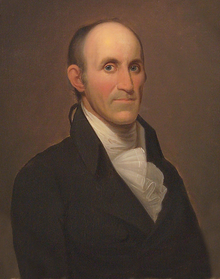
Charles Lee, Courtesy of Department of Justice

Charles Lee was born in 1758 on his father’s plantation Leesylvania in Prince William County, Virginia. The 2,000-acre farm that sat on the Potomac River and neighbored other Potomac River families such as the Fairfaxes, Washingtons and Masons. Charles’ father, Henry Lee II, a political colleague and friend of George Washington, Charles was one of eight siblings and five males that would solidify the Lee family’s role as leaders in politics and society. Continue reading “George Washington’s “Favorite” Charles Lee”