Book Review: Peckuwe 1780, by John F. Winkler

erw-book-reviews-11


9781472828859_6

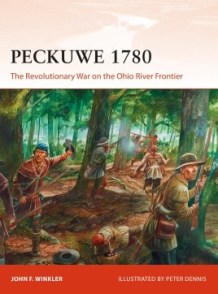
John F. Winkler, Peckuwe 1780: The Revolutionary War on the Ohio River Frontier, (Oxford: Osprey Publishing, 2018).   $24.00

I once read a review comparing Osprey Publishing’s monographs on particular battles, weapons, uniforms, or campaigns to “flash cards,” which made me smile.  As a kid, I somehow acquired stacks of flashcards laying out the technical specs of various military aircraft or ships and thought they were the greatest things since sliced bread.  Those were the days before Amazon or Barnes & Noble, when a kid had to depend on the local library and Waldenbooks for books about history, which they didn’t have in large numbers.  The Osprey monographs were a windfall of sorts when the local library started carrying them.  They’re not intended for an academic audience by any stretch, but can play a useful role in interesting popular audiences in places, people, and events that might otherwise prove too obscure or too intimidating for a young or casual reader.  So, when I came across John F. Winkler’s new monograph for Osprey, Peckuwe 1780, I snapped it up as much for sentimental reasons as for my interest in the American Revolution on the western frontier.

Continue reading “Book Review: Peckuwe 1780, by John F. Winkler”

From the Preservation Front: “Liberty Trailblazers – American Battlefield Trust”

ABTFrom our friends at American Battlefield Trust (ABT) comes the following announcement and call for assistance. 
The first line of the announcement sums up the importance of this new initiative of the American Battlefield Trust:

“They secured our liberty. It’s time for us to honor their legacy.” 

In a collaboration between the ABT, the National Park Service, and the South Carolina Battleground Trust, the joint initiative is to highlight the “tremendous significance of these places to American independence.” Their combined goal is to preserve 2,500 acres of American Revolutionary War battle lands in the Palmetto State.

As of the middle of this month, 308 acres of hallowed ground has been saved. The land protected are part of the battlefields of Camden and Eutaw Springs, which “bookend a period of incredible consequence to the American Revolution.”

This is a great start, but as that means, it is a beginning and the ABT will need all our help to make it happen. This new direction will bring preservation, education, and technology together into one investment and keep the effort going, until this land is saved for the present and future generations.

For those readers of ours that are already members, thank you. For those that are interested in learning  more, click here.

To check out the various sites and history associated with the Liberty Trail, click here.

Women’s History Month: The Story of Anna Maria Lane

Emerging Revolutionary War welcomes guest historian Paige Backus. 

image2
Aron, Paul. “Fighting as a Common Soldier”. Colonial Williamsburg: Trends and Traditions (Spring 2017). Accessed March 12, 2019. Click here for URL.

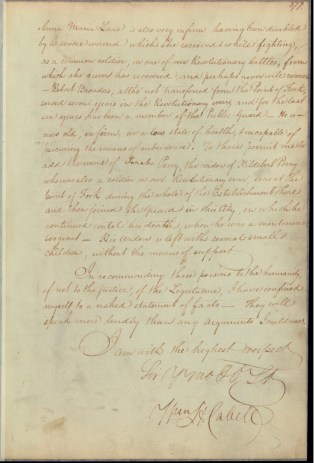
Women’s History Month is dedicated to celebrating extraordinary women and encouraging the women of today to be the same.  Throughout American history, there are multitudes of women who certainly were put into extraordinary situations and rose to the challenge to make their place in history. Throughout the American Revolution, women were generally not allowed to serve in the armies so they accompanied their husbands to war as camp followers assisting with the cooking, cleaning, nursing and other domestic tasks needed by the army. This is no small feat considering that women were exposed to the hardships and challenges of war, working without the modern technology we take for granted today, and doing it all in skirts. However, one woman named Anna Maria Lane not only followed her husband into war, but she joined him in battle becoming the only known woman in Virginia to serve as a soldier during the American Revolution. Continue reading “Women’s History Month: The Story of Anna Maria Lane”

An Irish Catholic Hero of the Revolution

One of the great unsung heroes of the American Revolution was an Irish Catholic colonel in the Continental Army who called Alexandria, Virginia home.  His name was John Fitzgerald and he would be by George Washington’s side during some of the most dramatic moments of the Revolutionary War.  Unfortunately, today in his adopted hometown, people are working to erase his gallant memory.

The_American_Soldier_-_U.S._Center_of_Military_History
George Washington conferring with an aide-de-camp. (U.S. Army Center of Military History)

In 1769 John Fitzgerald sailed from the emerald green fields of County Wicklow, Ireland to the southern British colonial town of Alexandria, Virginia.  Fitzgerald left a country that was firmly under the domination of British and Protestant rule.  Despite making up a majority of the residents of the country, Irish Catholics were treated as second class subjects in Ireland.  What Fitzgerald would find in colonial Virginia would not have been that much different as many British colonists had anti-Catholic sentiments.  Fitzgerald would find it illegal for him to openly worship in Virginia.  He would be forced to celebrate Catholic mass in his private home.

Despite the prejudices he faced, Fitzgerald became a merchant in Alexandria and would soon become good friends with the prominent local citizen, George Washington.  As tensions began to build between Great Britain and the American colonies, Fitzgerald would become an early proponent of the patriot cause.  As early as 1774, Fitzgerald had joined the local patriot militia, the Fairfax Independent Company, as an officer.

In early 1776, Fitzgerald became a captain in the 3rd Virginia Regiment of the Continental Line, and was promoted to major that fall.  In November, Fitzgerald was promoted to Lieutenant Colonel and joined Washington’s headquarters as an aide-de-camp.  Fitzgerald joined his staff at one of the darkest moments of the entire war.  Fitzgerald joined as what was left of Washington’s army was retreating across the state of New Jersey.  Washington’s army was dissolving before his very eyes. From 24,000 men that August, by December Washington only counted about 3,000 men.  In this trying time, Fitzgerald would be by Washington’s side as the revolution seemed near an end.  He would then join Washington and his men as they crossed the Delaware River on Christmas night and took part in the pivotal battles at Trenton and Princeton. (Read about these important battles in my book “Victory or Death: The Battles of Trenton and Princeton”)

Continue reading “An Irish Catholic Hero of the Revolution”

ERW Weekender: The George Washington House

IMG_1065

In September 1751, a 19-year old, tall, strapping, young Virginian accompanied an ailing older half-brother on a journey to Barbados, in the West Indies. Unbeknownst to this teenager, the journey to the Caribbean Island would be his last venture out of the colonies and/or country that inhabited the east coast of North America.

This young man’s name? George Washington.

The island he visited? Barbados.

Continue reading “ERW Weekender: The George Washington House”

First Shots

IMG_6846-min
Lexington Minuteman Statue , facing the route of the British advance (author collection)

We all have bucket list items that we want to check off in our lifetime. Some revolve around traveling, some may revolve around learning a new hobby or skill. We may have different categories of items. The last is true for me.

One of those categories was to see the first shots of the wars of the United States (okay and the French and Indian War, since that started the march toward independence, when looked at through the lens of history and distance). Continue reading “First Shots”

Women in War

As February turns to March, our friends at American Battlefield Trust (ABT), in honor of Women’s History Month, are starting a series on “Women in War.”

ABT

The objective of the initiative is to highlight the important role women have played in America’s conflicts, especially the wars that the Trust is actively trying to preserve the hallowed ground from. From the home-front to the front-lines, women were crucial to all aspects of the winning or sustaining the fight during the respective conflicts.

That got one historian at Emerging Revolutionary War thinking.

If you had to list the most influential women during the American Revolutionary War time period, who would top the list?

Feel free to comment below!

For information about the ABT’s month-long series click here.

George Rogers Clark Recaptures Fort Sackville, Part II

Vincenes (Army Center of Military History)
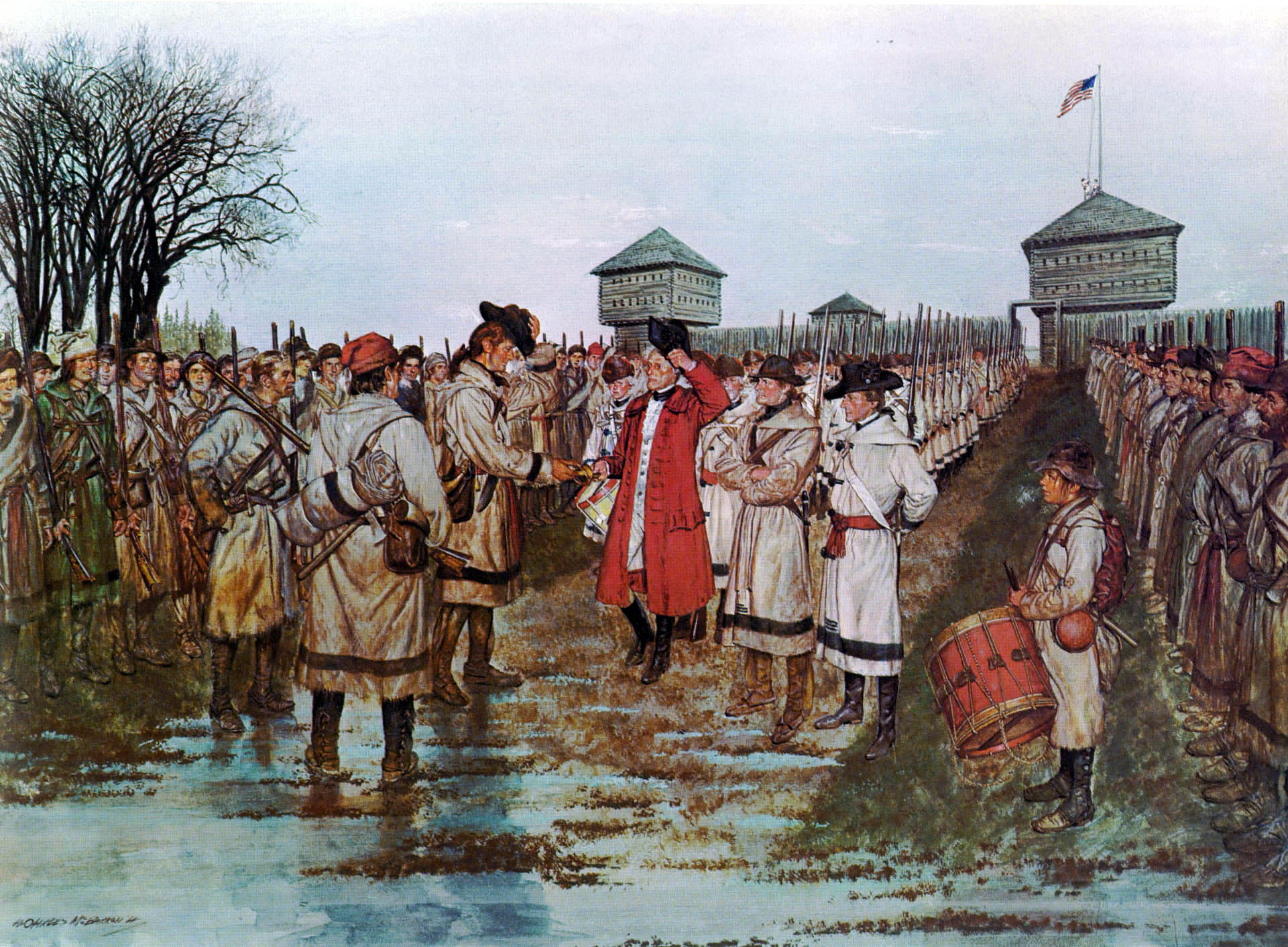
Hamilton Surrenders Fort Sackville (U.S. Army Center for Military History)

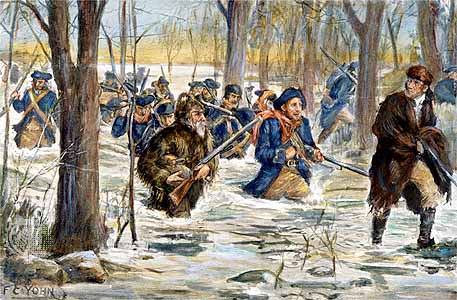
By February 23, 1779–two hundred and forty years ago—Virginia Lieutenant Colonel George Rogers Clark had marched his little army from the Mississippi across the flooded plains of what would become southern Illinois to the French town of Vincennes on the Wabash River, in modern Indiana.  His men were tired, hungry, and waterlogged, but they had made it safely across the Wabash and delivered themselves to the same shore as the town and Fort Sackville, then defended by the much-hated British Lieutenant Governor Henry Hamilton.  His river scouts had managed to find a small, dry hillock covered by a grove of trees and within sight of the town and Clark’s force, about 170 strong, lay in the grove drying their clothes by the sun, occasionally taking a wandering citizen from the town prisoner.   Clark later reported:

Continue reading “George Rogers Clark Recaptures Fort Sackville, Part II”

George Rogers Clark Recaptures Fort Sackville, Part I

March to Vincennes (Wikimedia Commons)
March to Vincennes by Frederick Coffay Yohn, 1875-1933 (Wikimedia Commons–Most of Clark’s men would not have dressed in the blue uniforms visible here, but would have dressed in fur and buckskin like the individual in the middle of the picture.)

Last fall, I posted several pieces following British Lieutenant Governor Henry Hamilton’s campaign in the Illinois territory as seen through the eyes of Captain Norman MacLeod.  MacLeod led an advance party stuck with the logistical and diplomatic mission of moving 33,000 pounds of supplies and trade goods south from Detroit in order to mobilize the local Indian tribes as British allies.  Hamilton’s campaign culminated with the successful capture of Fort Sackville (Vincennes, IN) on December 17, 1778.  Since it’s the 240th anniversary of the campaign, I thought I’d continue the series by shifting to the American perspective, particularly that of Virginia Lieutenant Colonel George Rogers Clark and one of his Captains, Joseph Bowman.  This is not a campaign history by any stretch.  It’s meant more to be considered in combination with portions of MacLeod’s diary that appeared last fall.  Taken together, they might give rise to a few different ideas about the Americans and British fighting the Revolution on the frontier.

Although he planned to recapture the entire Illinois territory, Hamilton decided to winter at Fort Sackville and resume his campaign in the spring.  He dismissed the bulk of his force, settling in at the fort with just under 100 men.  Normally, this would have been a prudent choice.  Hamilton did not expect Clark to retake the field until spring brought about the customary campaign season and dispersing his army eased the logistical burden of maintaining so many men idle in the wilderness.  Hamilton had under-estimated the meddle of his adversary.

Continue reading “George Rogers Clark Recaptures Fort Sackville, Part I”

Alexander Hamilton’s “First” Duel

glc07167engweb_
Lt. Col. Alexander Hamilton at Yorktown, VA by Alonzo Chapel

Alexander Hamilton has reappeared as a modern pop star with the wide success of the Broadway musical “Hamilton.” Due to this success, most people today know that Alexander Hamilton met his end in a duel with Aaron Burr on the banks of the Hudson River. But this was not Hamilton’s first involvement in a duel, nearly 26 years earlier Hamilton found himself embroiled in a feud with one of highest ranking Continental officers, Maj. Gen. Charles Lee.

It all started on June 28, 1778 at the Battle of Monmouth. The beginning of the battle had gone against the Americans and Lee, who was in command of the vanguard was ordering a retreat in front of the British. Washington, seeing the retreat rode ahead and encountered Lee. What was said between the men has been debated since that day, but what is not indisputable is that Lee took offense. Continue reading “Alexander Hamilton’s “First” Duel”