Phillis Wheatley: American Poet

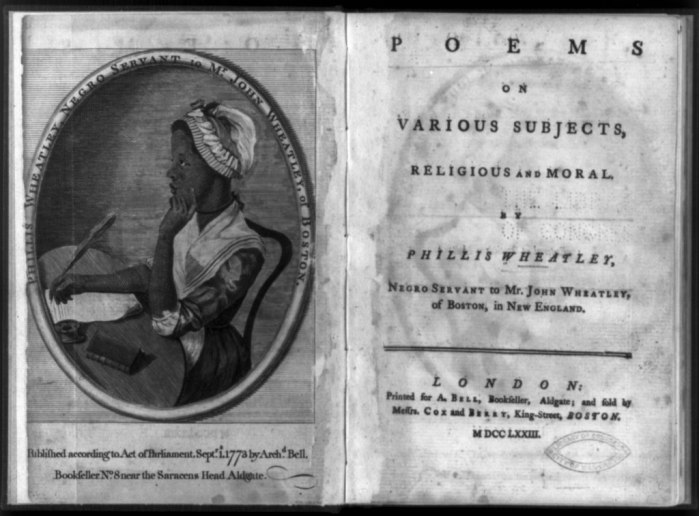
Phyllis Wheatley Book Frontspiece
Title Page from Phillis Wheatley’s Book of Poetry

The American Revolution was loaded with contradictions, perhaps none more glaring than the notion of fighting for individual liberty while slavery was so deeply embedded in the rebelling colonies.  To truly understand the American Revolution, it’s necessary to wrestle with that reality.  The stories of some individuals help shed light on the experience of enslaved Americans during the war.

Phillis Wheatley was born in West Africa, likely in 1753, and then imported into the British colonies in 1761.  John Wheatley of Boston purchased her to assist his wife Susanna and daughter Mary as a house servant.  Like many slaves, she was given the last name of her owners; her first may have come from the name of the ship that brought her across the Atlantic.  Susanna and Mary noticed something in young Phillis and taught her to read and write, introducing her to the Bible and religion.  She published her first poem in 1767 and the 1770 poem “An Elegiac Poem, on the Death of the Celebrated Divine George Whitefield,” gave her some degree of fame.

Continue reading “Phillis Wheatley: American Poet”

“You shall be carried to the gaol of Fredericktown” (Part 2)

The first post in this series looked at the various prisons established in Frederick, Maryland to hold British, German, and Loyalist prisoners. We’ll wrap this up by examining a notorious trial that took place in 1781.

Perhaps the most well-known case involving Loyalist prisoners in Frederick occurred in the summer of 1781. By this point in the war, enthusiasm for the American cause was on the wane in many communities. Conscription and heavy taxation to support the war effort were unpopular, especially as there was little battlefield success to boost morale. British forces were campaigning deep in Virginia and the Carolinas, giving hope to local Loyalists. Some Loyalists chose to declare their allegiance publicly, leading to a number of short-lived “uprisings” against American rule.[i] The Council of Maryland got wind of one such conspiracy in June, 1781, when orders were given to the lieutenants of the Frederick and Washington County militias to arrest a number of “disaffected and Dangerous Persons whose going at Large may be detrimental to the State.”[ii] Among those singled out for arrest were “Henry Newcomer and Bleachy of Washington County and Fritchy, Kelly, and Tinckles of Frederick County.” All these men had been connected to a supposed plot to raise a group of armed Loyalists in western Maryland, free the prisoners of war in Frederick, and march to support Lord Cornwallis in Virginia.

The details of the plot were uncovered by Christian Orendorff, an enterprising militia captain from the vicinity of Sharpsburg, in Washington County. His neighbor, Henry Newcomber, had confided to him one night that “we have raised a body of men for the Service of the King” to be commanded by a “Dutch Man” from Frederick named Fritchey. Orendorff feigned sympathy with Newcomber’s cause and soon met with Caspar Fritchey, who revealed more of the plot to him – including names of some of his co-conspirators. Captain Orendorff sent word to the authorities, who acted quickly to break up the insurrection and round up the ringleaders. Although Orendorff claimed that the Loyalists had recruited 6,000 men, only seven were brought to trial.
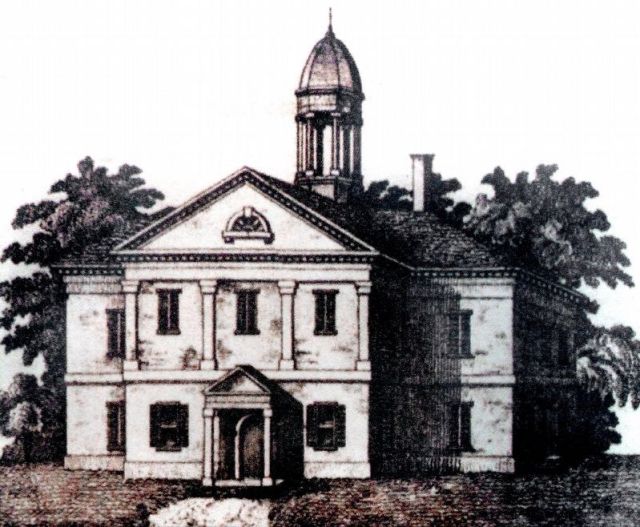
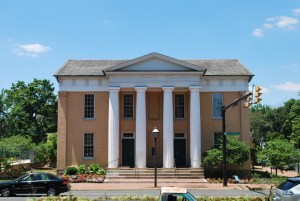
Photo431930.jpgFrederick’s 1752 Courthouse as depicted on the 1858 Isaac Bond Map. The Courthouse burned in 1861 and was replaced the following year. The former courthouse now serves as city hall. (Library of Congress)

The seven men condemned to stand trial – Peter Sueman, Nicholas Andrews, John Graves, Yost Plecker, Adam Graves, Henry Shell, and Caspar Fritchie[iii] – were singled out as the leaders of the plot. All were brought to Frederick under a heavy guard while a special court convened. Thomas Sprigg, serving as Lieutenant of Washington County, wrote to the Council that “[they Acknowledge themselves to be Captains that they have Misted and Admin’d the Oath of Allegeance to many persons, one of them to the Amot of 42 they Confess very freely they say they expect and deserve to be hang’d, and I pray God they may not be disappoint’d…”[iv]

On June 17th, 1781 a special court of oyer and terminer was called. Derived from old English law, these special courts were overseen by a panel of commissioners, and typically presided over serious crimes like treason. Among the judges were the local militia commander Col. James Johnson, Alexander Hanson (son of President of the Continental Congress, John Hanson), and Upton Sheredine. All were men with staunch patriot sympathies. It wasn’t a surprise, then, that the trial was a short one. Relying primarily on Orendorff’s testimony, the court found all seven men guilty of treason against the state of Maryland. For the crime of enlisting men for the service of the King, Judge Hanson handed down a grisly punishment:

“You, Peter Sueman, Nicholas Andrews, Yost Plecker, Adam

Graves, Henry Shell, John George Graves, and Casper Fritchie,

and each of you, attend to your sentence. You shall be carried

to the gaol of Fredericktown, and be hanged therein; you shall

be cut down to the earth alive, and your entrails shall be taken

out and burnt while you are yet alive, your heads shall be cut off,

your body shall be divided into four parts, and your heads and

quarters shall be placed where his excellency the Governor

shall appoint. So Lord have mercy upon your poor souls.”[v]

Four of the accused – Andrews, Shell, and the Graves brothers – were subsequently pardoned due to their “want of education and experience.” It appears that the court saw them as young men duped by the real leaders of the plot. The other three men were not so lucky.
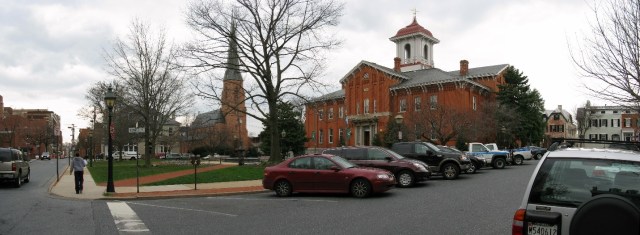
new courthouse.jpgThe former courthouse square in Frederick, near where the county jail once stood. It’s likely that the executions took place very near this location in August 1781. The large brick structure is the 1862 courthouse (now Frederick’s City Hall).

While the plot and trial are well documented, the aftermath is not. Later historians cannot agree on whether the entire sentence of hanging, drawing, and quartering was ever carried out, or if the three men were simply hung. On August 28, 1781 the Baltimore Advertiser simply reported that “On Friday the 17th instant, Caspar Fritichie, Peter Sueman, and Yost Plecker, suffered Death in Frederick Town for High Treason.” Many family stories that have been passed down in the area, however, firmly state that the full punishment was meted out on the unlucky Loyalists. Today the only physical reminder of this “First American Civil War” in Frederick is a simple bronze plaque and a small sign near the courthouse where the executions likely took place. The episode, however, still sheds light on the darker side of Maryland’s Revolutionary story.

[i] A perfect example was “Claypool’s Rebellion” on the Virginia frontier. In June 1781 John Claypool of Hampshire County, Virginia led a large body of men in resisting efforts to tax or raise troops for the State of Virginia. After dozens of men took up arms alongside Claypool a body of militia was sent to put down the “rebellion.” For more information visit https://secondvirginia.wordpress.com/2015/06/17/claypools-rebellion/

[ii] Journal and Correspondence of the Council of Maryland, 1780-1781. p 467

[iii] John Caspar Fritchie was the father-in-law of legendary Civil War heroine Barbara Fritchie

[iv] Journal and Correspondence of the Council of Maryland, 1781. p 298

[v] Scharf. P 143

Disaster on the Eastern Frontier

Part Two
For Part One, click here.

The British and loyalists would not have to wait long. Word of the landing reached the Massachusetts government within a matter of days, and preparations for a counterattack began almost immediately. There was such a hurry to respond that the General Assembly voted to carry out the operation with state forces rather than wait for Continental assistance.[1] Despite the initial rush it still took a month to assemble a force of over 1,000 militiamen, as well as the food, arms, and other supplies to sustain them. All of these troops and their supplies would be transported by a fleet of 21 transports, accompanied by nearly twenty state and Continental navy vessels and privateers. Among the warships the largest was the Frigate Warren of 32 guns which served as the flagship of Commodore Dudley Saltonstall. The Connecticut born officer was given overall command of the naval forces – no small task given the lack of experience with large scale fleet actions among his subordinates. Command of the land forces was given to Massachusetts Brigadier Solomon Lovell. Lovell has seen experience early in the war outside of Boston, but was also relatively untested in battle. The inexperience and poor communication between Saltonstall and Lovell was to have a decisive impact on the coming expedition. Notable among the other officers in the expedition was Paul Revere, who commanded the Massachusetts artillery. The expedition was also joined by a band of the local Penobscot Indians allied to the Continental Congress.

The New England fleet entered the Penobscot Bay on July 25th and immediately attempted a landing. Clearly outnumbered and with their works incomplete, General McLean and his men were determined to resist the Americans, but expected the worst. Saltonstall’s fleet sailed in close to the shore and exchanged cannon fire with both the British defences and the three remaining Royal warships, now under the command of Captain Henry Mowatt. In the confusion and smoke the Americans lowered seven launches full of marines and militiamen, but as they neared the shore they were met by a hail of musket fire[2]. At least one of the attackers – a Native American – was killed and the boats returned to the safety of the fleet. It was an inauspicious start to the battle for the New Englanders and already the relationship between the two commanding officers was becoming strained. General Lovell knew little about sailing or naval operations. He questioned the Commodore as to why he couldn’t just sail his fleet into the harbor and blast the British to pieces while his troops landed under their covering fire. The Connecticut seaman replied curtly, exclaiming “You seem to be damn knowing about the whole matter! I am not going to risk my shipping in that damned hole!”[3]

On the 26th a second militia landing on the peninsula was repulsed after the lead boat carrying militia Major Daniel Littlefield was swamped by British chain shot, drowning the Major and two privates.That same day, however, the Americans scored a small victory when a force of 200 Continental marines and artillerymen landed on Nautilus Island and captured the small British battery there[4]. More artillerymen were landed and soon the Americans had a battery from which they could harass the British shipping. With the Americans making some headway Captain Mowatt withdrew the remaining British ships deeper into the harbor, creating a defensive line across the Bagaduce River.

Castine harbor, looking out roughly where Captain Mowatt anchored the British transports and warships (Author_s photo)
Castine Harbor, looking out roughly where Captain Mowatt anchored the British transports and warships (Author’s photo)

Continue reading “Disaster on the Eastern Frontier”

Disaster on the Eastern Frontier

Emerging Revolutionary War welcomes back guest historian Travis Shaw.

Part One

I’d be willing to bet that Maine isn’t the first place to come to mind when you hear the word “frontier”. For many Americans I imagine they immediately think of the wild west. Wagon trains of pioneers crossing the prairies, and Native nations like the Sioux and Apache ranging the plains on horseback. A century before the age of Manifest Destiny, however, the region that is now the state of Maine marked the eastern frontier of the English colonies. It was a wild and sparsely settled place, caught between New England and the French colonies to the north. The few European settlers eked out a living from the thin, rocky soil or turned to lumbering and to the sea. They lived alongside and often fought against the region’s original inhabitants – the Wabanaki or “People of the Dawn.” For two centuries the Eastern Frontier was torn apart by war between various European powers and their respective Native allies. Nowhere is this more clearly evident today than in the small coastal town of Castine, Maine.

Castine is located near the mouth of the Penobscot River, more or less in the middle of the Maine coast (Google Maps)

Continue reading “Disaster on the Eastern Frontier”

Missionary Extraordinaire: David Zeisberger

Over the summer, I took a family excursion to several Revolutionary War sites in Ohio, some of which I recently wrote about.  In particular, I wanted to trace the experience of several Moravian missionaries and their congregations in the no-man’s land of the frontier.  Traveling a back road along the Tuscarawas River between the villages of Gnadenhutten and New Schoenbrunn, we stumbled across the graves of David Zeisberger (1721-1808) and several notable missionaries at the crossroads of Goshen.

IMG_2559
Moravian Cemetery at Goshen, Ohio.  (Author Photo)

Continue reading “Missionary Extraordinaire: David Zeisberger”

Visiting a Tragedy: Gnadenhutten, OH

Few places in the American Revolution evoke sorrow like Gnadenhutten, Ohio.  There, in March 1782, militia from Western Pennsylvania bludgeoned, scalped, and burned to death some ninety-six bound Indians who had adopted the Christian faith preached by missionaries from the church of the United Brethren.  Thirty-four of the victims were children.  Benjamin Franklin called the killings “abominable murders.”[1]

IMG_2540
The Chapel at Gnadenhutten with the 1872 memorial.  The Cooper’s Hut is to the right.  (ES Photo)

Continue reading “Visiting a Tragedy: Gnadenhutten, OH”

Visiting Carlyle House

IMG_2250
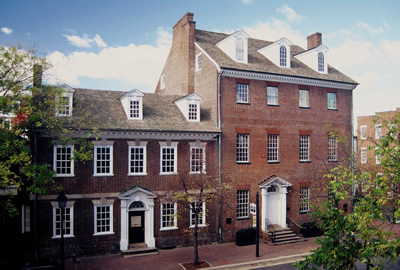
Carlyle House from the Front (Author Photo)

William Griffith’s examination of the Carlyle House Congress last month (The Carlyle House Congress and Britain’s Military Objectives for 1755) reminded me that I had been remiss in not visiting the site.   So, the family and I set off for Alexandria, VA and a visit to John Carlyle’s home.

Continue reading “Visiting Carlyle House”

THE AUTHORS AND THE AMERICAN REVOLUTION IN CONCORD

In honor of April being National Poetry Month, we share the connection of the literary icons of Concord (MA) and its American Revolution heritage. Concord historian Jayne Gordon wrote about these connections in an appendix in our recent release “A Single Blow.” Below is part of that text.

None of the eighteenth-century Concord authors lived through the American Revolution, yet reminders of that eighteenth-century war abounded in Concord in their lifetimes. Their neighbors were the grandchildren of the minutemen; veterans of the war were still among the townsfolk. Buildings, gravestones, old roads, and other landmarks evoked that part of the past, and they were surrounded by the stories of the fateful day of April 19, 1775. They each drew on their interpretations of the Revolution’s symbolic meaning, and incorporated those ideas into both their private and public writings.

J721_OldManseConcordMA
The “Old Manse” next to the North Bridge in Concord

In the case of RALPH WALDO EMERSON (1803-1882), there was a direct historical link to a grandfather who had played a significant role in the beginnings of the Revolution. Sixty years after colonial militiamen confronted the British troops at the North Bridge within sight of the Old Manse, the grandson of patriot minister Reverend William Emerson would come to his ancestral home to stay, writing in his journal, “Hail to the quiet fields of my fathers! . . . Henceforth I design not to utter any speech, poem, or book that is not entirely & peculiarly my work.” Continue reading “THE AUTHORS AND THE AMERICAN REVOLUTION IN CONCORD”

Dr. Prescott, Love & War

Love brought Dr. Samuel Prescott, a practicing physician, to the town of Lexington on the night of April 18, 1775. The young doctor was courting Ms. Lydia Mulliken, when the alarm of the British soldiers marching from Boston went out to the local militia. Lydia’s brother was one of those called to gather.

Love. That emotion also drew Dr. Prescott back toward his hometown of Concord—this time to alert friends, neighbors, and family members of the urgent news of the evening. En route, Dr. Prescott along with Paul Revere and William Dawes, alerted the countryside of the moving British troops. After being vetted and vouchsafed as a true friend of liberty, Dr. Prescott rode posthaste to his hometown, where his word carried greater weight.

paul_revere
A artist’s interpretation of Paul Revere’s (or maybe William Dawes or Dr. Samuel Prescott)’s ride to warn the Massachusetts countryside. (courtesy of VFW)

Continue reading “Dr. Prescott, Love & War”

Two Riders….Gage Gathers Information

As British General Thomas Gage and his American Whig (or Patriot) antagonists squared off in Boston and the surrounding towns, information gathering became the key to success. Both sides had created networks of spies, but the advantage was clearly in favor of the Whigs. During the winter 1774-1775, groups such as the Sons of Liberty had established a complex spy network within Boston comprised of a system of riders that spread information and “alarms’ quickly. The Committee of Safety and the Massachusetts Provincial Congress relied on this network to stay informed of what was going on in Boston and the British intentions. Continue reading “Two Riders….Gage Gathers Information”